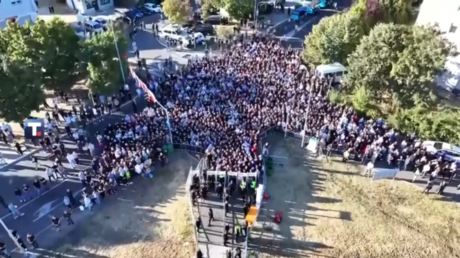
Western foreign policy pundits are currently losing their collective minds over Belgrade. Thousands gathering, state-backed logistics, military honors, and EU commissioners canceling flights in diplomatic fury. The lazy consensus in every major newsroom treats this as a sudden regression, a shocking nationalist relapse by a society that simply forgot its history.
They are getting it entirely backwards.
This is not a sudden ideological slip. It is the predictable, mathematical output of a transactional political market that has spent decades refusing to resolve its own foundational trauma. To understand why Ratko Mladić's death and subsequent send-off triggered this theater, you have to stop looking at it through the moral lens of Brussels and start looking at it through the cold calculus of domestic survival.
Look at the mechanics. President Aleksandar Vučić is staring down high-stakes snap parliamentary elections. His regime has weathered years of intense domestic pressure and urban civil unrest. In a polarized environment where hardline nationalists make up a core, immovable voting bloc, abandoning a military figure revered by that demographic is political suicide. Vučić didn't orchestrate this spectacle out of raw ideological zealotry alone; he did it because the alternative was conceding his right flank to forces far more radical than himself.
The Western playbook for handling this has been broken since the nineties. Brussels issues stern rebukes, cancels accession commissioner visits, and talks abstractly about European values. Belgrade's leadership absorbs the diplomatic slap on the wrist, pockets the domestic political capital, and doubles down on anti-Western rhetoric. It is a perpetual motion machine of performative grievance. The EU acts shocked that a population fed on state-aligned media for decades views a convicted war criminal through the distorted prism of a defender rather than an aggressor.
Stop treating historical revisionism as an education problem that can be fixed with another EU progress report. It is a structural utility. For political elites across the Western Balkans, unresolved ethnic animosities are the ultimate insurance policy. Whenever economic reforms stall or public anger over domestic governance peaks, you pull the lever marked identity politics.
The real story isn't that a fraction of the population turned out to honor a ruthless commander. The real story is that thirty years after the breakup of Yugoslavia, the international community still has zero leverage over countries whose leaders profit directly from keeping the ghost of the nineties alive. Until the West realizes that sternly worded statements are treated in Belgrade as campaign advertisements, the theater will continue.