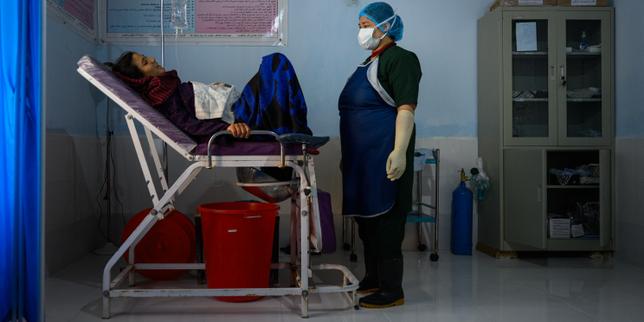
The standard media narrative about Afghanistan's healthcare system is built on a comfortable Western delusion. Mainstream reports love to paint a simple, cinematic picture of mustache-twirling ideologues actively banning medicine while helpless mothers suffer in the dark. It makes for great television and easy moral outrage. It also completely misunderstands how power, aid, and survival actually function on the ground.
When foreign journalists point and shriek at the Taliban for restricting medical access, they miss the structural reality of what happens when you cut off the oxygen to a system that was already built on quicksand.
Let us be brutally honest about the lazy consensus. The accepted wisdom says that if we just shame the regime enough, or pump enough NGO cash through bureaucratic middlemen, maternal mortality rates will magically drop back to their pre-2021 baselines. Anyone who has spent a week tracking foreign aid flows in Kabul knows this is a fairy tale. The crisis in Afghan healthcare is not merely a product of ideological malice. It is the predictable outcome of an aid-dependent economy collapsing overnight, compounded by a donor class that refuses to separate humanitarian reality from political punishment.
The Myth of the Functional Baseline
For twenty years, international donors treated Afghan public health like an infinite-budget science experiment. Billions poured in. Clinics popped up on paper. On Excel spreadsheets distributed in Geneva and Washington, metrics looked respectable.
I have watched foreign project managers sign off on inflated headcounts for rural clinics that existed only as ghosts in quarterly reports. The system was hollowed out long before the regime change. It was built on unsustainable international salaries, foreign logistics chains, and an assumption that Western military protection would fund local infrastructure forever.
When the foreign footprint vanished, the structural rot stood exposed. Blaming the current administration for a crumbling hospital roof is emotionally satisfying, but it ignores the architects who built the roof out of papier-mâché in the first place.
Where the Conventional Analysis Fails
People ask how maternal health can survive when female medical workers face severe workplace restrictions. It is a valid question, but it is framed incorrectly. The question assumes that the primary bottleneck is ideological prohibition rather than liquidity, supply chains, and basic operational survival.
In many provinces, local pragmatism routinely overrides central edicts out of sheer necessity. Provincial health directors, even hardliners, know that a dead population generates no revenue, no stability, and no administrative control. Where female practitioners are permitted to work in obstetrics and gynecology, they do so because the local elders made a deal with the district authorities.
The real threat to these clinics is not an ideological decree from a capital ministry. It is the banking blockade. It is the freezing of central reserves. It is the sudden evaporation of international salaries that kept doctors and midwives showing up to shifts when their families were starving.
+-----------------------------------+-----------------------------------------+
| The Media Narrative               | The Structural Reality                  |
+-----------------------------------+-----------------------------------------+
| Ideology is the sole barrier      | Liquidity and supply chains are broken  |
| Clinics are uniformly shuttered   | Local pragmatism varies by province     |
| Foreign aid solved maternal death | Aid created a fragile, fake baseline    |
+-----------------------------------+-----------------------------------------+
The Unspoken Cost of Sanctions
Let us talk about the uncomfortable downside of my own argument. If we lift financial restrictions and channel funds directly through functional state mechanisms to pay healthcare workers, we de facto stabilize an authoritarian regime. We grant them breathing room.
That is the trade-off. There is no clean, moral high ground here.
Western policymakers want to punish the government without hurting the population, which is the geopolitical equivalent of trying to starve a host without harming the parasite. It does not work. Comprehensive economic isolation guarantees that pregnant women die in rural outposts not because doctors refuse to treat them, but because the clinic cannot afford kerosene for the generator, fuel for the ambulance, or basic surgical gloves.
Every time a donor freezes a health fund to make a political statement in New York or Brussels, a midwife in Badakhshan goes unpaid.
Unconventional Realities on the Ground
If you want to fix healthcare delivery in Afghanistan, stop treating the country like a charity case for your political conscience and start treating it as a logistics problem.
- Bypassing the Capital: Effective aid must go straight to district-level health committees, bypassing corrupt ministry layers in Kabul entirely, while coordinating discreetly with local power brokers who actually control road access.
- Cash for Work, Not Ideology: Stop funding abstract training seminars designed by foreign consultants who have never left Wazir Akbar Khan. Pay the frontline staff in hard currency directly to their hands.
- Accepting Compromise: Realize that female mobility looks different in Kandahar than it does in Herat. Forcing a uniform Western model onto decentralized tribal structures guarantees total failure.
The maternal mortality crisis in Afghanistan is real, bloody, and entirely urgent. But treating it as a simple morality play allows foreign politicians to wash their hands of a catastrophe they helped engineer through reckless abandonment and punitive economics.
Until the international community drops its savior complex and looks at the cold mechanics of supply chains and cash flow, the rhetoric will keep flowing, and the mothers will keep dying.