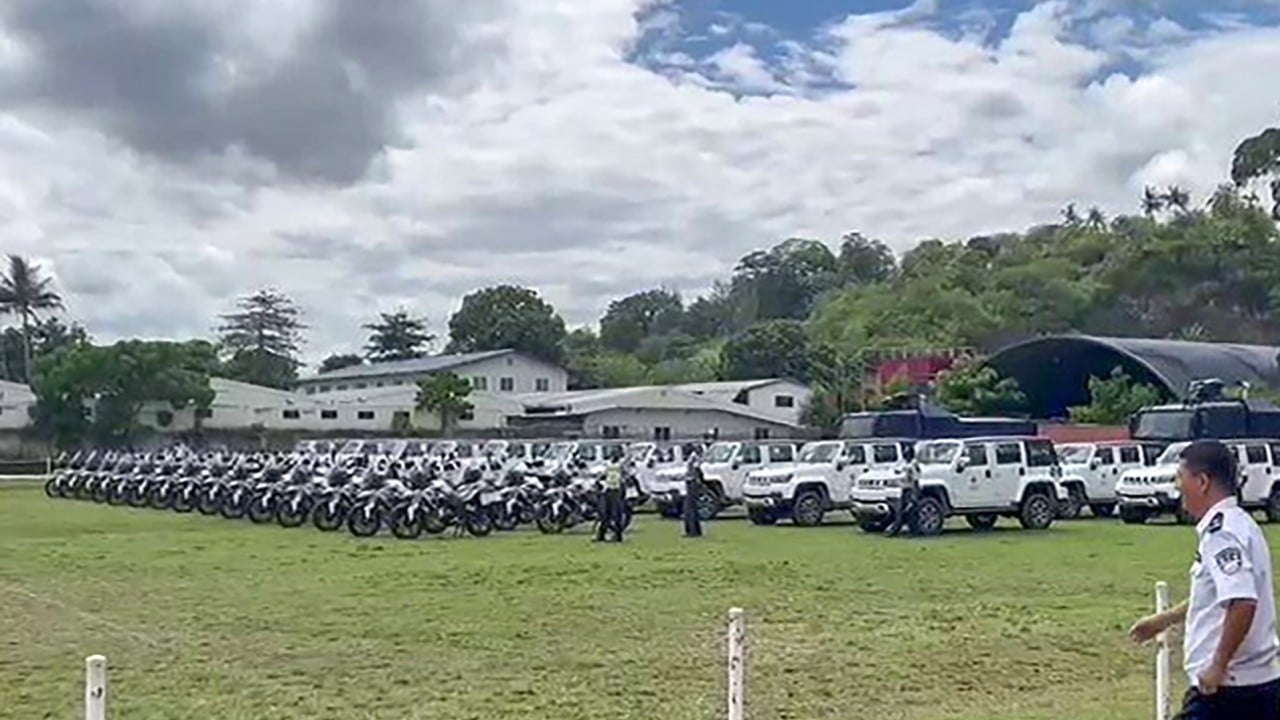
Every time a shipping container of riot gear leaves a Chinese port bound for Honiara, foreign policy pundits in Canberra and Washington hyperventilate. They see a water cannon and immediately hallucinate a People’s Liberation Army naval base.
That reflex is lazy. Worse, it is strategically blinding.
The mainstream narrative surrounding Beijing’s security pact with the Solomon Islands—specifically the training of the Royal Solomon Islands Police Force (RSIPF) in crowd control and non-lethal suppression—rests on a comfortable Western delusion. The consensus claims China is exporting authoritarianism to turn a fragile Pacific democracy into a forward operating base. It frames Prime Minister Manasseh Sogavare and his successors as passive pawns manipulated by debt-trap diplomacy and shiny riot trucks.
This reading ignores the actual history of Honiara, the mechanics of Pacific policing, and the glaring failures of traditional Western security assistance. If you want to understand why Chinese instructors are teaching Solomon Islands officers how to aim high-pressure hoses, stop looking at the South China Sea and start looking at the burned-out rubble of Honiara’s Chinatown.
The Myth of the Passive Pacific Pawn
Western commentary treats the 2022 China-Solomon Islands security agreement as an unprovoked geopolitical ambush. It was nothing of the sort. It was a predictable market correction in security provision.
For nearly two decades, security in the Solomon Islands was underwritten by the Regional Assistance Mission to Solomon Islands (RAMSI), led by Australia. RAMSI spent billions of dollars and successfully ended the ethnic tensions of the late 1990s and early 2000s. It disarmed militias and rebuilt state institutions. Yet, when RAMSI departed in 2017, it left behind a police force optimized for community policing and routine law enforcement, not high-intensity urban civil unrest.
When riots erupted in Honiara in November 2021, the system broke. Over three days, mobs burned down commercial districts, targeted Chinese-owned businesses, and attempted to storm parliament. The RSIPF ran out of tear gas. They lacked the numbers, the protective gear, and the crowd-dispersal doctrine to hold the line. Australian Federal Police (AFP) had to be flown in under a bilateral security treaty to restore order, arriving only after millions of dollars in infrastructure had been reduced to ash.
From the perspective of the Honiara political establishment, relying entirely on Canberra proved to have a fatal flaw. Australian intervention is reactive, politically conditional, and bound by domestic Australian scrutiny over use-of-force protocols.
Beijing offered a starkly different value proposition. China did not lecture Honiara on governance reforms or human rights benchmarks. It shipped anti-riot vehicles, replica firearms for training, shields, and water cannons. It sent Ministry of Public Security (MPS) officers to train local police in rapid, decisive crowd suppression.
Sogavare did not get tricked into signing a security pact. He shopped around for a security guarantor willing to protect his government from domestic insurrection without lecturing him, and Beijing closed the deal.
Water Cannons Are Domestic Insurance, Not Power Projection
Let us be brutally clear about what a water cannon actually does. It is an instrument of domestic regime survival, not external military power projection.
A truck mounted with a high-pressure water turret cannot sink an Australian destroyer. It cannot interdict shipping lanes between Guam and Sydney. It cannot track submarines. Treating Chinese riot-control training as the vanguard of a military invasion confuses public order policing with expeditionary warfare.
In security studies, this distinction is elementary.
- Expeditionary Warfare: Requires deep-water logistics, air defense networks, fuel depots, repair facilities, and sustained supply chains across thousands of miles of open ocean.
- Public Order Policing: Requires non-lethal crowd dispersal tools, clear perimeter defense, and rapid response units to prevent localized riots from toppling an incumbent administration.
Beijing’s primary objective in the Solomon Islands is not to launch an invasion of northern Australia. Its immediate, tangible goal is protecting Chinese nationals, Chinese state-owned enterprise infrastructure, and a compliant host government from recurring domestic volatility.
During the 2006 riots and the 2021 unrest, ethnic Chinese merchants and Beijing-backed projects were the primary targets of public anger—fueled largely by internal provincial rivalries between Malaita and Guadalcanal, high youth unemployment, and systemic corruption. Beijing watched its citizens get burned out of their livelihoods twice in fifteen years while waiting for Australian peacekeepers to land.
Training the RSIPF to use water cannons is Beijing’s insurance policy. If another riot breaks out in Honiara, China wants local police capable of crushing it before the mobs reach Chinese-built stadiums, telecommunications towers, or commercial districts. It is a localized, defensive posture designed to safeguard investments and keep a friendly government in power.
The Western Blind Spot in Security Assistance
I have watched Western defense and foreign aid bureaucracies burn hundreds of millions of dollars across developing states on "capacity building" that completely misses what local leaders actually need to stay alive.
When Washington or Canberra designs a police training program in the Pacific, the curriculum is heavy on human rights compliance, gender mainstreaming, community engagement, and administrative oversight. Those are admirable goals in stable, high-trust societies with robust tax bases. They are useless when three thousand angry protesters with machetes and petrol bombs are marching on the prime minister's residence.
Western security partners often treat public order suppression as a dirty word. Because democratic governments face intense domestic backlash if their aid is linked to police brutality, they restrict the transfer of crowd-control hardware and emphasize de-escalation tactics.
The result is a massive capability gap. Local governments in fragile states face existential threats from street-level instability, yet their traditional Western partners refuse to equip them for
Stop Panicking Over Chinese Water Cannons in the Solomon Islands
news
Every Western foreign policy desk just hit the panic button over a few high-pressure hoses in Honiara.
Mainstream headlines are screaming that Beijing is turning the Royal Solomon Islands Police Force (RSIPF) into an authoritarian strike force under their 2022 security pact. The lazy consensus goes like this: China hands over riot gear, teaches local cops how to blast protesters with water cannons, and suddenly the South Pacific has a brand-new Beijing-controlled military base sitting right on Australia’s doorstep.
It makes for terrifying clickbait. It also completely misses what is actually happening on the ground.
If you spend any time analyzing Indo-Pacific security architectures, you quickly realize that obsessing over tactical crowd-control gear is like worrying about a new coat of paint while someone is quietly rewiring the entire electrical grid. Water cannons are not a precursor to a People's Liberation Army naval blockade. They are a cheap, visible diplomatic receipt—and a massive strategic distraction that Western analysts are falling for hook, line, and sinker.
The Riot Gear Fallacy
Let’s look at the mechanics of public order policing in Melanesia.
In November 2021, Honiara burned. Riots tore through the capital, reducing Chinatown to ash, causing over $60 million in damages, and nearly toppling Prime Minister Manasseh Sogavare’s government. At the time, the RSIPF was critically under-equipped. When crowds surged, local officers had virtually no non-lethal buffer between verbal warnings and lethal force. Australia had to scramble troops and federal police under the 2017 Bilateral Security Treaty just to keep the city from collapsing entirely.
When a sovereign government watches its capital burn, its number one priority becomes regime survival and basic urban containment. Enter Beijing.
Following the 2021 riots, China’s Ministry of Public Security deployed the China Police Liaison Team (CPLT) to Honiara. They brought riot shields, batons, non-lethal munitions, martial arts instructors, and eventually, water cannon trucks and specialized training.
Western commentators instantly framed this as the export of Chinese domestic authoritarianism. That framing relies on total historical amnesia.
Water cannons are standard-issue riot control equipment across almost every Western democracy. Police in Germany, France, the United Kingdom, and Australia routinely maintain and deploy high-pressure water vehicles for civil disturbances. Even the Australian Federal Police (AFP)—the very force that has spent two decades training the RSIPF through the Regional Assistance Mission to Solomon Islands (RAMSI)—trains partner forces in public order management, crowd dispersal, and non-lethal containment.
The hardware itself is mundane. High-pressure water dispersal systems (typically mounted on heavy commercial chassis capable of delivering 10 to 15 bars of pressure at distances up to 60 meters) are designed to break up dense crowds without causing permanent kinetic trauma. Teaching a police force that previously lacked basic crowd-control infrastructure how to operate a water cannon does not magically transform Honiara into Tiananmen Square.
If you ask whether China is militarizing the Pacific through water cannons, you are asking the wrong question entirely. A water cannon has zero military utility. It cannot sink a frigate, track a submarine, or project power across an Exclusive Economic Zone.
What Beijing Is Actually Buying
I have watched defense attachés and regional analysts burn millions of dollars in consulting fees chasing tactical ghosts in the Pacific while missing the structural takeover happening right in front of them.
Beijing does not care about how the RSIPF manages a street protest in Honiara. Beijing cares about doctrinal alignment, institutional dependency, and intelligence access.
When the China Police Liaison Team trains Solomon Islands officers on Chinese-made riot vehicles, three things happen that have nothing to do with water pressure:
- Supply Chain Lock-In: Complex hydraulic vehicles require proprietary parts, maintenance schedules, and technical oversight. By donating the hardware and running the training, Beijing guarantees that Chinese technicians remain embedded inside RSIPF logistics hubs for years.
- Command-Level Influence: You do not just train the guy holding the joystick; you train the precinct commanders, the logistics officers, and the Ministry of Police bureaucrats. You invite them to Fujian Police College for all-expenses-paid "capacity building" seminars. You build personal patronage networks inside the exact ministry that controls internal security, VIP protection, and border enforcement.
- Legal and Operational Cover: Under the 2022 China-Solomon Islands Security Cooperation Framework, Beijing can deploy armed police and military personnel to protect Chinese citizens and major infrastructure projects upon request. Having an embedded police liaison team already operating inside Honiara’s command structure removes all friction if Beijing ever decides to scale up its footprint during a future crisis.
Western media obsesses over the visual optics of a water cannon spraying a street because it looks dramatic on television. Meanwhile, the real geopolitical shift happens in quiet conference rooms where standard operating procedures, communications protocols, and procurement contracts are rewritten in Mandarin.
The Western Aid Blind Spot
Why did Honiara take Beijing’s water cannons in the first place? Because Canberra and Washington spent twenty years giving the Solomon Islands what they thought it needed, rather than what local politicians actually wanted.
During the RAMSI era (2003–2017) and its successor programs, Australia poured billions of dollars into the Solomon Islands. Western donors focused heavily on institutional governance, judicial reform, gender mainstreaming, community policing, and long-term bureaucratic accountability. Those are noble goals. They are also slow, intangible, and deeply frustrating to local leaders facing immediate street-level instability.
When a prime minister in Honiara asks Canberra for heavy riot-suppression vehicles to stop his capital from burning down, Western diplomats hesitate. They worry about human rights optics, parliamentary blowback back home, and the risk of images surfacing showing Australian-funded gear being used against local protesters. So they offer another workshop on community engagement instead.
Beijing has zero domestic political constraints regarding optics. When Honiara asked for hard crowd-control capability, China put hardware on a cargo plane within weeks.
Experts on Pacific geopolitics, including scholars at the Lowy Institute and the Australian Strategic Policy Institute (ASPI), have repeatedly pointed out this asymmetry. Western aid is built around process and compliance; Chinese statecraft is built around speed and elite responsiveness. By refusing to supply the exact policing tools Honiara demanded, Western partners created a vacuum that Beijing happily filled at bargain-basement prices.
Dismantling the Common Myths
If you are trying to make sense of the security situation in the South Pacific, you need to strip away the sensationalism. Let’s look at the core assumptions driving the current panic and break down why they fail basic scrutiny.
Does this mean China is building a naval base in the Solomon Islands?
No. Establishing a sustained, combat-capable naval logistics hub thousands of miles from mainland China requires massive port dredging, hardened fuel depots, air defense networks, and continuous maritime resupply lines that would be completely indefensible in a conflict with the United States and Australia. Training local beat cops to use riot trucks does not lay a single inch of concrete for a deep-water naval berth. Beijing’s strategy in the Pacific is denial and political influence, not forward-deployed conventional warfare. They want Honiara to block Taiwanese diplomacy, vote with Beijing at the United Nations, and deny Western militaries uncontested access—all achievable without firing a shot or parking a destroyer in Honiara Harbor.
Are Solomon Islands police abandoning Australia for China?
Not entirely, and that is the nuance most headlines erase. The RSIPF is currently running a classic Melanesian balancing act—playing major powers off one another to maximize incoming resources. Even as RSIPF officers train with Chinese instructors on water cannons and martial arts, other units within the exact same police force are still receiving firearms training, maritime patrol boats (the Guardian-class patrol boats), and funding from Australia. Honiara is not switching teams; it is double-dipping.
Will Chinese riot training lead to violent crackdowns on Solomon Islanders?
This is where the contrarian take requires an honest admission of risk. While water cannons themselves are standard global policing tools, policing doctrine matters. Western public order doctrine emphasizes de-escalation, proportionality, and strict legal accountability after force is used. Chinese Ministry of Public Security doctrine treats civil unrest primarily as a threat to state stability that must be suppressed rapidly and decisively. When you pair heavy crowd-control hardware with a fragile democracy suffering from deep ethnic tensions (particularly between Malaita province and Guadalcanal), the risk of heavy-handed overreaction during an election cycle or economic protest is very real.
The Real Threat Nobody Is Covering
Imagine a scenario where the next major political crisis hits Honiara.
Protesters from Malaita or unemployed youth from the outskirts of the capital march on Parliament. The RSIPF deploys its Chinese-donated water cannons, operating under tactics learned from the China Police Liaison Team. Things escalate. Injuries occur, or worse, Chinese-owned businesses in Chinatown are targeted once again.
At that exact moment, the hardware doesn't matter. What matters is who controls the communications network.
Over the past several years, Chinese state-backed telecom giant Huawei has been deeply involved in building out telecommunications infrastructure across the Solomon Islands, backed by concessional loans from the Export-Import Bank of China. At the same time, Beijing has pushed "Safe City" policing concepts across the developing world—integrating CCTV networks, facial recognition, and centralized command-and-control software directly into local police headquarters.
If you are a Western intelligence analyst losing sleep over a water cannon truck, you are staring at the wrong end of the telescope. A water cannon can only spray one street corner at a time. A Chinese-built telecommunications backbone and police command system gives Beijing visibility into the entire country’s political nervous system 24 hours a day.
How Western Policymakers Actually Counter This
Complaining to Honiara about its sovereign security partnerships is a guaranteed losing strategy. Every time Washington or Canberra lectures Pacific Island leaders about the dangers of Chinese influence, it backfires. Pacific nations are fiercely protective of their sovereignty and deeply resent being treated like passive pawns on a geopolitical chessboard.
If Western nations want to stop Beijing from owning the internal security apparatus of the South Pacific, they need to stop whining about water cannons and change how they compete:
- Match the Hardware Speed: If a legitimate democratic partner asks for non-lethal riot control gear, forensic labs, or coastal radar, deliver it in months, not five-year procurement cycles. If you leave a capability gap, China will fill it before your feasibility study is even printed.
- Own the Maritime and Air Domains: Let Beijing have the PR win of donating riot shields and traffic motorcycles. Western partners must lock down the high-end domains that actually dictate regional security—maritime domain awareness, undersea fiber-optic cables, aviation infrastructure, and naval patrol interoperability.
- Tie Aid to Transparency, Not Lectures: Instead of demanding that Honiara cancel its security pact with Beijing (which it will not do), fund independent local journalism, parliamentary oversight committees, and civil society groups inside the Solomon Islands. Let Solomon Islanders scrutinize their own government’s deals with China. Domestic political pushback in Honiara is infinitely more effective than diplomatic pressure from Canberra.
- Control the Digital Backbone: Outbid Chinese state-owned enterprises on telecom towers, undersea cables, and police radio networks. Whoever builds the pipes controls the data.
The water cannons rolling through Honiara are a symptom of Western bureaucratic sluggishness, not a sudden military invasion. Stop staring at the hoses and start watching who is wiring the switchboard.


