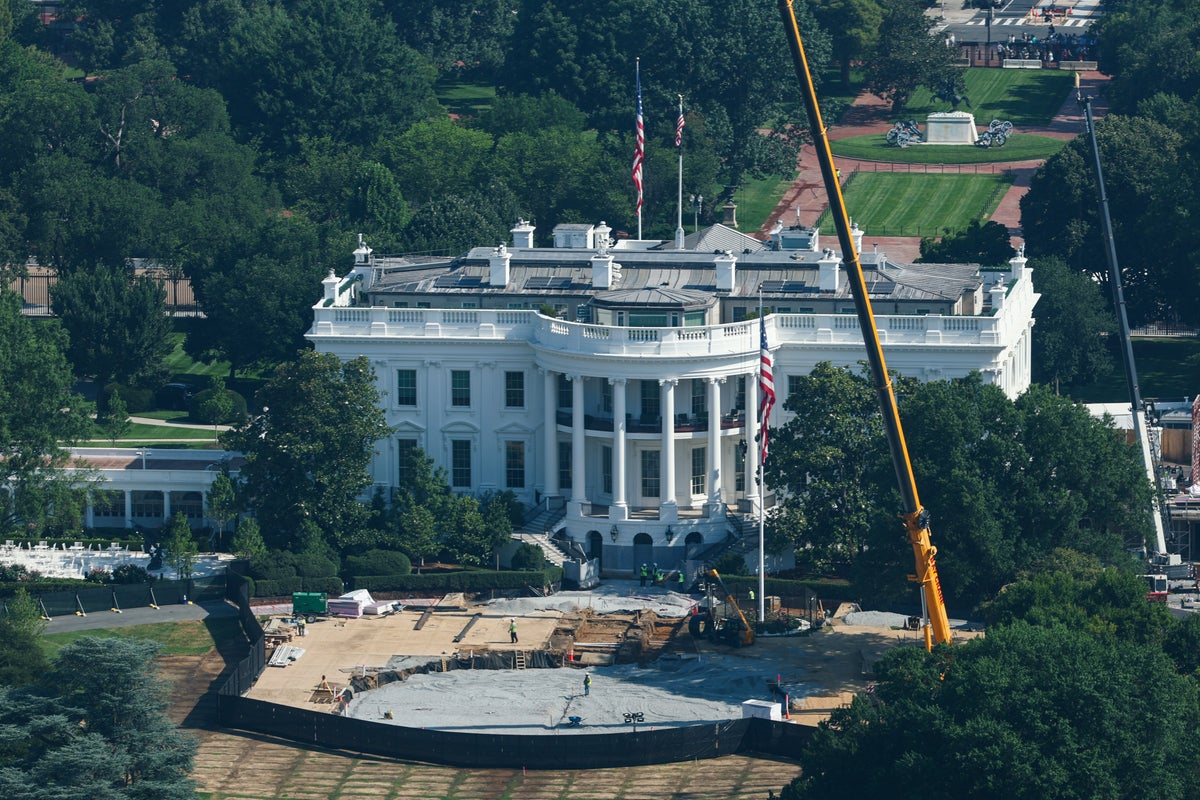
The media is swooning over Donald Trump’s latest fixations on a "beautiful" new White House helipad project. Commentators are breathlessly analyzing the aesthetics, the historical preservation angles, and the logistical footprint of upgrading Marine One’s primary landing pad. They are asking all the wrong questions. They want to know how it looks. They want to know if it fits the historic landscape.
They are missing the entire point.
Infrastructure at the executive level is never about concrete and aesthetics; it is about power projection, operational velocity, and systemic waste. While mainstream outlets regurgitate press releases about architectural harmony, anyone who has spent time auditing federal procurement or managing high-stakes capital assets sees this for what it is: a masterclass in vanity-driven asset allocation.
We need to stop evaluating presidential infrastructure through the lens of a home renovation show.
The Efficiency Illusion of Executive Transit
The lazy consensus states that upgrading a helipad inherently increases operational readiness. It sounds logical. Better pad, smoother operations, faster departures.
It is a lie.
I have spent years analyzing capital allocation budgets, and if there is one universal truth, it is that specialized, hyper-localized infrastructure upgrades yield diminishing returns almost immediately. Marine One does not get stuck in traffic. The constraints on presidential movement are not dictated by the quality of the turf or the visual appeal of the landing zone on the South Lawn. They are dictated by strict Secret Service protocols, airspace coordination, and mechanical maintenance cycles.
Imagine a scenario where a corporation spends $20 million to pave a executive-only driveway to save 12 seconds on a CEO's morning commute, while the core manufacturing plant faces a logistics bottleneck. That is exactly what happens when we fixate on localized White House upgrades.
The South Lawn has functioned as a perfectly viable landing zone since the Eisenhower administration. Pumping capital into making it "beautiful" or marginally more structured fixes a problem that does not exist.
The Real Constraints on Presidential Mobility
- Airspace Saturation: The P-56 airspace over Washington, D.C., is the most heavily restricted zone in the nation. A prettier pad does not change the physics of threat detection or flight routing.
- Security Footprint: The time-suck of executive travel is the human element—the motorcade staging, the advance teams, the communication sweeps. Changing the physical landing surface cuts down exactly zero seconds of protocol.
- Maintenance Overhead: Highly customized, aesthetically modified military-grade infrastructure requires bespoke upkeep. You aren't just pouring concrete; you are creating a permanent line item for specialized maintenance teams.
Dismantling the "Historical Preservation" Trap
Whenever a project like this hits the news, the immediate counter-argument from critics is the preservation of historical integrity. "We must protect the pristine nature of the South Lawn!"
This argument is just as flawed as the optimization argument.
The White House is not a museum frozen in amber; it is an active command center. Treating it like an untouchable historical artifact severely hinders necessary adaptation, while over-engineering it for aesthetic satisfaction turns it into a gilded set piece.
The obsession with keeping things looking "traditional" while trying to insert modern military capability creates a bizarre structural cognitive dissonance. You end up spending triple the market rate to camouflage modern engineering so it looks like it belongs in the 19th century. It is financial theater.
The Brutal Reality of Bureaucratic Procurement
Let’s talk about how money actually moves in federal construction. If a private enterprise builds a helipad, the process is linear: site assessment, bidding, pouring, inspection.
In the federal ecosystem, a "beautiful" project is a magnet for bureaucratic bloat.
| Project Phase | Standard Corporate Timeline | Federal Executive Timeline | Cost Multiplier |
|---|---|---|---|
| Site Assessment | 2 Weeks | 6–12 Months | 4x |
| Environmental Impact | Minimal (Existing Site) | Exhaustive Reviews | 10x |
| Material Sourcing | Market Rates | Specialized Defense Contractors | 5x |
| Security Clearing | Standard Background | Full Secret Service Clearance | 8x |
When you demand that a functional military landing zone also be a visual masterpiece, you invite every sub-committee, historical society, and defense contractor to extract their pound of flesh from the budget.
I have seen corporate entities burn through millions trying to satisfy aesthetic demands on industrial assets, only to realize the end-users—the pilots and the security detail—preferred the raw, unoptimized, highly functional original layout. The pilots flying the VH-92A Patriot do not care if the pad matches the surrounding flora. They care about wind shear, ground clearance, and thermal signatures.
The Wrong Question: "Is it Beautiful?"
The public is constantly asking: Will this change the iconic view of the White House?
This is a classic diversion. The real question we should be asking is: Why are we prioritizing localized capital projects over distributed operational resilience?
If executive transit requires optimization, the investment should go into decentralized logistics—upgrading secondary and tertiary emergency landing zones across the National Capital Region, improving secure communication links during transit, or accelerating the rollout of next-generation avian defense systems.
Focusing heavily on the primary lawn pad is the equivalent of buying a pristine, expensive leather case for a phone that has a cracked screen and a dying battery. It looks great in photos, but it does nothing to improve system health.
The Downside of the Hardheaded Approach
Admittedly, ignoring aesthetics entirely has its costs. The White House is a global symbol. A purely utilitarian, brutalist concrete slab slammed into the middle of the South Lawn would send a message of geopolitical anxiety and aesthetic degradation to visiting foreign dignitaries. Visual branding matters in diplomacy.
But there is a vast chasm between maintaining a dignified, functional lawn and launching a dedicated, high-profile infrastructure project aimed at redefining an asset under the guise of making it "beautiful." The former is stewardship; the latter is vanity.
Stop buying into the narrative that executive infrastructure projects are about modernization or efficiency. They are exercises in branding, funded by taxpayers and cheered on by a media apparatus that cannot see past the topsoil.
Next time you see a headline celebrating a sleek, redesigned executive asset, look past the pristine finish. Look at the operational bottlenecks left ignored while the prestige projects get the green light.
Stop looking at the paint job. Look at the engine.