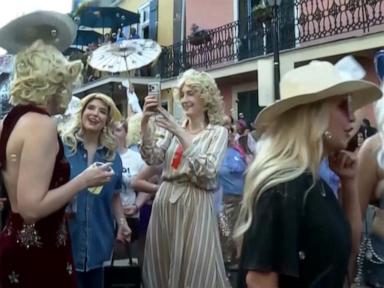
The air in the French Quarter smelled of fried beignets, humid autumn, and a collective, glittering determination.
Consider the streets of New Orleans on a late September morning, usually reserved for jazz funerals or quiet strolls beneath cast-iron balconies. On this particular day, the ordinary gave way to something entirely electric. Thousands of people poured onto the asphalt wearing head-to-toe sequins, teased blonde wigs that brushed against overhead power lines, and cowgirl boots scuffed from miles of dancing. They carried signs bearing lyrics about working nine-to-five just to survive, and they smiled with a fierce, unapologetic warmth.
They were celebrating Dolly Day.
Across the United States, from the bustling avenues of Nashville to neighborhood parks in Chicago and makeshift front-porch gatherings in small-town Ohio, a shared impulse rippled outward. People gathered not to mourn or to protest, but simply to honor a living icon of grace, grit, and rhinestone-studded resilience. But beneath the campy outfits and the booming amplifiers playing Jolene on repeat lay a deeper question. Why do we need days like this? And more importantly, what does our sudden, overwhelming need to celebrate Dolly Parton say about the state of our collective soul?
The Architecture of Comfort
To understand why a country often divided by politics, geography, and culture can unite in unanimous adoration of a woman from Sevier County, Tennessee, you have to look at the architecture of modern exhaustion.
Life has become remarkably sharp-edged. The daily news cycle reads like a series of sirens. Algorithms reward outrage, and the digital public square feels less like a town hall and more like a gladiatorial arena. In this environment, cynicism is armor. It is easy to protect yourself by expecting the worst from people.
Then comes Dolly Parton.
She represents an intentional counter-strategy to modern bitterness. For decades, she has deployed self-deprecating humor as a shield and unyielding empathy as a sword. When people slip into her orbit—whether through her music, her multimillion-dollar literacy programs that mail books to children, or her quiet, unheralded acts of philanthropy—they are reminded that kindness is not a weakness. It is a radical choice.
On Dolly Day, participants across the US were not merely playing dress-up. They were performing an act of communal relief. By donning the armor of rhinestones, they were stepping out of their daily armor of cynicism.
From Sevierville to the Soul of America
To trace the roots of this phenomenon is to trace a masterclass in authenticity. Dolly Parton was born into poverty as one of twelve children in a cabin in the Smoky Mountains. She grew up sleeping three to a bed, wrapped in patchwork quilts made by her mother out of rags.
That origin story is often romanticized, but the reality of rural poverty is brutal and isolating. What set Dolly apart was not just her three-octave voice, but her refusal to let circumstance dictate her capacity for joy. She took the ridicule of her early Nashville days—when industry executives told her she wore too much makeup and dressed too loudly—and turned it into a badge of honor.
"It costs a lot of money to look this cheap," she famously joked.
That line is a brilliant piece of psychological armor. It disarms the critic before they can strike. It says: I know what you are thinking, and I beat you to the punch. But beyond the wit lies a profound truth about ownership. Dolly claimed her own image, her own narrative, and her own worth. When Americans celebrate her today, they are celebrating that hard-won autonomy. They are celebrating someone who took every limitation handed to her by life and forged them into keys.
Consider what happened in New Orleans, where the Krewe of Dolly organized a massive parade through the historic streets. Thousands marched in unison, not under the banner of a political party or a corporate brand, but under the banner of shared delight. Streetcar conductors waved. Tourists dropped their maps. For a few hours, the invisible walls that separate strangers dissolved into a chorus of "I Will Always Love You" sung badly, loudly, and with total sincerity.
The Invisible Stakes
It is easy to dismiss nationwide celebrations of pop culture figures as mere escapism or harmless viral moments. But writing them off misses the psychological mechanics at play.
In a fragmented society, shared rituals are vanishing. Traditional civic organizations are shrinking; religious institutions are seeing declining attendance; neighborhood spaces are being replaced by digital feeds. People are physically proximate but socially starved.
When a cultural figure like Dolly Parton becomes the focal point for a nationwide day of celebration, people are improvising new rituals. They are building makeshift tribes based on shared values of generosity, resilience, and humor.
Imagine a retail worker in Chicago, exhausted by a grueling week, spending their Sunday morning pinning glitter to a denim jacket. That act is not trivial. It is an investment in joy. It is an intentional disruption of the humdrum misery that modern life so easily slips into. When that worker steps onto the train and sees a stranger wearing a matching blonde wig, a silent transaction occurs. A nod. A laugh. A shared recognition that life, despite its absurdities and hardships, is still worth dressing up for.
The Legacy of the Imagination
What makes this celebration endure across generations is that Dolly Parton has never stopped writing the soundtrack to ordinary lives. Her songs are not about untouchable wealth or abstract philosophical theories. They are about working at the factory, waiting for a paycheck, longing for home, and surviving heartbreak with your head held high.
When she established the Imagination Library in 1995—inspired by her father's inability to read—she didn't launch a faceless corporate charity. She tied it to the intimacy of storytelling. To date, that program has mailed over two hundred million books to children worldwide, completely free of charge, simply because she believed that literacy is the ultimate equalizer.
When communities across the US celebrate her, they are also celebrating the children who learned to read because a book arrived in the mail with their name on it. They are celebrating the workers who found dignity in a song about punching a clock.
The Sound of a Lasting Chord
We live in an age that desperately wants heroes, yet spends most of its time tearing them down. We scrutinize public figures until the flaws eclipse the achievements, leaving us cynical and stranded.
Yet Dolly Parton remains an outlier. Not because she is flawless—she would be the first to laugh at the suggestion—but because her commitment to kindness feels durable enough to withstand the scrutiny. She is living proof that you can rise from the most difficult circumstances without losing your sweetness.
The parades will end. The wigs will go back into boxes in the back of closets. The sequins will eventually be swept off the pavement of the French Quarter and the bars of Nashville.
But the impulse that brought millions of people together on Dolly Day will not disappear so easily. It lingers in the quiet realization that behind all the noise, the division, and the fatigue, people still know how to recognize light when they see it. And more importantly, they still know how to reflect it back.