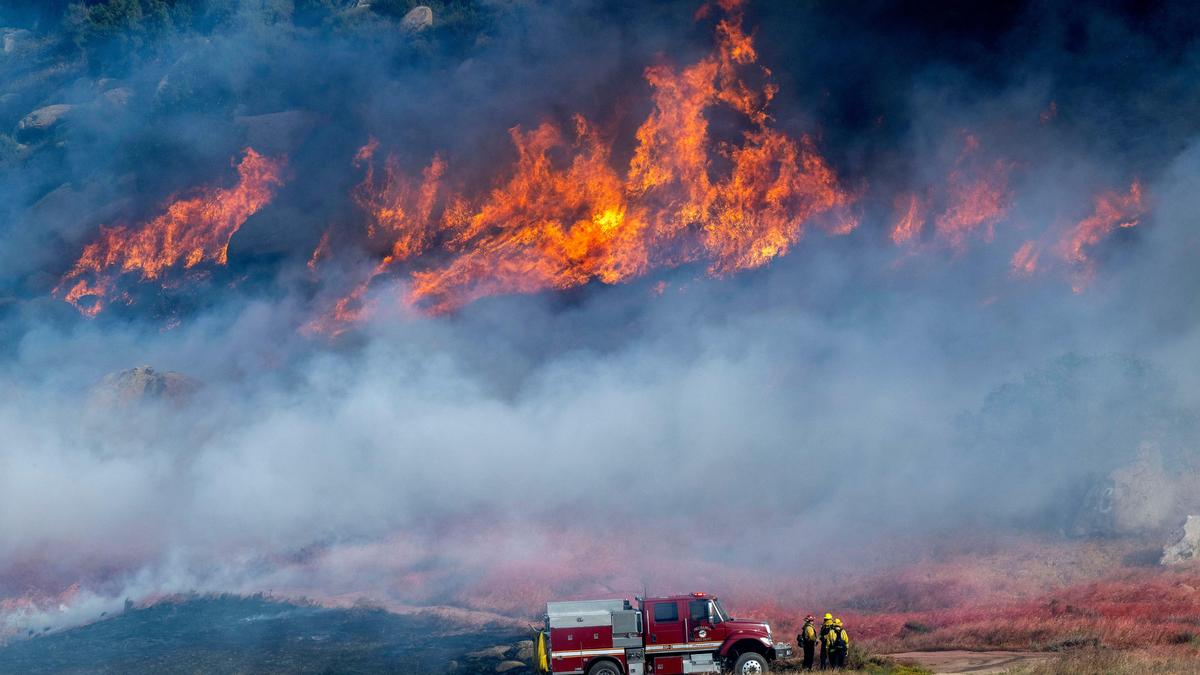
The transition from active wildfire suppression to the containment phase represents a critical shift in risk management where the primary threat evolves from thermal destruction to secondary structural instability and infrastructure failure. When officials lift evacuation orders, they are not declaring the absence of fire, but rather that the rate of fire spread has fallen below the suppression capacity of the current resource deployment. This phase change requires a rigorous assessment of the containment line integrity and the atmospheric variables that dictate fire behavior.
The Mechanics of Containment Percentages
Containment is a metric of perimeter stability, not an indicator of total extinguishment. A wildfire listed as 80% contained means that 80% of the fire's boundary is secured by a barrier—either natural or man-made—that is expected to hold under prevailing weather conditions. The remaining 20% remains active or unmonitored.
The stability of these lines depends on three primary variables:
- Fuel Continuity: The physical spacing of combustible material. Firefighters break this continuity by creating "black lines" (controlled burns to remove fuel) or "mineral soil lines" (scraping vegetation away down to the dirt).
- Thermal Inertia: Large diameter fuels, such as downed logs or heavy timber, can retain heat for weeks after the main fire front has passed. These hotspots represent latent energy that can breach containment lines if wind speeds increase.
- Topographic Buffers: Fire moves faster uphill due to pre-heating of upslope fuels. Containment lines established at the crest of a ridge are significantly more defensible than those mid-slope, as the fire's rate of spread slows once it reaches the plateau or begins a downslope descent.
The Logic of Evacuation Rescission
The decision to lift evacuation orders is a complex calculation involving civil liability, public safety, and resource allocation. It is a staggered process because the risk profile of a burn scar is heterogeneous.
The Infrastructure Integrity Audit
Before residents are permitted to return, utility providers and municipal engineers must clear "Life Safety" hurdles. Power lines must be de-energized or repaired to prevent arcing, which could spark secondary fires. Gas lines require pressure testing to ensure that soil movement or heat-induced expansion hasn't caused leaks. Most critically, the stability of the soil must be evaluated. Wildfires destroy the root systems that bind soil and create a hydrophobic layer on the earth's surface, significantly increasing the risk of flash flooding and debris flows during subsequent precipitation events.
The Logistics of Re-entry Triage
Evacuation orders are typically downgraded in tiers.
- Tier 1: Essential Services. Return of utility crews and damage assessment teams.
- Tier 2: Resident Access. Re-entry for homeowners to secure property and assess losses.
- Tier 3: Full Public Opening. Removal of all road closures and resumption of normal commerce.
This tiered approach prevents traffic congestion that would otherwise impede emergency vehicles still operating on the fire's active flanks.
The Atmospheric Ceiling on Suppression Success
Weather is the ultimate arbiter of fire containment. In Southern California, the primary driver is the offshore wind event, characterized by high-pressure systems over the Great Basin pushing dry, compressed air toward the coast.
The "containment window" opens when the Relative Humidity (RH) rises above a 20% threshold. Low RH levels—often dropping into the single digits during peak fire events—desiccate fine fuels (grasses and shrubs), making them highly receptive to embers. Once the RH recovers, the "fuel moisture" levels increase, effectively raising the ignition temperature required for the fire to advance.
Fire behavior is also dictated by the Haines Index, a tool used to measure the atmosphere's potential for dry, unstable air to contribute to large, erratic fire growth. A high Haines Index suggests that the fire can develop a plume-dominated column, which creates its own internal weather systems, including "fire whirls" that can leapfrog containment lines by throwing embers miles ahead of the main front.
Resource Allocation and Diminishing Returns
As containment percentages rise, the Incident Command System (ICS) begins the process of "right-sizing" the response. This is a strategic withdrawal of assets—Type 1 hand crews, air tankers, and engines—to make them available for new ignitions elsewhere.
The cost of containment follows a non-linear trajectory. The initial 50% of containment is often achieved rapidly as crews attack the most accessible flanks. The final 10% to 20% usually involves the most rugged terrain, where heavy machinery cannot operate, and work must be done by hand. This phase is characterized by "mop-up" operations: a labor-intensive process of searching for and extinguishing every puff of smoke within a certain distance of the perimeter (often 100 to 300 feet).
Secondary Risks in the Post-Containment Environment
Returning residents face a "High-Frequency, Low-Severity" risk environment. While the threat of a massive fire front has passed, the "Tactical Hazard Zone" remains.
- Ash Toxicity: Fire debris often contains heavy metals, asbestos from older structures, and concentrated household chemicals.
- Stump Holes: Subterranean root systems can burn for days, leaving hollow, ash-filled pits that are invisible from the surface and can collapse under the weight of a person or vehicle.
- Hazard Trees: Trees weakened by fire (widow-makers) can fall without warning, particularly during the afternoon wind shifts common in coastal canyons.
Strategic Framework for Long-Term Mitigation
Containment is a temporary victory in a larger cycle of land management failure. The Southern California ecosystem, particularly chaparral, is fire-adapted but currently experiences a fire frequency that exceeds its natural recovery capacity.
To transition from reactive suppression to proactive resilience, the operational focus must shift toward three structural changes:
- Hardened Ember Resistance: Most homes lost in wildfires are not consumed by the main wall of flame but by embers entering attic vents or igniting flammable landscaping adjacent to the structure. Retrofitting existing housing stock with non-combustible siding and 1/8-inch mesh screening is more cost-effective than any increase in fire department staffing.
- Vegetation Management via Targeted Grazing and Prescribed Fire: The removal of "ladder fuels"—lower-level vegetation that allows fire to climb into the tree canopy—is essential. In areas where prescribed burning is too high-risk due to population density, mechanical thinning and grazing provide a viable alternative for reducing the energy output of future fires.
- Real-Time Sensor Integration: Deploying localized weather stations and AI-linked thermal cameras allows for the "Initial Attack" phase to begin within minutes of ignition. The goal is to keep fires under 10 acres, a threshold beyond which the cost and complexity of suppression grow exponentially.
The current containment in Southern California provides a brief window for these systemic adjustments. Failure to implement these hardening strategies during the "recovery" phase ensures that the next wind event will simply restart the cycle of evacuation and loss.