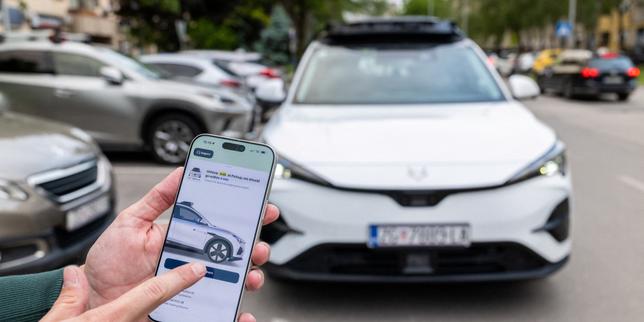
Zagreb has become the unexpected testing ground for Europe's first commercial autonomous ride-hailing deployment. While tech executives promised driverless fleets would dominate European roads by now, the reality on the ground in Croatia reveals a massive gap between corporate marketing and urban infrastructure. The deployment of autonomous vehicles here highlights a fundamental miscalculation. Developers built systems for sterile, predictable highways, but European cities present an chaotic mix of centuries-old tram tracks, aggressive pedestrian behavior, and unpredictable traffic patterns.
The venture in Zagreb, backed by significant European Union funding and led by Project 3 Mobility—a company closely tied to Croatian electric hypercar manufacturer Rimac—undertook the task of launching a fully autonomous taxi service. Dubbed "Verne" after the science fiction author Jules Verne, the project aims to integrate a fleet of custom-built, two-seater autonomous vehicles into a capital city known for complex transit bottlenecks.
Looking past the slick promotional videos reveals the immense friction of deploying this technology under strict European regulatory frameworks and unforgiving geographical constraints.
The Friction of Old World Infrastructure
Autonomous driving systems rely on predictability. They require clear lane markings, standard intersection layouts, and predictable actor behavior to calculate safe trajectories. Zagreb offers none of these conveniences.
The city center features an extensive tram network that shares narrow lanes with standard passenger cars. Trams create unique sensor challenges. Their massive metallic bodies can distort radar signatures, while the overhead catenary wires introduce vertical noise for roof-mounted LiDAR sensors. When a tram stops, passengers step directly into the street, creating sudden pedestrian obstacles that lack the predictable geometry of a standard crosswalk.
+-------------------------------------------------------------+
|               URBAN SENSOR DISTORTION RISK                  |
+-------------------------------------------------------------+
| [Overhead Tram Wires]  --> Introduces vertical LiDAR noise  |
| [Metallic Tram Body]   --> Distorts radar signatures        |
| [Mid-Street Boarding]  --> Creates irregular pedestrian paths|
+=============================================================+
Standard machine learning models struggle with these edge cases. An autonomous vehicle operating in San Francisco or Phoenix deals with wide, grid-based American roads. In Zagreb, the vehicle must navigate tight medieval layouts, cobblestone transitions, and a local driving culture that views aggressive lane merging as a necessity rather than an infraction. If an autonomous vehicle operates too conservatively, it becomes a rolling roadblock, drawing ire from human drivers and grinding local traffic to a halt. If it operates too aggressively, it risks severe liability under strict European safety laws.
The Venture Capital Delusion and the EU Funding Paradox
The financial mechanics behind the Zagreb initiative expose a broader trend in the tech sector. For nearly a decade, venture capital flooded autonomous vehicle startups based on the assumption that full autonomy was just a few software updates away. When private funding began to cool due to repeated missed deadlines, companies pivoted toward public subsidies.
Project 3 Mobility secured roughly 180 million euros from the European Union's Recovery and Resilience Facility. This injection of public capital kept the project alive, but it arrived with rigid bureaucratic milestones that do not align with the messy reality of software engineering.
Public funding requirements often force companies to hit specific deployment dates regardless of whether the software is ready for edge-case anomalies.
This creates an environment where companies might deploy vehicles in highly restricted "geo-fenced" zones just to satisfy regulatory checklists, rather than proving the commercial viability of the technology. The business model depends on scale. A fleet of fifty or one hundred specialized vehicles cannot generate enough revenue to offset the massive capital expenditure required to maintain high-definition 3D mapping data, remote assistance command centers, and specialized maintenance facilities.
The Remote Operator Myth
Proponents of autonomous ridesharing often present these vehicles as entirely self-sufficient entities driven by artificial intelligence. That depiction is inaccurate.
Every major autonomous vehicle operation requires a hidden army of human technicians sitting in remote monitoring centers.
When a vehicle encounters a situation it cannot resolve—such as a construction site blocked by unmapped traffic cones or a police officer directing traffic with hand gestures—the onboard computer stops the car and requests human intervention. A remote operator then reviews the vehicle's camera feeds and draws a safe path forward for the machine to execute.
[AV Encounters Unmapped Obstacle]
               │
               ▼
[Onboard AI Safely Halts Vehicle]
               │
               ▼
[Remote Operator Reviews Live Camera Feeds]
               │
               ▼
[Operator Paths Vehicle Around Obstacle]
               │
               ▼
[AV Resumes Autonomous Operation]
This dependency undermines the economic premise of eliminating the driver. If a company needs one remote operator for every four or five vehicles on the road, the labor savings disappear. This calculation excludes the high salaries commanded by specialized tech workers compared to traditional taxi drivers. Furthermore, cellular network latency introduces risk. A temporary drop in 5G connectivity in a dense urban canyon can leave a stalled vehicle stranded in the middle of a busy intersection, compounding traffic congestion and drawing public backlash.
European Sovereignty Versus Silicon Valley Data
The race to deploy autonomous fleets in Europe is heavily influenced by geopolitical data concerns. European regulators remain deeply wary of allowing American or Chinese tech giants to control the transportation data infrastructure of European capitals. Alphabet's Waymo and Baidu's Apollo have logged millions of autonomous miles, giving them an immense data advantage over domestic European startups.
By backing local initiatives like the Zagreb project, European institutions attempt to build a domestic ecosystem for autonomous mobility. The core challenge is that data accumulation is exponential. A company that has run operations for years has already encountered and solved millions of edge cases that a new European competitor is experiencing for the first time.
Attempting to catch up while adhering to the General Data Protection Regulation (GDPR) adds another layer of friction.
Autonomous vehicles constantly record high-resolution video of their surroundings, capturing the faces of pedestrians and the license plates of surrounding cars. Under European law, treating this data requires stringent anonymization protocols at the edge, meaning the vehicle must blur faces and plates before saving or transmitting data for machine learning training. This requirement complicates the data pipeline, slowing down the rate at which the system can learn from its mistakes.
The Real Cost of Public Road Testing
Cities that accept autonomous vehicle testing essentially turn their public streets into laboratory benches for private corporations. When an autonomous test vehicle makes an error, the consequences are borne by the residents. In several American deployment sites, driverless cars blocked emergency vehicles, interfered with fire department operations, and caused erratic traffic delays.
In Zagreb, public tolerance for these disruptions is tied to the promise of economic modernization. The city administration welcomed the project as a badge of technological progress. However, if the vehicles cause significant delays during the tourist season or interfere with the punctual operation of the city's tram system, political support can erode quickly.
The physical infrastructure of the city cannot be easily updated to accommodate autonomous sensors.
Moving tram tracks, rewriting traffic laws, or restricting pedestrian movements to make things easier for an AI system is politically unfeasible and financially prohibitive. The technology must adapt to the city, not the other way around.
The Long Road to Real Autonomy
The commercialization of driverless transportation faces an existential bottleneck. The transition from ninety-nine percent reliability to ninety-nine point nine nine nine percent reliability represents the vast majority of the engineering work. Achieving that final fraction of a percent requires billions of dollars and decades of real-world driving data.
The Zagreb deployment proves that launching a robotaxi service requires more than manufacturing a sleek vehicle chassis and installing a suite of cameras. It requires navigating an intricate web of local driving habits, historical infrastructure, public funding obligations, and stringent data privacy laws. Until autonomous systems can handle the chaotic, unmapped realities of a rainy Tuesday evening in a historic European city center without human intervention, these fleets will remain limited to expensive, subsidized demonstrations. The future of urban mobility remains firmly in human hands, operating on iron tracks and steering through the daily friction of unpredictable city life.