Dust. That is what you taste first in the eastern Free State of South Africa. It coats your tongue like powdered chalk, slips beneath your fingernails, and settles into the creases of your knuckles before you have even unpacked your rock hammer.
For years, paleontologists walked over those rust-red mudstones looking for giants. They wanted the towering, earth-shaking titans of the Late Triassic—the beasts whose femurs looked like fallen redwoods and whose footprints could hold a rainstorm. When you spend your life hunting monsters, you develop a very specific kind of blindness. You learn to scan the horizon for massive, sweeping curves of fossilized bone, stepping right over the smaller fragments scattered at your boots.
Then, someone looked down.
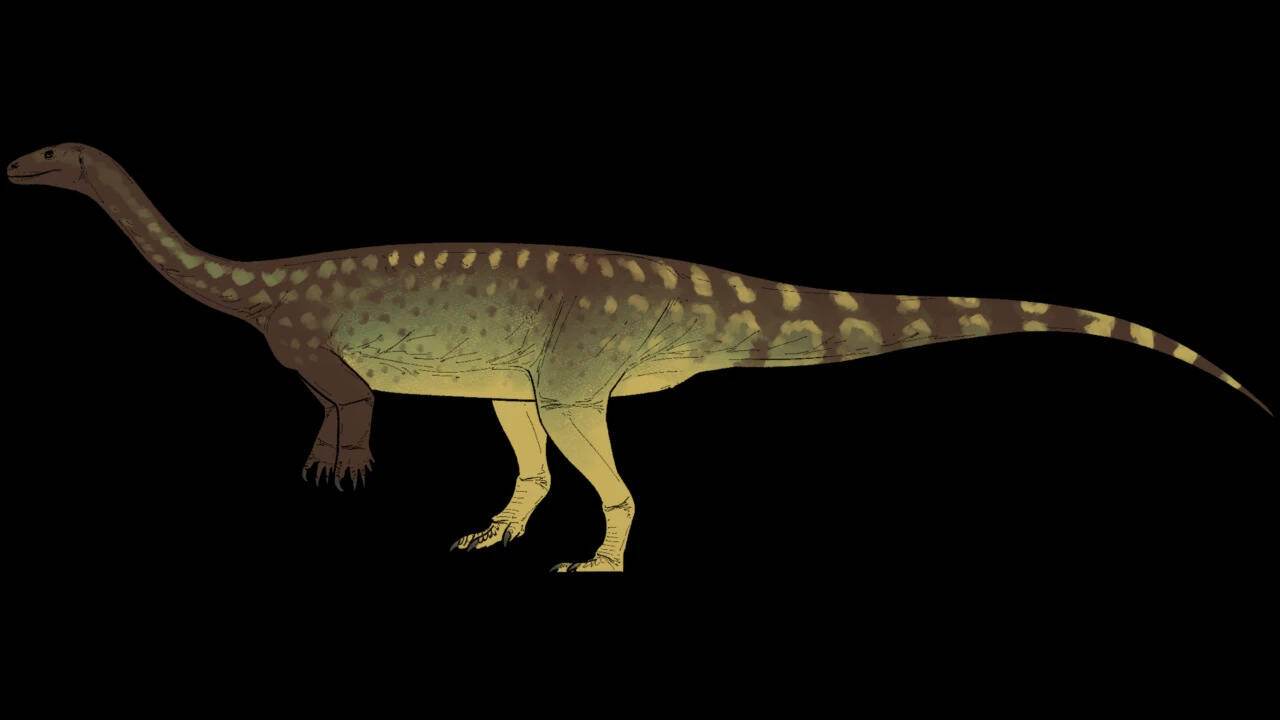
What they found in the rock layers of South Africa’s Elliot Formation did not belong to a fully grown behemoth. It belonged to a youngster. A juvenile dinosaur that had barely begun its life, yet already tipped the scales at roughly 400 kilograms.
Pause and let that number sit in your chest for a second. Four hundred kilograms. That is the weight of an adult male grizzly bear, or a grand piano, or five grown men standing on a scale together. And this creature was still a kid.
The Weight of a Childhood
To understand why a 400-kilogram baby stops evolutionary biologists dead in their tracks, you have to strip away everything you think you know about how animals grow.
Picture a hypothetical scenario on a modern African savanna. Watch a newborn wildebeest drop onto the grass. Within minutes, it is wobbling on spindly, trembling legs. Within an hour, it is running alongside the herd. It has to. On a continent built for predators, being small and slow is a death sentence. Yet even that wildebeest starts life weighing barely twenty kilograms. To reach four hundred, it needs years of grazing, surviving droughts, and outrunning lions.
Now, rewind the clock roughly 200 million years to the Late Triassic period. The supercontinent Pangaea was beginning to groan and fracture. The climate was fierce, swinging between parched, blistering heat and sudden, violent monsoons. Life on land was an arms race, and the earliest sauropodomorphs—the evolutionary grandfathers of long-necked giants like Brachiosaurus and Diplodocus—were trying to figure out a radical new survival strategy.
Size. Pure, unadulterated bulk.
For decades, scientists assumed that true gigantism arrived later in the Jurassic period, when lush forests provided endless buffets for sixty-ton plant-eaters. The Triassic ancestors were supposed to be modest creatures—two-legged, nimble, maybe the size of a large dog or a small horse. They were the rough drafts. The prototypes.
Except the bones in South Africa told a completely different story.
When researchers examined the fossilized remains—specifically a partial skeleton recovered from rocks dating back roughly 205 to 210 million years—they expected to find the dense, tightly packed bone tissue of an old, fully grown animal. Bones keep a diary. Just like cutting open an oak tree reveals rings of wet summers and harsh winters, slicing a fossilized bone into a microscopic thin section reveals Lines of Arrested Growth. Every year, as seasons shift and food grows scarce, a dinosaur’s skeleton slows down, leaving a faint dark ring in the mineral matrix.
The scientists put the South African specimen under the microscope, looking for the crowded, closely spaced rings near the outer edge of the bone that signal adulthood.
They found none.
Instead, the tissue was riddled with wide, chaotic channels where blood vessels had once surged with nutrients. The bone was laying down new tissue at a frantic, explosive pace. There was no outer ring. There was no sign that this animal had even reached sexual maturity, let alone its maximum adult size.
It was a teenager. Maybe even younger. And it was already heavier than a concert grand piano.
Reading the Diary Inside Stone
I remember the first time I held a cross-section of fossilized dinosaur bone in a university prep lab. You expect stone to feel dead—cold, heavy, inert, like a river pebble. Yet when you hold it up to a bright lamp, the light catches the ancient vascular canals, turning the rock into a translucent honeycomb of amber and rust. You suddenly realize you are not looking at a rock at all. You are looking at frozen physiology. You are staring directly at the metabolic engine of an animal that breathed air before the Atlantic Ocean existed.
That is the quiet magic of paleohistology—the study of ancient tissues. Without it, paleontology is just a game of measuring shapes and guessing. With it, the dead speak.
When the South African team—led by researchers from the University of the Witwatersrand in Johannesburg—analyzed the skeleton, they realized they were staring at a brand-new species. They named it Ledumahadi mafube in later companion discoveries, and across this specific lineage of early sauropodomorphs, a breathtaking pattern emerged. These animals were not waiting around for the Jurassic period to become giants. They had already cracked the code.
Think of growth like building a house. Most reptiles—crocodiles, lizards, turtles—build slowly. They lay down a brick, wait for the weather to clear, lay down another brick, and keep building at a crawl for decades. Mammals and birds do the opposite. We build at breakneck speed while we are young, burning massive amounts of energy to reach adult size quickly, and then we slam on the brakes and stop growing altogether.
These Triassic dinosaurs were straddling two worlds.
Their bone histology showed that they grew in rapid, intense bursts—much faster than modern reptiles—allowing them to rocket past the danger zone of being small, bite-sized snacks for early meat-eaters. By the time a juvenile reached 400 kilograms, almost nothing walking the Late Triassic floodplains could easily bring it down. It had outgrown its predators before it had even finished growing up.
Why Bigger Meant Faster
It is easy to get lost in the sheer romance of giant numbers, so let us ground this in a simple, physical reality. Why does bulk matter so much to an herbivore?
Imagine trying to survive on a diet of raw celery and pine needles. Tough, fibrous, low-calorie plants require an enormous amount of time to break down. A small animal has a small stomach and a fast metabolism; if it eats low-quality plants, it starves to death before it can digest them.
To turn tough Triassic ferns and conifers into muscle and bone, an animal needs a fermentation vat. It needs a gut so vast that swallowed vegetation can sit inside for days, slowly breaking down under the work of gut bacteria.
You cannot fit a massive fermentation vat inside a small body.
Here is the evolutionary catch-22 that trapped early plant-eating dinosaurs: to eat the abundant, tough plants around them, they needed to be huge. To become huge, they needed to eat massive amounts of food while they were still small.
How do you solve a riddle like that? You cheat. You front-load your growth.
By hatching from relatively small eggs—dinosaurs were physically limited by how thick an eggshell could be before a baby could no longer break out or breathe through the pores—these animals started life tiny, perhaps no bigger than a housecat. From the moment they cracked out of the shell, their bodies went into metabolic overdrive. They ate relentlessly, converting every calorie into bone length and muscle mass, ballooning from a few kilograms to 400 kilograms in a fraction of the time it would take a crocodile to grow a meter.
Once they crossed that 400-kilogram threshold, the physics of survival flipped in their favor. Their guts were large enough to process poor-quality foliage. Their stride was long enough to travel miles between seasonal waterholes. Their sheer mass conserved body heat through chilly Triassic nights.
Walking on Four Pillars
There is another detail hidden in those South African bones, and it changes how we picture these creatures moving across the ancient earth.
Early sauropodomorphs started out walking on two legs. Picture something graceful, balanced at the hips, using its long tail as a counterweight while its front hands grasped branches. That posture works wonderfully when you weigh fifty or a hundred kilograms.
It becomes a structural nightmare when your teenager weighs four hundred.
Physics does not negotiate. As an animal’s length doubles, its volume—and therefore its weight—increases roughly eightfold. Bones, however, only gain strength based on their cross-sectional area, which increases fourfold. If a dinosaur simply scaled up its two-legged body plan without changing its posture, its shin bones would snap under its own weight the moment it broke into a trot.
In the fossilized limbs of these massive South African juveniles and their adult relatives, paleontologists saw the skeleton actively remodeling itself to handle the load. The front limbs were thickening. The wrists were losing their ability to grasp and instead locking into sturdy, weight-bearing columns. These animals were dropping down onto all fours.
Unlike the later Jurassic giants—which stood on straight, pillar-like legs directly beneath their bodies like elephants—these Triassic pioneers walked with a slightly crouched, wide-stanced swagger. They were still figuring out the engineering of gigantism in real time. Every step through the mud of ancient southern Africa was a structural experiment, testing how much weight bone and cartilage could bear before giving way.
The Invisible Stakes of the Triassic
We tend to look at the history of life as a neat, tidy ladder: small things evolve into big things, simple things evolve into complex things, and everything marches forward according to some grand design.
That is a comforting lie we tell ourselves in museums. The truth is far messier, and far more thrilling.
Roughly 201 million years ago, right at the end of the Triassic period, the Earth suffered one of the five worst mass extinctions in its history. Massive volcanic eruptions tore open the crust as Pangaea split apart, pumping staggering amounts of carbon dioxide into the atmosphere. Temperatures spiked. Oceans acidified. Roughly eighty percent of all species on the planet vanished.
Most of the great rivals of the dinosaurs—the giant, crocodile-like rauisuchians, the armored aetosaurs, the tusked dicynodonts that had ruled the land for millions of years—were wiped off the map.
Yet the sauropodomorphs survived. Not only did they survive, they exploded into the Jurassic period, diversifying into the largest land animals that have ever walked the Earth.
Why did they make it through the bottleneck when so many others perished?
Look back at that 400-kilogram youngster in the Free State mudstone. When the world went into ecological chaos, when droughts withered the lush riverbanks and only the toughest, most scrubby vegetation remained, being big and growing fast was the ultimate insurance policy. Animals that could sprint through their vulnerable youth, reach massive sizes quickly, and survive on low-grade forage held the winning hand.
The South African fossils show us that the blueprint for Jurassic dominance was not forged in times of plenty. It was hammered out in the harsh, unpredictable crucible of the Late Triassic.
What Remains in the Red Dust
It is easy to feel small when you stand in the Karoo Basin or the foothills of the Maloti Mountains in South Africa. The landscape stretches out under a sky so wide it makes your eyes ache. Every layer of sandstone and shale stacked in those cliffs represents hundreds of thousands of years of vanished rivers, forgotten storms, and ecosystems that lived and died without a single human witness.
When paleontologists brush the dust off a femur that belonged to a 400-kilogram juvenile, they are doing more than adding a Latin name to a scientific catalog. They are correcting our arrogance.
For decades, we assumed we understood the timeline of giants. We drew neat boxes on evolutionary charts and told ourselves that nature moved slowly, cautiously, taking tens of millions of years to build a titan. We forgot how fiercely life pushes against its limits when survival is on the line.
Somewhere in the late Triassic, an animal that had barely outgrown its childhood stood beside a seasonal river, casting a shadow the size of a boulder across the red mud. It was awkward, heavy-limbed, and still growing at a pace that would tear a modern mammal’s metabolism apart. It had no idea it was an evolutionary pioneer. It was just hungry, heavy, and alive—carrying inside its bones the exact biological architecture that would rule the Earth for the next hundred and forty million years.