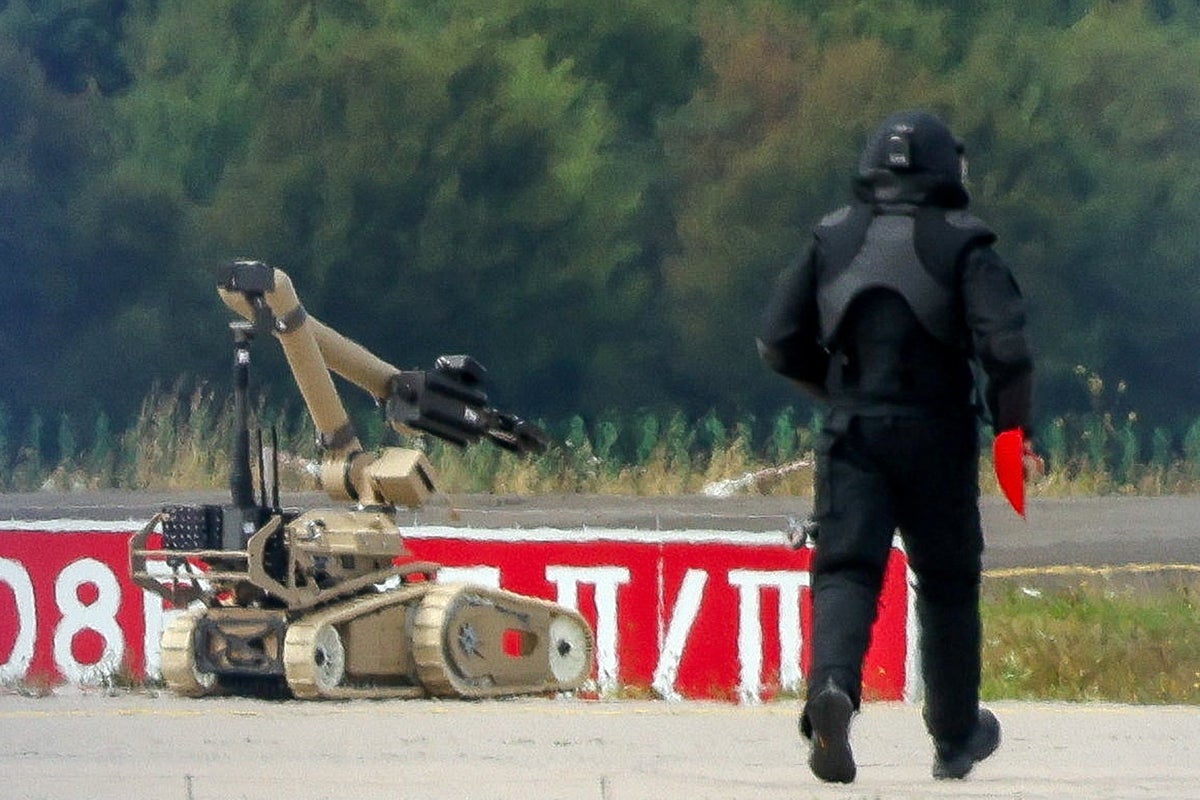
The recovery of an explosive-laden quadcopter near the active runway of Leipzig/Halle Airport transitions European aviation security from a passive monitoring paradigm into an active threat mitigation crisis. For years, commercial and military authorities treated unauthorized unmanned aerial vehicle sightings as nuisance reconnaissance or low-level disruptions. The introduction of an improvised explosive device directly into a restricted cargo operations zone invalidates baseline security assumptions across critical infrastructure nodes. Deconstructing this event requires analyzing the operational mechanics of asymmetric sabotage, the structural vulnerabilities of multi-use transport hubs, and the economic cost function of modern hybrid warfare.
The Economics of Asymmetric Disruption
State-backed or proxy-executed sabotage operates on a severely asymmetric cost curve. Traditional air defense and counter-unmanned aircraft systems rely on capital-intensive radar arrays, signal jamming architectures, and kinetic interceptors that cost tens of thousands of dollars per engagement. Conversely, commercial quadcopters equipped with basic payload delivery mechanisms require minimal financial outlay and zero specialized military infrastructure to deploy near civilian perimeters.
When an explosive drone penetrates a major logistics nexus such as Leipzig/Halle—which functions simultaneously as a commercial passenger airport, a primary sorting facility for global freight carriers like DHL, and a strategic maintenance base for Ukrainian Antonov cargo aircraft—the secondary economic fallout dwarfs the tactical manufacturing cost. Runway closures force immediate flight diversions, disrupt tightly scheduled cargo supply chains, and mandate exhaustive counterterrorism sweeps.
The incident also triggered a secondary airborne hazard when an aborted freight landing resulted in a mid-air collision with an unidentified flying object, inflicting structural damage on the aircraft. This cascading effect illustrates the core objective of modern hybrid strategies: maximizing operational friction and generating widespread institutional uncertainty with minimal resource expenditure.
The Three Pillars of Modern Airport Vulnerability
Critical infrastructure protection in Western Europe faces three structural bottlenecks that restrict rapid defensive scaling.
First, perimeter surveillance geometry remains optimized for ground-level intrusion rather than low-altitude aerial access. Commercial airports span vast geographic footprints designed for unobstructed flight paths, creating vast blind spots for small, low-heat-signature aerial platforms. Standard air traffic control radar is calibrated to track large metallic commercial airframes, rendering consumer-grade composite drones virtually invisible until visual confirmation occurs.
Second, the dual-use nature of strategic transport hubs complicates defensive hardening. Facilities housing commercial passenger terminals alongside military logistics or foreign aid transit points cannot implement military-grade airspace lockouts without crippling regional economic activity. When an airport serves as a primary European logistics artery, security protocols must balance continuous throughput against emerging threat vectors. This operational friction creates windows of vulnerability that external actors systematically exploit.
Third, the attribution dilemma inherent to hybrid warfare dampens rapid deterrent responses. Because operations are frequently outsourced to regional proxies, criminal networks, or local operatives recruited via digital channels, establishing a definitive chain of command back to a hostile state actor requires exhaustive forensic analysis. This investigative lag delays diplomatic or retaliatory measures, allowing hostile actors to maintain plausible deniability while probing defensive thresholds.
The Shift From Espionage to Kinetic Sabotage
Intelligence assessments indicate a calculated escalation in foreign sabotage campaigns targeting European logistics networks. Prior incidents primarily involved reconnaissance overflights or latent sabotage, such as incendiary devices concealed within commercial freight shipments. The placement of a detonator-equipped drone directly adjacent to high-value transport assets represents a qualitative leap from intelligence gathering to active kinetic interdiction.
Targeting facilities utilized by Ukrainian transport operators serves a dual purpose. Operationally, it aims to degrade the supply lines supporting Ukraine's defense logistics. Psychologically, it signals to Western populations that critical infrastructure deep within NATO territory remains exposed to foreign interference. By executing these operations near civilian population centers, the perpetrators exploit the risk tolerance of open societies, where preventing structural damage must be weighed against the potential for collateral harm.
Strategic Realignment for Critical Infrastructure
Defending against autonomous or semi-autonomous explosive payloads requires a fundamental overhaul of airport security architecture. Perimeter defense can no longer rely exclusively on static physical barriers and periodic human patrols. Integrating active radio-frequency detection grids, acoustic sensors, and automated optical tracking systems into airport perimeter zones is necessary to identify micro-UAV signatures before payloads can be positioned near active tarmac areas. Furthermore, regulatory frameworks must grant regional authorities the legal mandate to deploy electronic countermeasures—such as localized signal spoofing and forced automated landings—without risking interference with commercial avionics.
Security agencies must treat unauthorized airspace incursions not as isolated security infractions, but as active reconnaissance phases preceding kinetic deployments. Intelligence sharing between national counterterrorism units and private logistics operators must transition from periodic briefings to real-time telemetry integration.
Deploy hardened, multi-layered electronic counter-UAS grids across all designated strategic transport hubs, decoupling low-altitude airspace monitoring from traditional air traffic control dependencies while establishing mandatory automated shutdown protocols for vulnerable runway corridors during unverified airspace intrusions.