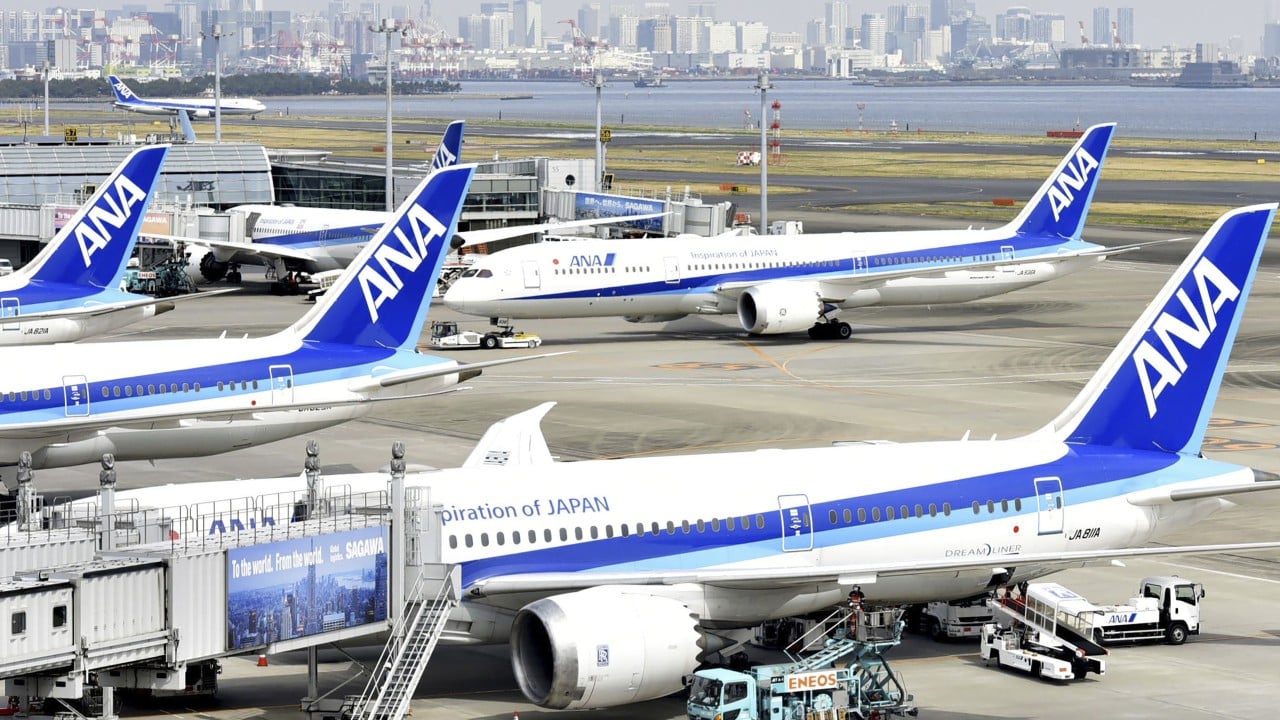
Modern high-density air traffic management operates on an assumption of zero tolerance for systemic convergence errors, yet high-volume hubs like Tokyo Haneda continue to experience critical geometry failures. When All Nippon Airways Flight 968, a Boeing 767 arriving from Shanghai, converged with a Japan Civil Aviation Bureau calibration jet on final approach, the incident exposed the limits of procedural separation in congested airspace. Deconstructing this event requires moving past superficial accounts of pilot reactions and examining the structural mechanics of intersecting flight paths, automated collision avoidance thresholds, and human-in-the-loop control limits.
The Structural Anatomy of Intersecting Departure and Arrival Vectors
Haneda Airport manages high throughput by utilizing intersecting runway configurations depending on wind vectors. During north wind operations, departures from Runway 05 and arrivals to Runway 34R create intersecting spatial vectors by design. This architecture places the burden of safety entirely on air traffic control sequencing and tactical pilot visibility.
The mechanics of the near miss involved two distinct performance profiles:
- The Arrival Vector: A heavy commercial widebody descending on an instrument landing system path, locked into a stabilized descent rate and configuration.
- The Calibration Vector: A lighter business jet executing an ascending right turn immediately after departure to evaluate navigation aids.
When these two vectors cross at low altitudes, the time window for error correction compresses exponentially. The system relies on precise temporal spacing. If a departure experiences a slight climb-rate variance or an arrival compresses its descent timeline, the buffer zone evaporates. The structural flaw in this model is its reliance on continuous, uninterrupted verbal coordination and visual acquisition in airspace segments where workload is already at maximum capacity.
The Failure Mode of Automated Defenses at Low Altitudes
Public discourse frequently treats cockpit automation as a fail-safe barrier, yet avionics systems possess hard operational boundaries built into their logic. The Traffic Collision Avoidance System onboard the commercial airliner functioned as designed by issuing a Resolution Advisory, forcing an immediate go-around. However, the physics of low-altitude airspace limit the utility of these automated alerts.
Below specific altitude thresholds above ground level, Traffic Collision Avoidance Systems intentionally alter their advisory logic. Descending close to the terrain restricts the system from commanding abrupt descents, as doing so introduces a high probability of controlled flight into terrain. Consequently, the burden shifts entirely to vertical climbs or horizontal maneuvers executed manually by flight crews.
Furthermore, the calibration aircraft did not receive a corresponding avoidance instruction from the automated architecture in the same timeframe due to operational parameters governing low-level flight inspections. This asymmetry in tactical advisories creates a dangerous information gap. One crew executes an aggressive evasive climb while the other maintains its assigned trajectory under visual or basic instrument rules, assuming standard separation vectors remain intact.
The Human-in-the-Loop Bottleneck in High-Density Sequencing
Air traffic control audio recordings from the Haneda approach position reveal the immediate operational strain placed on controllers when spatial buffers collapse. The cognitive load of managing mixed traffic—comprising scheduled commercial heavy jets, regional turboprops, and specialized government calibration flights—exceeds standard cognitive thresholds during peak operational banks.
Human controllers manage traffic density through predictive mental modeling. They project aircraft speed, weight, configuration, and environmental variables into future spatial coordinates. When an inspection aircraft executes non-standard profiles required for calibration work, it introduces a variable that standard sequencing algorithms struggle to normalize.
The cascading effect on the commercial flight crew compounds this bottleneck. Following the initial automated avoidance maneuver, the flight deck was forced to execute a go-around, re-enter the queue, and manage fuel and thrust parameters in rapid succession. The subsequent decision by the pilots to execute a second go-around due to an unstable approach profile demonstrates operational discipline, but it also highlights how a single geometric conflict destabilizes downstream terminal operations for extended periods.
Systemic Vulnerabilities and Strategic Adjustments
Airports operating near capacity cannot eliminate intersecting runways without sacrificing commercial throughput, meaning tactical risk mitigation must replace structural redesign. High-density hubs must decouple calibration and non-routine flight inspections from peak commercial arrival and departure banks. Restricting government and maintenance flights to designated off-peak temporal windows removes anomalous performance profiles from high-stress sequencing blocks.
Additionally, the integration of advanced surface and air surveillance automation must move beyond basic radar tracking to predictive conflict resolution tools that alert controllers seconds before procedural buffers are breached. Relying on cockpit-activated avoidance advisories after aircraft have already entered the critical proximity zone is a reactive containment strategy, not a preventive architecture. Eliminating future convergence events requires shifting the safety margin upstream from automated cockpit alarms to predictive, automated ground-side trajectory enforcement.