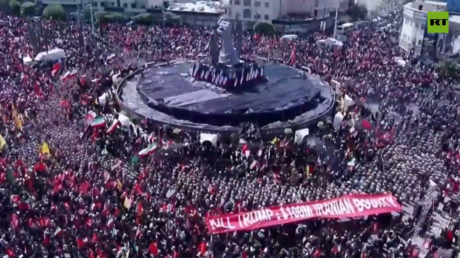
The visual emergence of state-sanctioned threats targeting a foreign head of state during a high-profile state funeral cannot be understood simply as an emotional outburst of public grief. The multi-day funeral procession for Iran’s late Supreme Leader, Ayatollah Ali Khamenei, featured highly coordinated imagery, including banners reading "Kill Trump" and explicit reward offers. In parallel, the United States executive branch issued public statements regarding its capacity to neutralize the gathered Iranian leadership. Rather than signaling an immediate, uncontainable slide into kinetic warfare, this public exchange operates under a precise logic of asymmetric deterrence and escalation management.
Evaluating these events requires moving past sensationalized reporting to examine the underlying structural mechanisms. The intersection of public domestic consolidation and highly deliberate international brinkmanship forms a framework where explicit threats serve as calculated instruments of negotiation.
The Dual-Track Framework of State Rhetoric
State behavior during periods of high geopolitical instability functions across two distinct tracks: internal domestic stabilization and external diplomatic signaling. When these tracks intersect during a major political transition, such as the succession following the death of a supreme leader, the rhetoric becomes amplified to fulfill conflicting objectives.
       [State Rhetoric Strategy]
             /           \
            /             \
[Track 1: Domestic]     [Track 2: External]
 - Ideological Continuity - Asymmetric Deterrence
 - Regime Legitimacy      - Cost Imposition
 - Public Mobilization    - Coercive Bargaining
Track 1: Domestic Mass Mobilization and Legitimacy Consolidation
For the Islamic Republic, a state funeral for a supreme leader is a critical infrastructure point for regime continuity. The mass mobilization of the public along a 10-kilometer route in Tehran serves to project domestic strength during an exceptionally vulnerable transition period, particularly while the newly appointed Supreme Leader, Ayatollah Mojtaba Khamenei, remains out of public view due to security threats.
In this context, the deployment of aggressive anti-American imagery and explicit calls for retribution—such as eulogist Mohammad Rasouli’s public declarations that executing an assassination is a state "duty"—acts as an ideological adhesive. It bridges the theological narrative of martyrdom with the immediate political necessity of state survival. The state media’s emphasis on the scale of the gathering, framing it as the largest public assembly in modern Iranian history, is an operational metric designed to demonstrate domestic cohesion to adversarial intelligence networks.
Track 2: Asymmetric Deterrence and Coercive Bargaining
On the external track, the permission and promotion of explicit threats against President Donald Trump and Israeli Prime Minister Benjamin Netanyahu serve a specific defensive purpose: cost imposition. Having experienced devastating airstrikes that penetrated senior leadership circles, Tehran utilizes the threat of grey-zone retaliation to establish a floor for ongoing negotiations. By embedding threats into the official fabric of the state funeral, Iran communicates a willingness to pursue asymmetric, non-conventional retaliatory options if its core security boundaries are breached during the transition.
The Cost Function of Decapitation Strikes
The response from Washington highlights the mathematical and strategic calculus governing modern decapitation strategies. In an interview with Axios, President Trump noted that while the concentrated congregation of Iranian leadership presented a tactical opportunity for liquidation via "one shot," execution was withheld because it would leave Washington with "nobody to negotiate with."
This rationale demonstrates a sophisticated understanding of the structural limits of targeting adversary leadership, which can be modeled through three operational variables.
The Problem of Void Architecture
In highly institutionalized ideological states, the elimination of top-tier leadership rarely triggers systemic collapse. Instead, it activates established succession protocols or shifts power toward more radical, less predictable factions. The sudden removal of an entire ruling cadre creates an authority vacuum that destroys the structural mechanisms required to enforce treaties, enforce ceasefires, or govern territory.
The Preservation of Negotiating Nodes
Diplomatic resolution requires a counterparty capable of command and control. If a state successfully liquidates the entire political and military command of an adversary, it simultaneously destroys the signaling mechanism required to end the conflict. A decapitated state degrades into a decentralized network of autonomous actors, shifting the conflict from a manageable state-to-state framework to an unmanageable, protracted counterinsurgency against disparate militias.
The Threshold of Total War
Executing a strike on a state funeral complex transforms a contained conflict into a war of existential survival for the target nation. When an adversary perceives that its total destruction is actively sought, its defensive calculus changes:
$$\text{Retaliatory Threshold} = \text{Utility of Survival} - \text{Cost of Total Escalation}$$
When the utility of survival approaches zero due to relentless leadership targeting, the adversary is incentivized to deploy all remaining strategic assets—including regional proxy networks, anti-ship ballistic missiles in vital transit corridors, and cyber warfare capabilities—without regard for long-term survival.
Geopolitical Friction Points
The volatile equilibrium between Washington and Tehran is restricted by concrete bottlenecks that limit the strategic options available to both administrations.
The primary bottleneck is the ongoing requirement for a permanent diplomatic resolution to recent kinetic conflicts. Both nations are operating under intense economic and logistical pressures. Iran faces severe structural challenges compounded by the costs of recent warfare, while the United States is balancing broader global power dynamics alongside a domestic mandate to prevent prolonged military entanglements in the Middle East.
This creates an environment of high friction:
- Communication Gaps: The reliance on indirect diplomatic channels slows down response times, increasing the probability that tactical posturing will be misread as an imminent offensive action.
- The Commitment Trap: When leaders employ highly visible, aggressive rhetoric to satisfy domestic constituencies, they narrow their own room for diplomatic maneuver. A leader who publicly promises total retribution faces severe domestic political costs if they ultimately accept a compromise deal.
- Proxy Autonomy: While Tehran maintains deep logistical and ideological ties with regional partners, these groups possess their own local incentives. A localized tactical decision by a proxy commander can instantly bypass the carefully managed escalation caps established between the primary state actors.
Managing the Escalation Equilibrium
Despite the highly visible threats and aggressive posturing in Tehran, the underlying mechanics indicate that both states are actively trying to manage a fragile escalation equilibrium. The public display of threats satisfies the ideological imperatives of domestic mobilization, while the calculated restraint exercised by Washington preserves the structural framework required for back-channel diplomacy.
The critical operational variable over the coming weeks will be whether the newly established Iranian leadership can successfully project internal stability without triggering an inadvertent escalatory response from foreign adversaries. Strategic stability will depend entirely on both sides maintaining functional negotiating nodes, ensuring that theatrical political posturing does not compromise the institutional channels required to secure a durable diplomatic framework.
The Anatomy of Geopolitical Deterrence
This video provides direct, on-the-ground visual context of the funeral procession in Tehran, illustrating how state-sanctioned imagery and public demonstrations are operationalized for domestic mobilization and international signaling.


