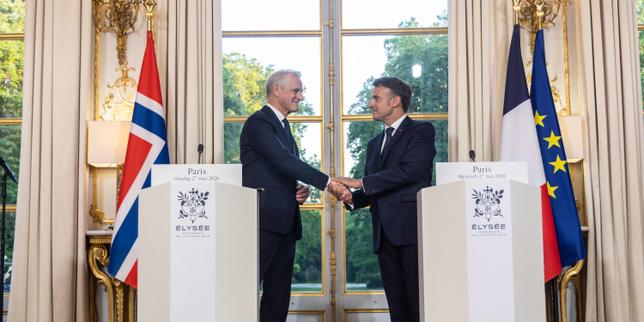
The bilateral defense pact formalized between French President Emmanuel Macron and Norwegian Prime Minister Jonas Gahr Støre establishes a foundational shift in European security architecture. Norway's integration into France’s "forward deterrence" (dissuasion avancée) framework represents far more than a diplomatic gesture. It is a calculated structural adaptation to the systemic degradation of traditional transatlantic security guarantees and the aggressive nuclear rearmament of the Russian Federation in the Arctic and High North.
By analyzing this integration through the lens of strategic calculus, operational mechanics, and geopolitical friction points, we can map the true strategic utility of this alignment. The agreement alters the regional balance of power not by sharing nuclear warheads, but by creating an asymmetric, highly distributed operational network designed to complicate adversarial targeting and fortify Europe’s northern flank. Don't miss our previous post on this related article.
The Tripartite Framework of Forward Deterrence
To understand the mechanics of this pact, the concept of forward deterrence must be broken down into its three constituent pillars. France maintains a doctrine of strict sovereignty over its nuclear arsenal, which currently sits at approximately 290 warheads. The initiative does not establish a dual-key sharing mechanism analogous to NATO’s nuclear sharing program (where US B61 gravity bombs are hosted by non-nuclear allies). Instead, it functions as a modular, interoperable framework governed by distinct operational layers.
Pillar 1: The Archipelago of Forces and Temporal Dispersal
The primary operational mechanism of forward deterrence is the temporary dispersal of elements of the French Strategic Air Forces (Forces Aériennes Stratégiques or FAS) to allied territory during periods of heightened strategic crisis. For Norway, this involves optimizing select military infrastructure to temporarily host French Rafale B fighters equipped with the ASMPA-R (Air-Sol Moyenne Portée Amélioré-Rénové) nuclear-tipped supersonic cruise missiles. If you want more about the history of this, The Guardian provides an informative summary.
This creates a highly fluid geographic distribution of nuclear delivery platforms. By transitioning from centralized domestic basing (such as Istres or Saint-Dizier in France) to temporary, unpredictable deployments across northern Europe, the alliance creates a shifting target matrix. This complicates an adversary’s first-strike mathematics and enhances the pre-launch survivability of the European airborne deterrent.
Pillar 2: Asymmetric Burden Sharing
The integration model relies on a clear differentiation of labor. France provides the strategic nuclear asset and retains absolute, uncompromised sovereign command over its release authority. In return, incoming partners like Norway provide conventional enablement. This cost function is distributed across specific domains:
- Early Warning and Space Capabilities: Utilizing Norway’s advanced Arctic surveillance infrastructure and satellite tracking assets to feeding telemetry into the shared intelligence loop.
- Integrated Air and Missile Defense (IAMD): Deploying Norwegian NASAMS and potentially higher-tier air defense assets to insulate dispersal airfields from preemptive conventional or hypersonic strikes.
- Conventional Escort and Deep Strike: Providing Norwegian F-35A Lightning II aircraft to fly conventional combat air patrols (CAP) and electronic warfare missions to clear corridors for French nuclear-capable delivery platforms.
Pillar 3: Institutionalized Mutual Assistance
The pact formalizes regularized military dialogues, joint strategic exercises, and the pre-positioning of specialized ground support equipment. This structural preparation ensures that a political decision to execute a "forward deployment" can be translated into operational reality within hours, bypassing bureaucratic friction during a fast-evolving crisis.
The Strategic Value of the Norwegian Geography
Norway’s inclusion as the ninth nation in this program—joining Belgium, Denmark, Germany, Greece, the Netherlands, Poland, Sweden, and the United Kingdom—is dictated by geographical imperatives. The strategic geography of the High North introduces a critical variable into France's deterrence equation.
[Adversary Northern Fleet / Kola Peninsula]
       │ (Subsurface / Strategic Transit)
       ▼
[Barents Sea / GIUK Gap] ◄─── [Norwegian Surveillance & Deep Strike]
       ▲
       │ (Temporal Dispersal Layer)
[French Forward Deterrence: Air Base Infrastructure]
The Kola Peninsula, directly adjacent to Norway’s northeastern border, acts as the densest concentration of strategic military power for the Russian Federation, housing its Northern Fleet and ballistic missile submarines (SSBNs). Control over the Greenland-Iceland-United Kingdom (GIUK) gap and the Barents Sea is paramount for both Russian power projection and Western defensive reinforcement.
By integrating Norway into the French nuclear ecosystem, the alliance inserts a localized strategic complications matrix directly adjacent to Russia’s strategic bastions. While Norway’s long-standing domestic policy explicitly prohibits the permanent basing of nuclear weapons or foreign bases on its soil during peacetime, the forward deterrence framework circumvents this political constraint. It establishes the infrastructure, technical training, and technical compatibility required for wartime or crisis-driven elasticity without violating peacetime legislative red lines.
Systemic Vulnerabilities and Strategic Friction Points
No robust analytical model can ignore the inherent limitations and vulnerabilities embedded within this defense posture. The forward deterrence architecture introduces several structural bottlenecks and risks that participating nations must actively manage.
The Infrastructural Capital Bottleneck
Operating nuclear-capable aircraft, even temporarily, demands severe security protocols and technical infrastructure. Dispersed operating bases in Norway must feature hardened aircraft shelters, highly secure specialized communications networks, and specialized storage or handling areas for conventional support systems. The capital expenditure required to upgrade Norwegian airfields to meet these exact French operational standards will compete directly with existing procurement priorities, such as expanding conventional artillery reserves or anti-submarine warfare (ASW) inventories.
Escalation Control and Signaling Ambiguity
The core strength of the French doctrine—deliberate ambiguity regarding what constitutes its "vital interests"—becomes a liability when translated into a multilateral forward posture. If a French Rafale B carrying an ASMPA-R missile deploys to an airfield in Northern Norway during an active border crisis, an adversary face an information vacuum: Is this a conventional signaling exercise, or a pre-delegated nuclear posture?
This ambiguity can compress an adversary's decision-making timeline, potentially triggering a preemptive conventional strike on Norwegian soil under the mistaken assumption that a nuclear launch is imminent. The risk of inadvertent escalation via miscalculation increases significantly when nuclear delivery platforms are integrated alongside conventional assets in a contiguous theater of operations.
Domestic Political Durability
The longevity of France’s extended deterrence architecture faces a hard political ceiling tied to electoral cycles. French President Emmanuel Macron’s term limit expires in 2027. Prominent domestic opposition factions, most notably the far-right Rassemblement National, have historically critiqued any perceived Europeanization or geographic dispersal of the French nuclear mission, viewing it as a dilution of national sovereignty. Norway and other European partners are investing strategic capital into a framework whose foundational political support in Paris could be structurally realigned or curtailed by a subsequent French administration.
Tactical Execution Plan for Regional Integration
To maximize the defensive utility of this pact while mitigating its systemic vulnerabilities, the defense establishments of Paris and Oslo must execute a highly sequential integration blueprint over the next twenty-four months.
Harmonize the Air Defense Umbrella: Norway must prioritize the acquisition and positioning of long-range air defense capabilities specifically dedicated to protecting the designated Dispersed Operating Bases. These bases cannot rely on generic national air defense coverage; they require dedicated, localized close-in weapon systems and anti-missile batteries to guarantee survivability against low-altitude cruise missiles and hypersonic weapons.
Conduct "Cold-Start" Dispersal Exercises: The French Air and Space Force and the Royal Norwegian Air Force must execute unannounced, low-notice dispersal exercises. These drills should involve flying Rafale B assets from French bases directly into Norwegian northern installations, executing rapid refueling and re-arming procedures using pre-positioned Norwegian ground crews, and returning to operational holding patterns without permanent housing. This tests the logistical velocity of the "Archipelago of Forces" concept under realistic operational stress.
Establish a Dedicated Franco-Nordic Strategic Coordination Cell: While avoiding any dilution of France's ultimate nuclear command, a permanent trilateral liaison framework involving France, Norway, and Sweden must be embedded within the tactical intelligence loop. Given the geographic contiguity of the Scandinavian peninsula, any airspace utilization or temporal dispersal by French strategic assets requires real-time deconfliction and electronic warfare synchronization across both Oslo and Stockholm. This cell will focus heavily on mapping out the specific parameters of "conventional enablement," ensuring that Allied F-35s can execute seamless escort profiles for French strike groups under any electronic degradation scenario.