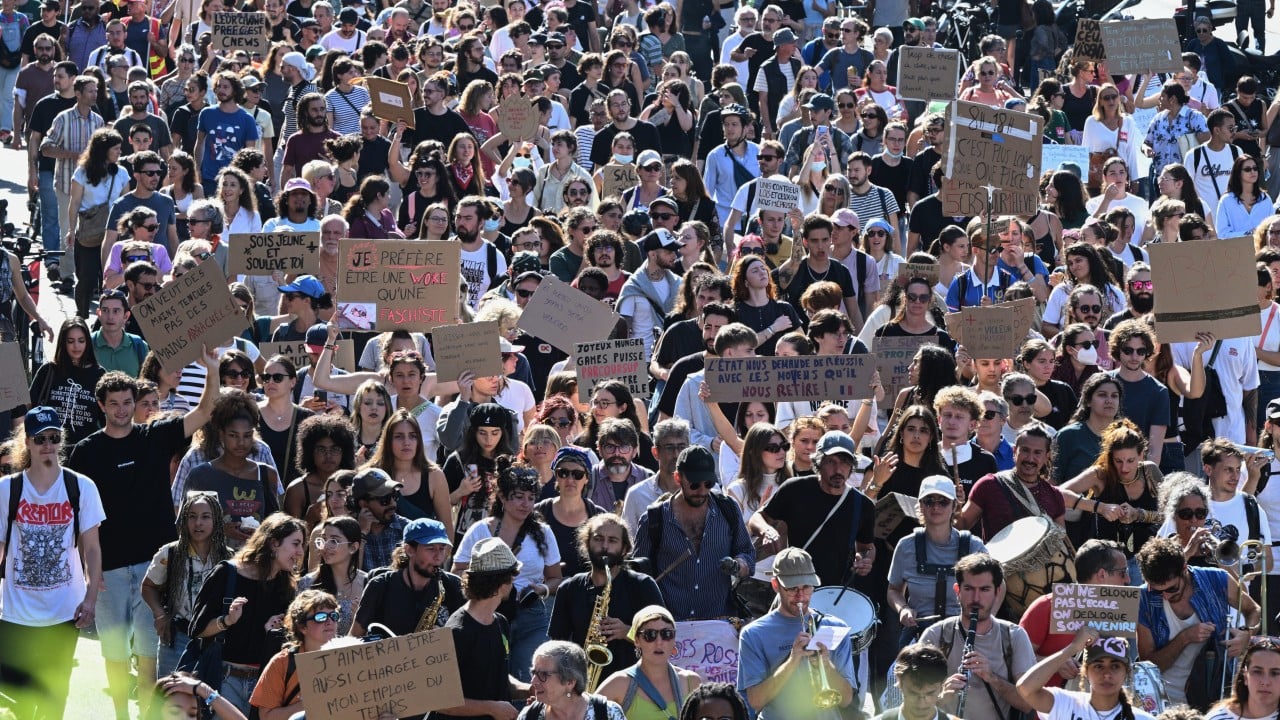
The contemporary French public education crisis is not merely a localized dispute over budgets; it is a systemic failure of state resource allocation colliding with rigid bureaucratic inertia. When high school students and educators blockade facilities across urban peripheries, they are exposing a deep structural friction between centralized educational mandates and the operational reality of crumbling infrastructure. To understand the mechanics of this mobilization, one must deconstruct the tripartite cost function driving the unrest: infrastructural decay, administrative overload, and the compounding velocity of decentralized digital coordination.
The initial vector of the crisis centers on chronic underfunding of facilities located outside core metropolitan centers. The physical plant of the French public secondary school network suffers from decades of deferred maintenance. Data regarding capital improvements indicate that fewer than fifteen percent of public school buildings have undergone major structural renovations within the last decade. This creates an operational bottleneck where student density outpaces spatial capacity, yielding overcrowded classrooms, broken sanitary infrastructure, and severe deficits in basic operational provisions. When infrastructure degrades past a specific threshold, the transaction cost of attending school—measured in compromised hygiene, physical discomfort, and psychological fatigue—begins to outweigh the perceived institutional value of attendance.
Compounding this physical decay is an acute human capital shortage. The Ministry of National Education operates under a centralized staffing model that struggles to maintain adequate educator-to-student ratios, particularly in high-density suburban districts such as Seine-Saint-Denis. Chronic vacancies in teaching posts, combined with shortages of administrative assistants, school nurses, and specialized social workers, generate an operational deficit. Teachers face an escalating workload without commensurate compensation adjustments, while students navigate fragmented schedules featuring prolonged midday gaps that stretch the operational school day late into the evening. This creates a high-friction environment where instructional quality degrades systematically.
The rapid escalation of these localized grievances into a national mobilization relies on modern communication vectors. Unlike historical student movements that required months of formal union mobilization to gain traction, the current wave leverages decentralized social media networks to produce rapid copycat blockades. Digital coordination allows peripheral institutions—traditionally isolated from national political discourse—to synchronize actions simultaneously. Wheelie bins, barricades, and symbolic occupations transform physical school gates into nodes of political leverage, circumventing traditional bureaucratic channels and forcing executive intervention.
The economic and political fallout extends beyond the school gates, entangling broader labor dynamics. Public sector unions, facing identical cost-of-living pressures and wage stagnation, have capitalized on student momentum to launch synchronized general strikes. This convergence creates a multi-front political challenge for the executive branch. As public transport workers, healthcare personnel, and educators align their demands, the state faces a consolidated challenge to its fiscal priorities. The financial calculus required to satisfy these overlapping demands involves substantial capital injection into public services, a move that directly conflicts with broader macroeconomic deficit-reduction targets.
Government responses have thus far followed a predictable containment cycle. Initial phases rely on defensive security measures and administrative deflection, followed by piecemeal concessions. Proposals to cap specific class sizes, distribute regional maintenance loans, or reform university admissions platforms like Parcoursup are consistently evaluated by student unions and educators as reactive band-aids rather than foundational overhauls. Because these concessions fail to alter the underlying resource scarcity, they trigger renewed cycles of mobilization. Each deadlock hardens the opposition, shifting the movement from tactical bargaining toward long-term institutional distrust.
The systemic risk of this prolonged stalemate is the acceleration of political polarization. As institutional channels fail to deliver immediate operational relief, the ideological extremes on both the left and the right weaponize the resulting social friction. The structural impasse trains a new generation of citizens to view direct confrontation as the sole mechanism for policy change, permanently altering the stability of civil-state relations in public administration.
To stabilize the public education network, the state must abandon short-term containment strategies and execute a multi-year capital expenditure program focused on decentralized facility management, autonomous school-level hiring flexibility, and a transparent audit of structural maintenance deficits. Without a verifiable shift in resource allocation, periodic mobilization will remain a structural feature of the French institutional landscape.