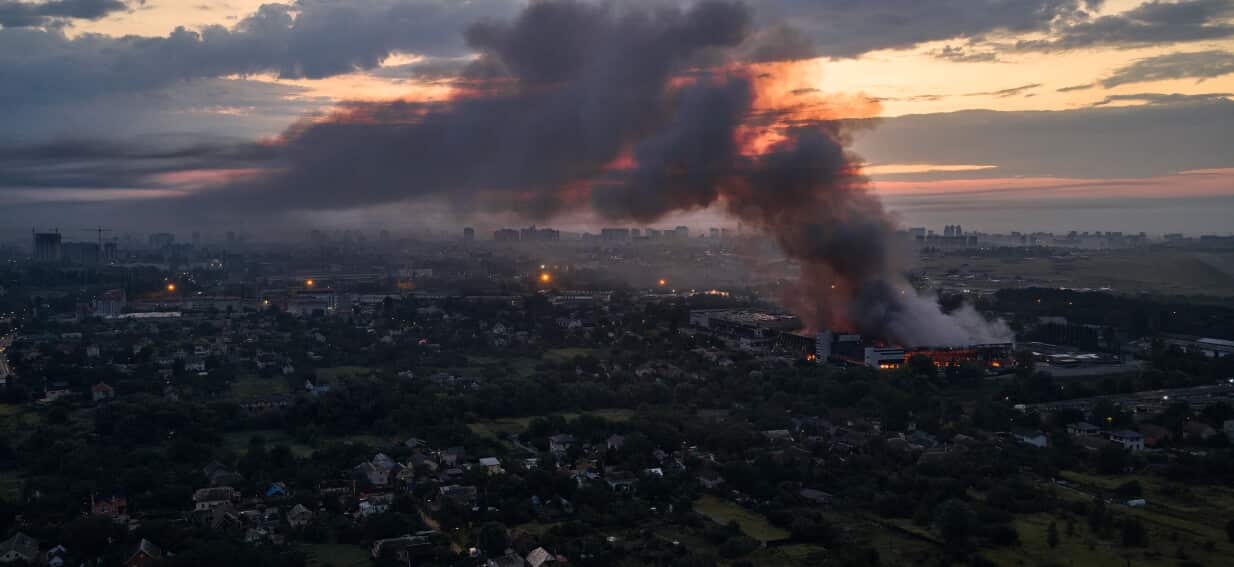
Seventeen dead. Dozens wounded. Another barrage of Russian ballistic and cruise missiles tearing through civilian infrastructure while Ukrainian officials issue yet another urgent plea for air defense interceptors. The core reality driving this headline is a brutal math problem of exhaustion, attrition, and supply chain bottlenecks that Western capitals have spent years mismanaging. When a sovereign nation begs for more Patriot batteries, NASAMS, or compatible munitions after a mass casualty strike, they are not just reacting to the latest tragedy. They are attempting to hold back an accelerating structural collapse of their defensive shield.
Having tracked military procurement and defense economics for over twenty years, the pattern here is painfully familiar. Initial shock leads to rhetorical support, followed by agonizingly slow bureaucratic delivery, capped by a realization that Western defense industrial capacity was never built for a protracted conventional war against a peer adversary.
The Arithmetic of Exhaustion
Air defense is fundamentally a game of asymmetric economics. Ukraine faces a barrage utilizing cheap, mass-produced loitering munitions alongside sophisticated hypersonic and ballistic missiles. Every time a Russian Kinzhal or S-300 missile arcs toward a Ukrainian city, defenders must calculate whether to expend a scarce, multi-million-dollar interceptor.
The defense equation is simple yet brutal.
- Cost disparity: Interceptors cost exponentially more than the incoming threat vectors.
- Production velocity: Western missile manufacturing lines operate on peacetime schedules.
- Inventory depletion: Stockpiles in NATO arsenals have dipped below safe strategic thresholds.
When leaders in Kyiv plead for interceptors following a major strike, they are staring down an empty ledger. The factories producing these missiles cannot simply scale up overnight. Specialized guidance systems, solid rocket propellants, and microprocessors require supply chains that take years to expand. Every Patriot PAC-3 fired to protect a thermal power plant or a residential district leaves a strategic gap somewhere else.
The Strategic Miscalculation of Gradualism
Washington and Brussels chose a policy of calibrated escalation. The underlying theory was simple: provide enough military aid to prevent total collapse, but meter it out slowly enough to avoid crossing imaginary red lines set by Moscow. That philosophy has created a logistics nightmare.
By feeding weapons systems into Ukraine piecemeal, allies ensured that maintenance networks became a patchwork quilt of incompatible parts. A single battery might require components from five different European nations, none of which use standard logistics protocols.
Instead of treating air defense as an integrated national grid from day one, allies treated it as an emergency triage unit. Triage saves lives on the operating table, but it does nothing to stop the artillery shells from falling in the first place. The seventeen dead in the latest strike are casualties of a political hesitation that prioritized political comfort over decisive industrial mobilization.
Why Interceptor Replenishment Stalls
The bottleneck is not merely financial. Western defense budgets are bloated, yet they suffer from structural sclerosis. Legacy defense contractors function like monopolistic utilities rather than agile wartime innovators.
When a contract for new interceptors is signed today, delivery schedules routinely stretch into late 2027 or 2028. Modern air defense missiles are hand-assembled marvels of engineering. They rely on rare earth minerals, ultra-precise radar homing heads, and titanium airframes.
China controls significant portions of the critical mineral processing pipeline. Any friction in those supply chains ripples straight down to the assembly floors in Texas or Munich. When politicians announce a billion-dollar aid package containing air defense missiles, the public envisions crates arriving at the front lines within weeks. The reality is vastly different. Those missiles often exist only as raw materials sitting in a warehouse waiting for a clearance stamp.
The Shift Toward Domestic Innovation
Recognizing that international supply chains are buckling under the strain, Ukraine has been forced to accelerate its own asymmetric solutions. Domestic defense tech startups are scrambling to build lower-tier interceptor drones—inexpensive, agile platforms designed to ram or net slow-moving cruise missiles and Shahed drones before they reach populated areas.
It is an impressive display of ingenuity born out of existential dread. Yet, these improvised drone interceptors cannot stop a ballistic missile plunging downward at Mach 5. For ballistic threats, there is no substitute for high-end kinetic intercept systems.
The Cost of Inaction
As fatigue sets in across Western electorates, the political appetite for sustained military funding is fraying. Opponents of aid point to high inflation and domestic budget deficits, arguing that endless resource allocation yields diminishing returns.
That argument ignores the strategic alternative. If Ukraine's air defense grid completely collapses, the humanitarian catastrophe will dwarf anything seen so far. Millions more refugees will flood across European borders. The energy grid will face total annihilation, rendering entire regions uninhabitable during freezing winters.
The seventeen dead are not an isolated tragedy. They are a preview of what happens when advanced industrial nations fail to align their economic might with their stated geopolitical commitments. Interceptors are not charity handouts. They are the frontline security barrier of the democratic world, purchased with Ukrainian blood while the rest of the world debates delivery timelines.
The missiles will eventually run out if the industrial base does not wake up. History will not judge kindly the nations that had the factories, the blueprints, and the capital, but lacked the urgency to press the start button.