You trip over a rug that has sat in the exact same spot for five years. You stumble while putting on your socks. You catch yourself leaning against the kitchen counter just to tie your shoes.
Most people blame clumsiness. They shrug it off as a bad morning or fatigue. It is rarely clumsiness. It is silent balance decay. You might also find this similar story useful: Inside the DRC Ebola Crisis Where the Response Is Still Losing Ground.
Physical decline starts in the nervous system and the inner ear long before you feel old. Doctors at Mayo Clinic note that proprioception—your body's awareness of its position in space—begins a slow, steady downward drift around age forty if you do not actively maintain it. Gym culture obsesses over bench press numbers and VO2 max, completely ignoring the single physical trait that determines whether you live independently at eighty.
You do not need a stability ball, a BOSU trainer, or a gym membership to reverse this. You need the kitchen floor, five minutes, and a willingness to look slightly ungraceful while your stabilizer muscles wake up. As extensively documented in detailed reports by WebMD, the effects are notable.
The Proprioceptive Wake Up Call
Stand on one foot right now. Do not look away from your screen. Just lift your right foot two inches off the floor.
Did you wobble? Did your ankle twitch violently? Did you have to grab the nearest chair?
If you struggled past ten seconds, your neuromuscular communication lines are rusty. Balance is not a single muscle group. It is a rapid-fire coordination drill between your eyes, your inner ear vestibular system, and the proprioceptors embedded in your joints and tendons. When one of these systems goes quiet, the other two panic.
Most adults live in a cushioned, paved bubble. We walk on flat concrete, sit in ergonomic chairs, and wear supportive shoes with thick rubber soles. Our feet never have to feel the ground. Because the small muscles in our feet and ankles never have to adapt to uneven terrain, they atrophy.
Fixing this requires zero equipment. You just have to stop letting modern infrastructure do your stabilization work for you.
Single Leg Stands Without the Safety Net
The foundation of any home balance routine starts with the single-leg stance, but you are probably doing it wrong.
People stand on one leg while staring straight ahead at a fixed point on the wall, holding a yoga pose. That is fine for stretching, but real life is dynamic. Real life involves turning your head, reaching for a mug, or stepping around a dog.
Here is how you actually build functional stability.
Stand barefoot near a kitchen counter or sturdy chair just in case. Lift one foot. Now, instead of staring blankly at the wall, slowly turn your head from left to right. Then tilt your chin up and down.
Watch what happens to your ankle. It will fire off micro-adjustments like a malfunctioning laser printer. That frantic twitching is neuroplasticity in action. You are forcing your brain to process spatial orientation without visual anchoring.
Do this for thirty seconds per leg. If you can do it easily, close your eyes. Closing your eyes instantly removes visual input, forcing your inner ear and joint receptors to carry the entire load. You will humble yourself within three seconds.
The Heel to Toe Walk for Real World Stability
Walk across your living room right now. Watch your feet. Are they tracking in a straight line, or are they wandering wide?
We evolved navigating narrow forest paths, rocky shores, and uneven dirt trails. Modern hallways encourage wide, lazy strides. The tandem walk, or heel-to-toe walk, reactivates the lateral hip stabilizers and core engagement required to keep you upright on a crowded sidewalk or a hiking trail.
Clear a straight path down your hallway or living room rug. Place the heel of your right foot directly against the toe of your left foot. Pause. Shift your weight fully onto that front foot. Then bring your left foot forward, placing the heel directly against the right toe.
Do not rush. Speed is the enemy of stability training. If you barrel through this, your momentum does the work instead of your nervous system.
Take ten slow steps forward. Then, without turning abruptly, reverse direction and take ten steps backward. Backward tandem walking forces an entirely different cognitive load onto your brain, recruiting the posterior chain and challenging your vestibular system in ways forward motion never touches.
The Single Leg Sit to Stand
Every time you get out of an office chair, a dining chair, or a car seat, you are performing a functional squat. Most people use both legs equally, letting one leg compensate for minor imbalances or weakness on the other side.
The single-leg sit-to-stand exposes those asymmetries instantly.
Choose a sturdy dining chair. Sit near the front edge with both feet flat on the floor. Extend your right leg straight out in front of you, hovering just above the floor. Cross your arms over your chest. Using only your left leg, drive through your heel and stand all the way up.
If you fling your upper body forward with momentum to cheat your way up, you missed the point. Keep your torso upright, engage your core, and press through the floor. Once you are standing, lower yourself back down with absolute control. Do not drop into the chair like an anchor. The eccentric lowering phase is where the actual strength and balance adaptations occur.
Aim for five clean reps per leg. You will feel this in muscles you forgot existed, particularly the gluteus medius, which acts as the primary anchor keeping your pelvis level when you walk.
The Weight Shift Reach
Stability is useless if you cannot maintain it while moving outside your center of gravity. Most falls do not happen while standing still. They happen when reaching for a high shelf, stepping out of the shower, or reacting to a sudden slip.
You need to train your body to handle lateral displacement.
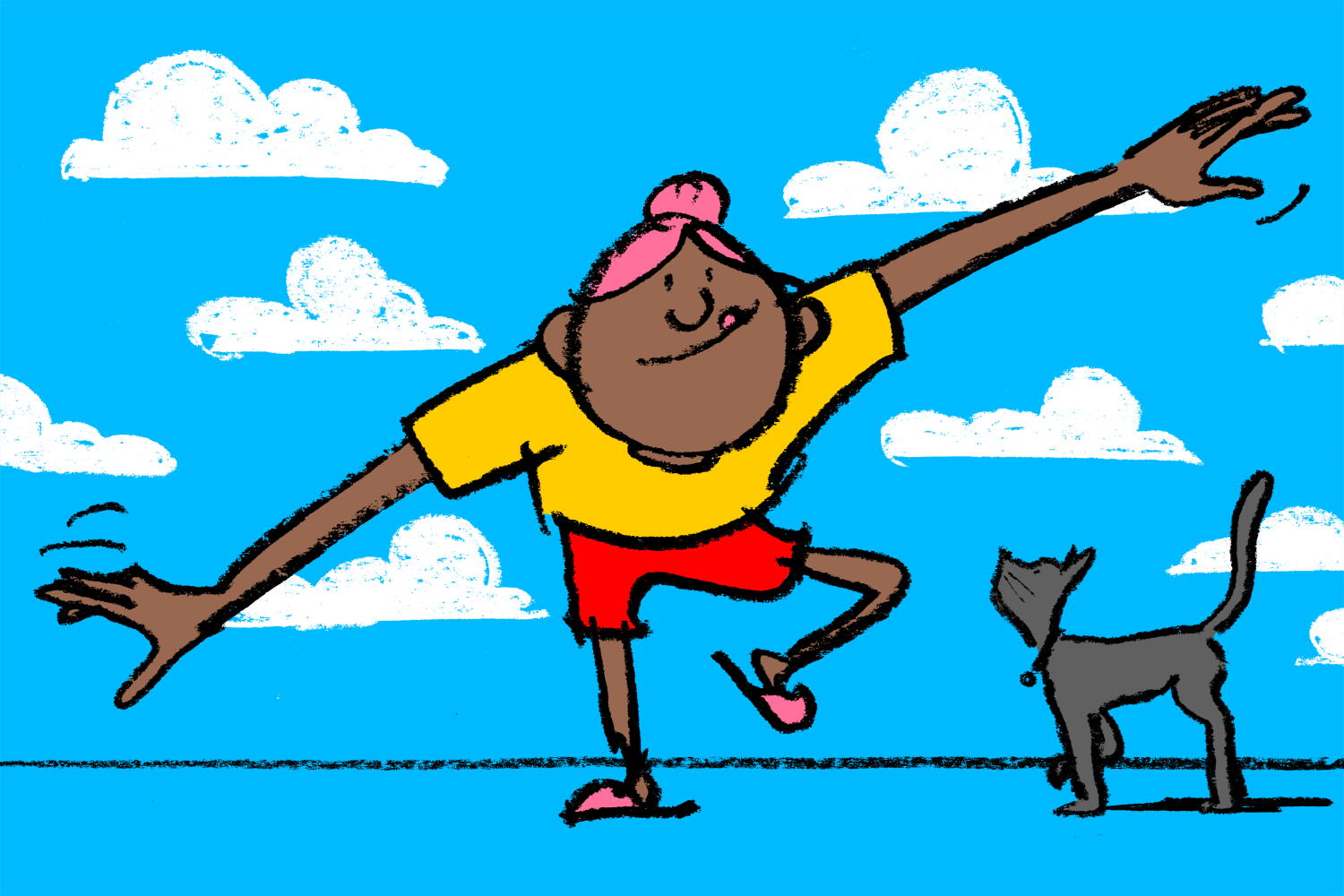
Stand with your feet hip-width apart, barefoot. Shift all your weight onto your left foot, lifting your right foot just barely off the ground. Now, reach your right arm straight out to the side, then overhead, and finally reach down toward your left ankle, all while keeping your left foot completely planted.
Your torso will want to tip over. Your left ankle will wobble. That is the point. You are teaching your nervous system how to manage a shifting center of mass without taking a panicked step to save yourself.
Perform five slow reaching sequences on the left leg, then switch to the right.
Consistency beats intensity every single time with balance training. Doing these four movements for five minutes while waiting for your morning coffee to brew will yield vastly better long-term results than a single grueling balance class once a month. Drop the shoes, clear a small patch of floor, and give your nervous system the daily challenge it is begging for.