The canvas of the backpack was entirely spotless. No scuffs on the bottom corners. No ink stains bled through the front pocket from a loose ballpoint pen. No crumpled math worksheets shoved haphazardly against the lining.
For eleven months, that backpack sat upright on a folding chair in the corner of a cramped emergency shelter room, zipped tight. Every zipper tooth aligned. Every strap pulled straight. It waited.
Inside lay a pair of brand-new sneakers smelling faintly of cardboard and rubber, their soles completely untouched by pavement. Beside them sat a box of twelve Crayola colored pencils, the sharp points still perfectly conical, unblunted by any frantic shading of autumn leaves or ocean waves.
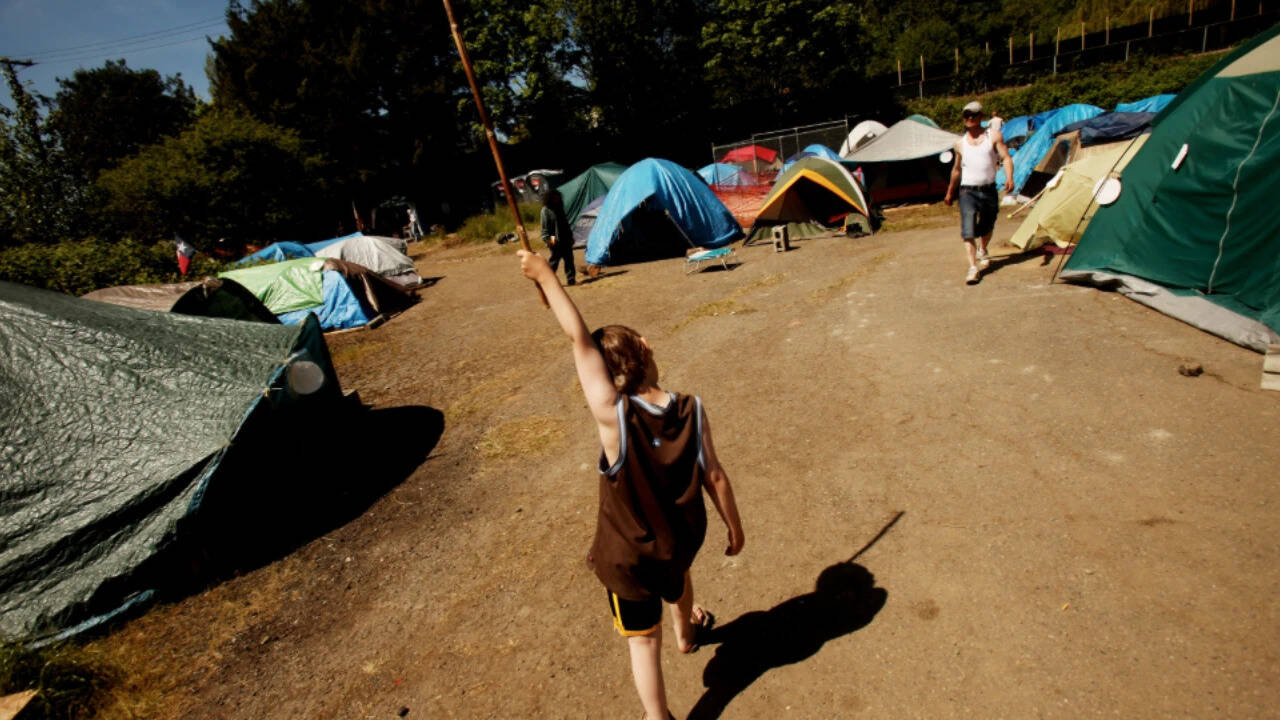
To a child living in a tent city beneath the concrete underbelly of Seattle, a school backpack is not merely a receptacle for books. It is an anchor. It is an artifact of a parallel dimension where time moves in predictable intervals of bells and homework assignments rather than the erratic, heart-stopping rhythm of municipal sweep operations and shifting weather forecasts.
We talk about homelessness in dry, administrative percentages. We measure it in point-in-time counts, housing deficits, and emergency shelter bed capacities. We treat it as an economic equation waiting for a policy adjustment. But poverty, at its human center, is an erosion of routine. It is the slow, grinding theft of ordinary tomorrows.
Consider what happens to a ten-year-old boy when his world shrinks from a classroom to a nylon dome pitched on cold asphalt.
Leo—a name we use here to represent the countless children caught in the undertow of urban housing crises—knew the sound of heavy rain hitting canvas long before he knew the sound of a morning attendance bell. He knew how to press his back against the thin nylon wall of a tent to keep the morning condensation from soaking his winter coat. He knew how to keep his voice quiet when the wind howled, because in a camp of fifty other displaced families, noise was a luxury no one could afford.
For eleven months, the rescue effort was a slow-motion war fought by outreach workers, social advocates, and case managers whose desks were buried beneath stacks of housing vouchers and expired waitlists. Eleven months of broken promises from landlords, lost paperwork, dropped phone calls from disconnected prepaid cellular lines, and bureaucratic dead ends. Eleven months of living in the shadow of a city defined by tech booms and soaring glass towers, where a ten-year-old child could remain entirely invisible to the rush-hour commuters driving past his temporary home every single morning.
We often wonder how a child falls through the cracks. The truth is much worse. They do not fall. They are placed there, gently and systematically, by a system that requires a permanent address to secure an education, and an education to secure a future, locking families into a cruel architectural paradox.
You cannot enroll without proof of residence. You cannot find residence without stability. You cannot find stability without a roof.
For nearly a year, Leo's mother fought this math. She carried his birth certificate in a Ziploc bag inside her coat pocket to keep it from the dampness of the tent floor. She guarded that plastic bag like a sacred text. When outreach workers finally broke through the housing backlog—securing a subsidized transitional apartment on the edge of the city—the victory did not arrive with a fanfare of trumpets. It arrived in the heavy, quiet thud of cardboard boxes hitting a linoleum floor.
The first night in the apartment, Leo did not sleep in the bed. He lay awake on the bare floorboards, staring up at a ceiling that did not sway when the wind blew. He listened for the familiar rustle of nylon outside his ear. There was only silence. A deep, heavy, unfamiliar silence that felt almost dangerous in its permanence.
Morning arrived with pale gray light filtering through vertical blinds instead of translucent tent walls.
That was the morning the backpack came off the chair.
Leo unzipped the main compartment. The smell of new rubber and crisp paper drifted out into the small, sunlit room. He pulled out the sneakers. They fit snugly, his toes pressing right to the edge. He laced them up, double-knotting the bows with fierce concentration, as if a loose string might cause the entire room to dissolve back into canvas and gravel.
Walking to school that day required crossing four busy arterial streets. The urban morning hummed with diesel engines, coffee shop chatter, and the impatient rush of people late for work. To anyone passing by, Leo looked like any other kid heading to class. A blue hoodie. Jeans that were slightly too short at the ankle. A clean backpack slung over both shoulders.
No one looked twice. No one saw the eleven-month ghost walking beside him. No one knew that every step he took on the concrete sidewalk was the first time in nearly a year his feet had touched ground that wasn't temporary.
When the school doors loomed ahead—brick and mortar, tall wooden frames, the faint smell of floor wax and cafeteria oatmeal drifting through the open entrance—Leo stopped. His mother knelt on the concrete, smoothing down the collar of his hoodie with hands that still trembled from the memory of the cold.
She did not give a long speech. There was no grand philosophical takeaway about resilience or overcoming adversity. She simply reached out, adjusted the right strap of his backpack so it hung evenly, and whispered a single instruction.
Go inside.
He turned, walked up the three concrete steps, and pulled the heavy glass door open. The interior swallowed him whole, the warmth of the hallway closing around him like a long-overdue embrace.
The door clicked shut. The street noise faded. And somewhere beneath the surface of a city racing toward tomorrow, a ten-year-old boy finally sat down at a wooden desk, opened his clean notebook, and began to write his own story from the very beginning.