Why Most Home Cooks Ruin a Simple French Classic
The classic French cherry clafoutis looks remarkably simple on paper. You pit some cherries, whisk together a thin batter of milk, eggs, flour, and sugar, poured over fruit, and bake it until puffed and golden. Yet, the vast majority of recipes floating around online produce something resembling a sweetened rubber tire or a wet scrambled egg bake rather than a delicate, custard-like dessert.
The issue stems from a fundamental misunderstanding of batter chemistry and heat transfer. Food blogs frequently pitch this dish as an effortless, throw-it-all-in-a-blender weeknight treat. That narrative sells page views, but it fails in the kitchen. Achieving the tender texture of a traditional Limousin clafoutis requires precision regarding egg protein coagulation, fat ratios, and pan selection.
+-------------------+------------------------------+---------------------------------+
| Component         | Common Mistake               | Technical Solution              |
+-------------------+------------------------------+---------------------------------+
| Pit Treatment     | Pitting all cherries         | Leave pits in (or use extract)  |
| Batter Mix        | Over-whisking flour          | Rest batter 30+ minutes         |
| Dairy Ratio       | Low-fat skim milk            | Whole milk plus heavy cream     |
| Baking Vessel     | Thin metal pie pan           | Heavy ceramic or cast iron      |
+-------------------+------------------------------+---------------------------------+
The Great Pit Debate and the Science of Amaretto Flavor
Traditionalists in the Limousin region of France insist on leaving the cherry pits intact. This is not merely laziness or rural tradition.
"Unpitted cherries release amygladin—a compound inside the pit—during baking, infusing the surrounding custard with a subtle, natural almond aroma while keeping the fruit juices intact."
When you puncture a cherry with a mechanical pitter, cell walls rupture. During the 40 minutes inside a 375°F oven, those ruptured cells bleed water continuously into the surrounding batter. That extra moisture dilutes the egg matrix, preventing the proteins from setting cleanly. The result is a soggy boundary layer right where the fruit meets the custard.
Leaving the pits intact solves two issues at once. It prevents water leakage and adds flavor. However, serving unpitted stone fruit to unsuspecting dinner guests carries a genuine risk of chipped teeth.
Modern Workarounds for the Pit Dilemma
If you choose to pit your fruit for safety, you must compensate for the structural and flavor changes:
- Macerate and Drain: Toss pitted cherries with a tablespoon of sugar and let them sit in a colander for 20 minutes to draw out excess surface moisture before panning.
- Aroma Compensation: Add a quarter-teaspoon of pure almond extract or a splash of Kirsch (cherry brandy) to the liquid base to replicate the amygladin profile provided by natural pits.
- Pre-roasting: Flash-roast high-moisture cherries at 400°F for 7 minutes to evaporate water before pouring batter over them.
Deconstructing the Batter Dynamics
A clafoutis batter is essentially a crepe batter baked in a deep dish. It relies on the heat-induced coagulation of egg proteins to trap steam and fat droplets within a flour-stabilized gel.
Egg Protein Coagulation + Starch Gelatinization = Silky Custard Structure
If you use too many eggs, the dish tastes like an omelet. If you add too much flour, it turns into a dense pan cake.
The Role of Gluten Development
Gluten develops when wheat proteins (gliadin and glutenin) mix with liquid and undergo mechanical agitation. In a cake, you want controlled gluten. In a clafoutis, you want almost none.
Mixing the batter in a high-speed blender is convenient, but it rapidly whips air into the mixture and over-develops gluten. Excess air causes the clafoutis to puff up violently in the oven like a souffle, only to collapse into a leathery, wrinkled disk as it cools.
Why Rest Period Is Non-Negotiable
Hydration takes time. Allowing your liquid batter to rest for at least 30 minutes at room temperature—or overnight in the refrigerator—allows the starch granules in the flour to swell and fully absorb the liquid.
Resting relaxes any gluten formed during whisking and allows micro-bubbles to escape. A rested batter bakes evenly, displaying a uniform, velvet crumb without rubbery pockets.
Pan Material and Thermal Mass Dynamics
The vehicle you bake in alters the rise and setting time of the egg structure. Aluminum pie tins heat up too quickly, scorching the outer crust before the dense, fruit-laden center cooks through. Glass pie dishes conduct heat poorly, often leaving the bottom layer raw and gummy.
Enamelled cast iron or thick, high-density ceramic baker dishes offer high thermal mass. They absorb heat slowly and distribute it steadily across the bottom layer.
Preheating the Vessel
An old technique borrowed from Yorkshire pudding makers changes the outcome significantly. Butter your ceramic dish generously, then place it in the preheating oven for three minutes until the butter sizzles without browning. Pour a thin, quarter-inch layer of batter onto the hot pan first, let it set for two minutes until opaque, then scatter your cherries and pour in the rest of the mixture.
This creates a pre-baked bottom seal that prevents the fruit from sinking to the cold bottom and sticking to the pan.
The Recipe Precision Matrix
Forget volumetric measuring cups when dealing with eggs and flour. A cup of flour can weigh anywhere from 110 grams to 150 grams depending on how packed it is. That 40-gram variance represents the difference between a tender custard and a rubber block.
Exact Ingredient Ratios by Mass
- Sweet Cherries: 450 grams (stems removed, drained)
- Whole Milk: 250 grams (min 3.25% butterfat)
- Heavy Cream: 60 grams (36% butterfat for rich mouthfeel)
- Whole Eggs: 150 grams (roughly 3 large eggs)
- Granulated Sugar: 85 grams
- All-Purpose Flour: 45 grams (sifted)
- Unsalted Butter: 20 grams (melted, for greasing dish)
- Vanilla Paste: 5 grams
- Pure Almond Extract: 2 grams
- Fine Sea Salt: 2 grams
Step-by-Step Execution Sequence
Phase 1: Batter Preparation
- Whisk the eggs, sugar, and salt together in a bowl until the sugar dissolves completely and the mixture turns pale yellow.
- Sift the flour over the egg mixture. Whisk gently from the center outward until just combined.
- Stream in the milk, heavy cream, vanilla paste, and almond extract. The consistency should resemble thin cream, not pancake mix.
- Strain the batter through a fine-mesh sieve into a glass pitcher to catch un-mixed flour lumps.
- Cover and rest the batter at room temperature for 45 minutes.
Phase 2: Assembly and Heat Application
- Place a rack in the middle position of your oven and preheat to 350°F (175°C).
- Rub a 9-inch ceramic baking dish with butter.
- Pour a 1/4-inch layer of rested batter into the bottom of the dish.
- Bake the bare batter layer empty for 5 to 7 minutes until it just begins to set at the edges.
- Remove the dish. Arrange your cherries evenly across the set bottom layer.
- Gently pour the remaining batter over the back of a spoon to avoid disturbing the fruit layout.
Phase 3: The Bake and Pull Point
Bake for 35 to 40 minutes. Do not open the oven door during the first 25 minutes; sudden temperature drops deflate rising egg structures.
Look for two visual cues to judge doneness: the edges should be puffed and golden brown, while the center should retain a slight, jelly-like wobble when shaken gently. Insert a toothpick into the custard halfway between the edge and center. It should come out clean, without wet batter clinging to it.
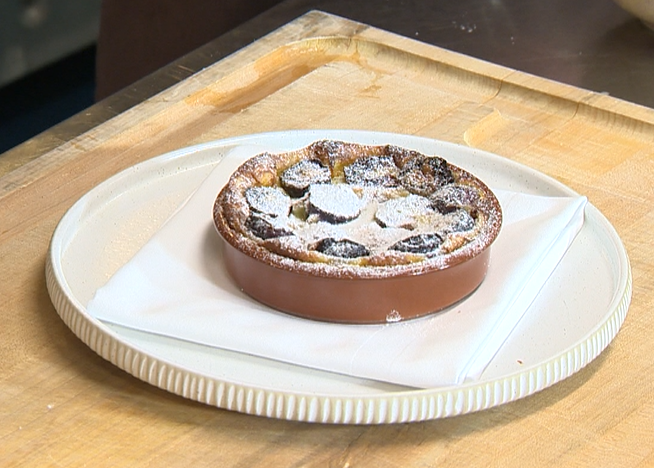
Dust the top lightly with powdered sugar while still warm. Serve warm or chilled, never scalding hot straight from the oven.
Beyond Cherries: The Flognarde Variation
Understanding the mechanics of clafoutis allows you to adapt the technique to other stone fruits and berries. When you substitute cherries with apples, pears, plums, or blueberries, French culinary terminology shifts. The dish becomes a Flognarde.
+----------------+---------------------+----------------------------------+
| Fruit Type     | Technical Name      | Moisture Management Requirement  |
+----------------+---------------------+----------------------------------+
| Sweet Cherry   | Clafoutis           | Macerate/Drain if pitted         |
| Black Berry    | Flognarde           | No pre-treatment needed          |
| Firm Pear/Apple| Flognarde           | Pre-sauté in butter to soften    |
| Apricot/Plum   | Flognarde           | Dust cut sides with cornstarch   |
+----------------+---------------------+----------------------------------+
High-water fruits like sliced plums release far more moisture than cherries. When adapting this batter for plums or apricots, reduce the milk content by 30 grams and increase the flour content by 10 grams to maintain structural stability.
Mastering this classic comes down to respecting basic thermal principles and moisture control rather than searching for secret ingredients. Bake with precise weights, let your flour hydrate fully, control the moisture of your fruit, and stop over-baking the egg proteins.