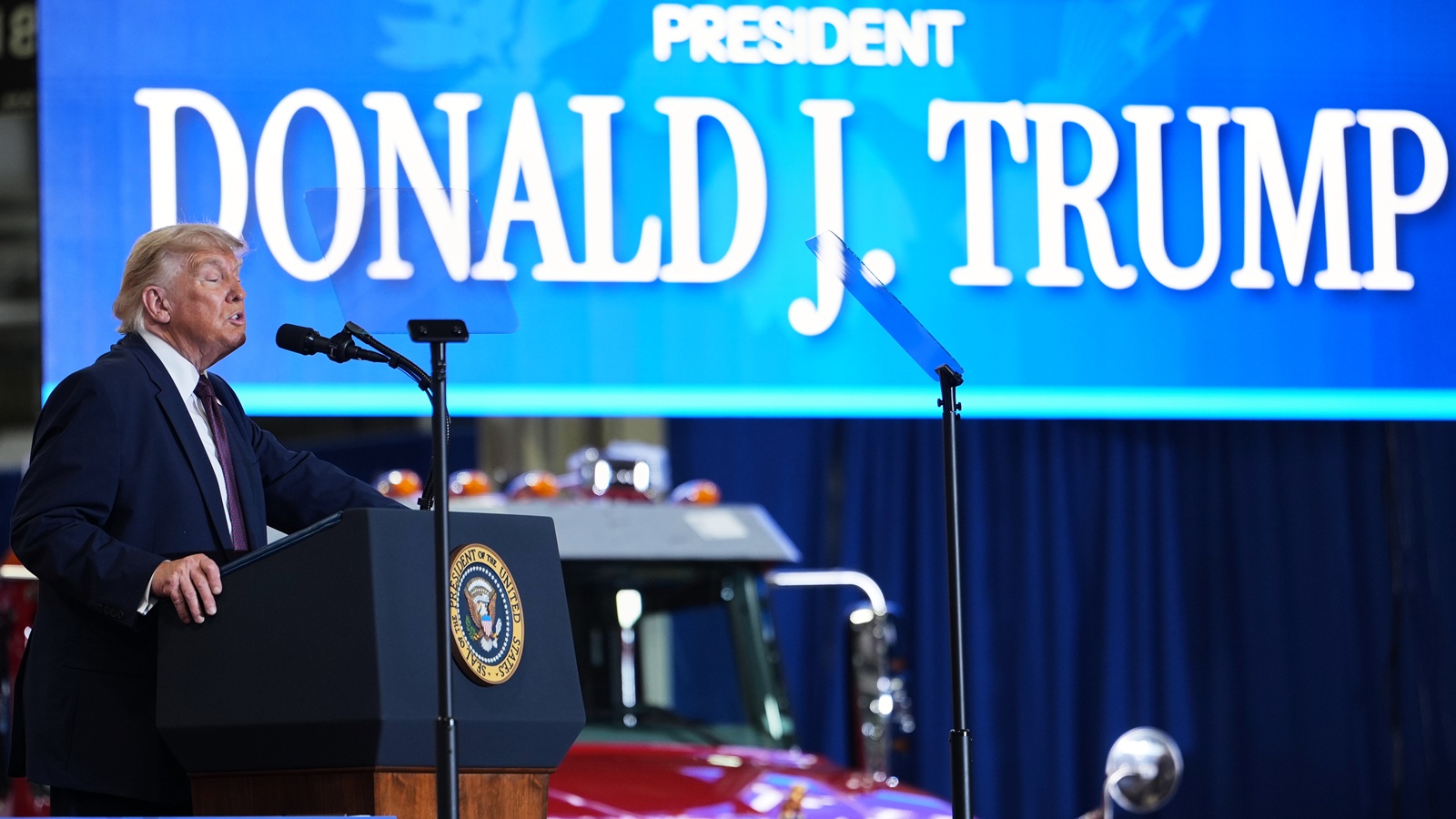
The renegotiation of the Gordie Howe International Bridge operating agreement represents a textbook study in asymmetrical capital exposure and the monetization of sovereign veto points. Canada’s decision to front 100 percent of the $6.4 billion CAD construction cost was predicated on a clear, long-term capital recovery mechanism. Under the original 2012 Canada-Michigan Crossing Agreement, Canada retained exclusive claim to all toll revenues until its initial capital outlay was fully recovered. The recently brokered 15-year revenue-sharing modification, catalyzed by a threatened border closure, alters the cash flow waterfall without compromising the underlying principal recovery timeline.
Evaluating the financial viability of this deal requires moving past political rhetoric and examining the precise mathematical definitions of "net revenue," debt-servicing schedules, and joint toll governance.
The Financial Architecture and Capital Exposure
To understand the restructuring, one must first isolate the asset’s balance sheet. The Gordie Howe International Bridge is not a standard joint venture; it is a unilaterally funded cross-border conduit. Canada assumed 100 percent of the construction risk, financing the $6.4 billion CAD expenditure through public funds and debt instruments managed via the Windsor-Detroit Bridge Authority.
The economic justification for this absolute capital exposure rested on two primary pillars:
- Monopoly Capture of Toll Revenues: Canada maintained an absolute right to 100 percent of the gross toll receipts until debt amortization was complete.
- Asset Lifecycle Management: Post-debt retirement, the toll revenues were scheduled to transition to a 50-50 split with the State of Michigan, aligning long-term yields with long-term maintenance liabilities.
This structure insulated Canadian taxpayers from long-term capital loss while offering Michigan a risk-free future revenue stream. However, this model assumed zero regulatory or political friction at the physical border. The introduction of political intervention disrupted this assumption, forcing a restructuring of the cash flow waterfall.
The Net Revenue Waterfall Model
The core of the revised agreement lies in the definition of "net revenue". Prime Minister Mark Carney’s defense of the deal relies on a strict accounting interpretation of net profits:
$$\text{Net Revenue} = \text{Gross Toll Receipts} - (\text{OPEX} + \text{Debt Servicing})$$
Where:
- $\text{Gross Toll Receipts}$ are the total collections from commercial and passenger vehicle transits.
- $\text{OPEX}$ represents ongoing operational expenditures, including maintenance, security, toll-booth administration, and weather mitigation (e.g., snow removal).
- $\text{Debt Servicing}$ constitutes the interest payments and principal amortization required to service the $6.4 billion CAD capital debt.
This formulation ensures that Canada's Treasury is reimbursed for the cost of capital before any profit distribution occurs. The priority of payments (the waterfall) is structured as follows:
[Gross Toll Receipts]
         │
         ▼
 1. Operational Expenditures (OPEX)
         │
         ▼
 2. Debt Servicing (Principal & Interest)
         │
         ▼
 3. Capital Reserves & Contingencies
         │
         ▼
[Net Revenue (Profit)] ──► Shared 50-50 for 15 Years
Because the debt-servicing requirements for a $6.4 billion CAD asset are substantial, the net profit remaining at the bottom of the waterfall will be minimal in the initial 15 years. Financial modeling of highly leveraged greenfield infrastructure projects indicates that debt-service coverage ratios (DSCR) typically absorb the vast majority of operating cash flows during the first half of the asset’s lifecycle. The 50 percent share allocated to the United States—designated for a regional economic development fund—is therefore a fraction of a highly diminished residual pool, rather than a top-line extraction.
The Joint Governance Bottleneck and Toll Elasticity
The most significant structural risk introduced by the renegotiation is not the cash split itself, but the surrender of unilateral tolling authority. Under the revised terms, the United States must agree if Canada seeks to increase bridge tolls by more than 10 percent or lower them below regional averages.
This clause limits Canada's ability to optimize the asset's yield curve. Toll rate optimization is governed by the price elasticity of demand ($\epsilon_p$):
$$\epsilon_p = \frac{% \Delta Q}{% \Delta P}$$
Where:
- $% \Delta Q$ is the percentage change in traffic volume.
- $% \Delta P$ is the percentage change in the toll rate.
In the highly competitive Windsor-Detroit corridor, the Gordie Howe International Bridge competes directly with the privately owned Ambassador Bridge and the Detroit-Windsor Tunnel. This means demand is highly elastic. If Canada cannot adjust toll rates fluidly to respond to competitive pricing strategies from the Ambassador Bridge, it faces two distinct systemic risks:
- Under-pricing Risk: If regional inflation or operating costs rise rapidly, and Canada cannot raise tolls by more than 10 percent without US approval, the real value of toll revenues will erode, delaying debt retirement.
- Over-pricing Lock-in: If Canada is prevented from dropping tolls below regional averages to capture market share from the Ambassador Bridge, the asset may suffer from chronic under-utilization, prolonging the debt-servicing phase.
The restriction on pricing autonomy introduces a political variable into what should be a purely quantitative yield-management calculation.
Geopolitical Rent-Seeking and Asset Valuation
The renegotiation highlights a broader reality of cross-border infrastructure finance: the physical host country of an international crossing holds an implicit veto over the asset's economic utility, regardless of who holds the debt.
The threat to block the bridge’s opening—despite Canada having funded the customs plazas on both sides of the border—represents an exercise in geopolitical rent-seeking. By delaying the ribbon-cutting, the US administration weaponized the time value of money. For every month a $6.4 billion CAD asset sits idle, the capitalized interest accrues without corresponding revenue, deteriorating the project's net present value (NPV).
Canada’s concession to share 50 percent of the highly diluted "net" profits was a tactical calculation to preserve NPV. The cost of a prolonged opening delay far exceeded the discounted present value of the "modest" net revenues shared over the 15-year term. Canada minimized immediate fiscal damage by conceding a portion of future, uncertain profits rather than accepting near-term structural debt-servicing losses.
Strategic Operating Recommendations
To navigate this joint operating model and protect the Canadian treasury's capital recovery schedule, the Windsor-Detroit Bridge Authority must implement three specific operational strategies:
1. Maximize Non-Toll Ancillary Revenues
Because non-toll revenues (such as duty-free retail, commercial advertising, fiber-optic routing fees, and utility leasing along the span) are typically excluded from standard bridge toll definitions, Canada should aggressively monetize these channels. These revenues should be structurally ring-fenced to offset Canadian-side OPEX, thereby artificially lowering the operational costs factored into the net revenue calculation.
2. Establish Strict Cost-Accounting Standards for Debt Allocation
Canada must employ a conservative accounting framework that fully loads all overhead, administrative costs, and capitalized interest from the past decade of construction into the "Debt Servicing" category of the waterfall. By ensuring every dollar of interest accrued during the construction and delay phases is amortized prior to calculating "net profits," Canada protects its principal recovery timeline from premature leakage to the US economic development fund.
3. Implement Dynamic Congestion Pricing Within Allowed Bounds
To maximize gross revenue without triggering the 10 percent renegotiation threshold, the operating authority should deploy dynamic congestion pricing. By structuring toll rates to fluctuate based on real-time traffic volume and time-of-day demand—while keeping the weighted average price fluctuations within the 10 percent limit—the bridge can optimize yield and capture maximum commercial freight volume from competing regional crossings.