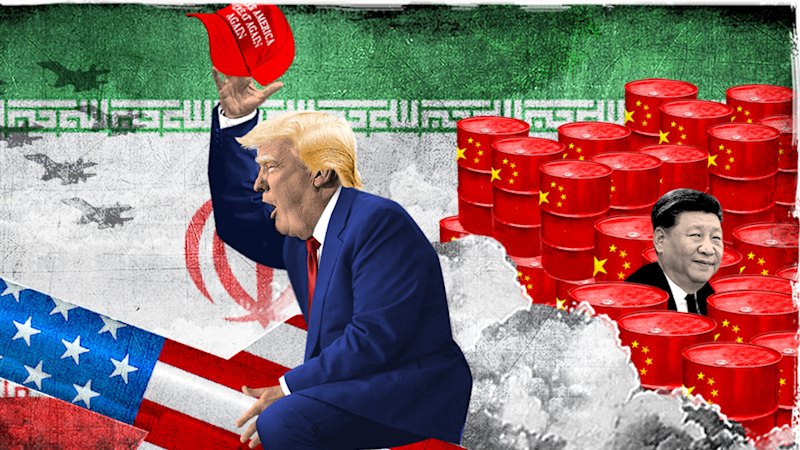
Beijing doesn't do drama. While the rest of the world watches every tweet and drone strike between Washington and Tehran with bated breath, China usually stays in the shadows. You've probably noticed it. Every time tensions in the Middle East spike, there’s a predictable pattern of shouting from the White House and defiant rhetoric from Iran. Then there's China. They issue a short, dry statement about "restraint" and go back to business.
It’s not because they’re indifferent. Far from it. China has more skin in the game than almost any other outside power, but they've mastered the art of the strategic silence. They aren't looking to be the world's policeman. They're looking to be the world's landlord. When the US and Iran get into a scrap, Beijing sees a mess they didn't start and a set of risks they’d rather not pay for.
The oil factor is everything
China is the world’s largest importer of crude oil. That isn't a statistic; it’s a vulnerability. If the Strait of Hormuz closes, China’s economy doesn't just slow down. It chokes. About 40% of their oil imports come from the Persian Gulf. They need that oil to keep the lights on in Shanghai and the factories running in Shenzhen.
You’d think this would make them more aggressive. In reality, it makes them cautious. They know they can’t protect those shipping lanes themselves. The People’s Liberation Army Navy (PLAN) is growing, sure, but they don't have the blue-water capacity to secure the Gulf. So, they let the US Navy do the heavy lifting of keeping the lanes open while they buy the product. It’s a bit of a "free rider" strategy, and it works perfectly for them. Why spend billions on a carrier strike group in the Middle East when you can just buy the oil and let someone else take the bullets?
Balancing the regional rivals
Beijing’s biggest trick is staying friends with everyone. They don’t just talk to Iran. They’re also the biggest trading partner for Saudi Arabia and the UAE. Think about how hard that is. The US has to pick sides. If Washington gets too close to Riyadh, Tehran gets angry. If they try to talk to Tehran, the Saudis feel betrayed.
China doesn’t have that problem. They treat the Middle East like a giant gas station and construction site. They signed a 25-year "strategic partnership" with Iran, but they also built a massive refinery in Saudi Arabia. They sell drones to both sides. By staying quiet during conflicts, they avoid the "with us or against us" trap that has plagued American foreign policy for decades. They want the oil, the infrastructure contracts, and the investment opportunities. Picking a side in a war just gets in the way of the bottom line.
Why Trump presented a unique headache for Beijing
When the Trump administration shifted to a "maximum pressure" campaign against Iran, it put China in a tight spot. They didn't want a war because it would spike oil prices and threaten their Belt and Road Initiative (BRI) projects. But they also didn't want to bail out Iran and trigger a massive trade war with the US that was already simmering.
Basically, China played both sides. They officially complied with many sanctions to keep the US happy, but they also kept the back door open. Millions of barrels of Iranian oil still made it to Chinese ports via "ghost tankers" and ship-to-ship transfers in international waters. They provided Iran with a financial lifeline just thick enough to prevent a total collapse, but thin enough to avoid a direct confrontation with Washington. It’s a high-wire act. It's calculated. It's smart.
The Belt and Road anchor
The Middle East is a central hub for China’s Belt and Road Initiative. They’ve invested billions in ports from Pakistan to Oman. If a full-scale war breaks out between the US and Iran, those investments become targets or, at the very least, useless.
China sees the Middle East through the lens of connectivity. They want a stable bridge between Asia, Africa, and Europe. War is the ultimate disrupter of trade routes. Every time a missile flies, the insurance rates for cargo ships go up. For a country that exports more physical goods than anyone else, that’s a direct tax on their GDP. Their silence isn't a sign of weakness; it’s a sign of a country that values stability over ideology.
No interest in the regime change business
The US has spent trillions trying to reshape the Middle East. Whether it’s spreading democracy or toppling dictators, Washington thinks it can fix the region. China thinks that’s a fool’s errand. They don't care how a country is run as long as the contracts are honored and the oil keeps flowing.
This "non-interference" policy is their greatest diplomatic tool. It’s why they can sit down with the Taliban one day and the Iranian Revolutionary Guard the next. By staying quiet during the Trump-era escalations, they sent a message to the entire region: "We aren't here to judge you or change you. We're here to trade." To many leaders in the Middle East, that’s a much more attractive proposition than the lecture-heavy approach of Western powers.
The risk of being the new guy
There’s a growing fear in Beijing that if the US actually leaves the Middle East, China will be forced to take over. They don't want that. Being the dominant power in the Middle East is like winning a prize you can't afford to keep. You inherit all the ancient grudges, the border disputes, and the sectarian violence.
China prefers the current status quo—where the US is the "villain" that everyone complains about but also the security guarantor that keeps the peace. If China steps up and starts taking a lead role in Iran-US mediation, they lose their neutrality. They become the ones responsible when things go wrong. Right now, they can blame "Western hegemony" for the mess while they profit from the recovery. It’s a brilliant, if cynical, position to hold.
Realities of the 2026 energy market
As we move through 2026, the energy transition is changing the math, but not as fast as people think. China is leading the world in solar and EVs, but their industrial base still lives on fossil fuels. The Middle East remains the heartbeat of their economy.
Don't mistake Chinese silence for a lack of power. They're using their economic weight to tie these countries to Beijing in ways that don't require firing a shot. While the US focuses on the military balance of power, China is focused on the balance of payments. They're buying up the future while everyone else is fighting over the past.
If you’re waiting for China to take a bold, public stand the next time the US and Iran trade blows, don't hold your breath. They’ll stay in the corner, keeping their heads down and their wallets open. They know that in the long run, the power that stays out of the fight is the one that wins the peace.
Keep an eye on the trade data, not the diplomatic statements. Watch where the tankers go and where the infrastructure projects are being built. That’s where the real story is. If you want to understand the modern Middle East, stop listening to what China says and start looking at what they buy. They’re playing a different game entirely.