The tilting of the Metropolitan Cathedral isn’t a subtle thing once you’re standing in the Zócalo. It is a slow-motion architectural swoon. If you lean your head just right, the heavy stone walls seem to be sighing under the weight of five centuries. But the cathedral isn't just settling. It is being pulled down by a thirsty ghost.
Mexico City is sinking. It is descending into the earth at a rate of up to twenty inches per year in certain districts. This isn't the gentle compression of soil or the natural shift of tectonic plates. It is a self-inflicted collapse. From the vantage point of a satellite 400 miles above the Earth, the displacement is so vast that the city looks like a bruised thumbprint pressed into the crust of the planet. If you enjoyed this post, you might want to check out: this related article.
To understand how a megalopolis of 22 million people begins to vanish into its own foundations, you have to look at what lies beneath the pavement. Imagine a giant, wet sponge. Now, imagine that for centuries, a massive population has been sticking straws into that sponge and sucking it dry. As the water leaves, the pores of the sponge collapse. The structure flattens. The problem is that once a "sponge" made of ancient lacustrine clay collapses, it can never be re-inflated. The storage space for water is gone forever.
The Architect and the Spirit Level
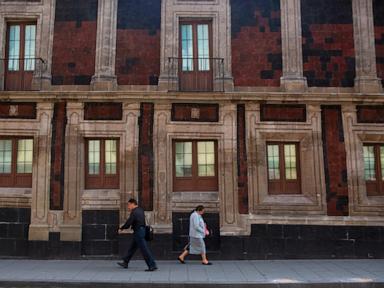
Consider a hypothetical engineer named Mateo. Mateo works for the city's water authority, SACMEX. Every morning, he visits the same colonial-era buildings in the historic center. He carries a spirit level and a laser rangefinder. He isn't looking for cracks—those are everywhere, spiderwebbing through the stucco like lightning frozen in time. He is looking for "differential subsidence." For another angle on this event, see the recent coverage from The New York Times.
This is the technical term for a nightmare. It means one side of a building is sinking faster than the other. When a skyscraper sinks uniformly, it is a geological footnote. When it sinks unevenly, it becomes a guillotine.
"The earth here is 80% water," Mateo might tell you, gesturing to the heavy volcanic rock of the buildings. "We built a stone city on top of a jelly bowl. And then we decided to drink the jelly."
The facts bear out Mateo's anxiety. Mexico City was built on the ruins of Tenochtitlan, an Aztec island city surrounded by Lake Texcoco. When the Spanish arrived, they didn't see a sophisticated hydraulic system; they saw a nuisance. They drained the lakes. They paved the valley. They turned a water-rich basin into a dusty bowl. Today, the city gets about 70% of its water from the aquifer lying beneath it. We are mining "fossil water" that took tens of thousands of years to accumulate, and we are doing it in a human heartbeat.
The Invisible War Under the Streets
As the water table drops, the ground compacts. This creates a surreal landscape where the city’s infrastructure is in a constant state of war with the earth.
Walk through the neighborhood of Iztapalapa and you will see it. Sidewalks don’t just crack; they buckle into miniature mountain ranges. Pipes don’t just leak; they snap. Because the ground moves at different speeds, the very veins of the city—the sewage lines and water mains—are being twisted until they rupture.
There is a cruel irony at the heart of this. As the city sinks, the sewage pipes lose their gravity-fed slope. In some areas, the pipes now tilt backward. The city has to spend millions of dollars on massive pumping stations just to force waste uphill. Meanwhile, because the pipes are constantly breaking, nearly 40% of the fresh water pumped from the dying aquifer is lost to leaks before it ever reaches a kitchen tap.
The city is thirsty because it is leaking, and it is leaking because it is sinking, and it is sinking because it is thirsty. A closed loop of systemic failure.
The Weight of History
It is easy to look at satellite data and see a color-coded map of descent. It is harder to look at a grandmother in a sinking barrio who has to buy water from a truck—a pipa—because her taps have run dry for the third week in a row.
The "invisible stakes" aren't just about skewed skylines. They are about the loss of a future. When the clay beneath the city collapses, it loses its porosity. This process is called "aquitard consolidation." Even if we had a miraculous season of infinite rain, the ground could no longer hold the water. The underground reservoir is being physically crushed out of existence.
Why does this matter to someone who doesn't live in Mexico? Because this city is a laboratory for the 21st century. Jakarta is sinking. Houston is sinking. Parts of the Central Valley in California are dropping so fast they’ve altered the path of canals. We are treating the ground beneath our feet as an infinite resource, forgetting that the earth is a structural element.
The Engineering of Despair
Some propose a "Great Canal" to whisk away floodwaters, while others argue for "green infrastructure"—parks that act as sponges to recharge the aquifer. But the scale of the problem is biblical. To stop the sinking, the city would need to stop pumping from the aquifer entirely.
Where would the water come from?
The city already imports a massive amount of water through the Cutzamala System, an engineering marvel that pumps water over a mountain range 3,000 feet high. The energy required to move that much water is staggering. It is one of the most energy-intensive water systems on the planet. And yet, it isn't enough.
Consider the physics. $P = \rho gh$. The pressure required to move water against gravity at that scale is a constant battle against the laws of the universe. We are burning coal and gas to move water into a city that is simultaneously drowning in seasonal floods and dying of thirst.
During the rainy season, the city is terrified of the water. Because the basin is now lower than its drainage outlets, a heavy storm can turn the streets into rivers of sewage. The "sink" has turned the city into a literal drain. Residents in low-lying areas build small concrete walls at their front doors—barricades against the inevitable. They live in a fortress of their own making, waiting for the sky to fall and the ground to give way.
The Ghost Lake Returns
There is a haunting beauty to the resilience of the residents. They shimmy their doors to fit slanted frames. They patch the cracks in their walls with a practiced weariness. They have learned to live on an incline.
But the satellites don't lie. They see the truth that a human eye, trapped in the daily rhythm of the streets, might miss. They see the entire valley warping. They see the edges of the ancient lake bed reasserting themselves, not as water, but as a void.
The Aztec prophecy spoke of an eagle perched on a cactus, devouring a snake in the middle of a lake. It was an image of triumph and foundation. Now, the lake is taking its revenge. It isn't coming back as a shimmering blue expanse; it is claiming the city inch by inch, pulling the concrete and the steel back into the mud.
The bells of the cathedral still ring, but they ring from a slightly different angle every year. We are watching a slow-motion shipwreck on dry land. The most sophisticated civilization in the history of the Americas is discovering that you cannot build a permanent home on a temporary miracle.
As the sun sets over the volcanic peaks surrounding the valley, the shadows of the leaning buildings grow long and distorted. The city doesn't feel like a triumph of engineering in these moments. It feels like a heavy, tired creature, settling deeper into its bed of silt, waiting for the day the sponge finally goes dry.
The pavement beneath your boots feels solid. It is an illusion. You are standing on the surface of a liquid history, and the tide is going out for the last time.