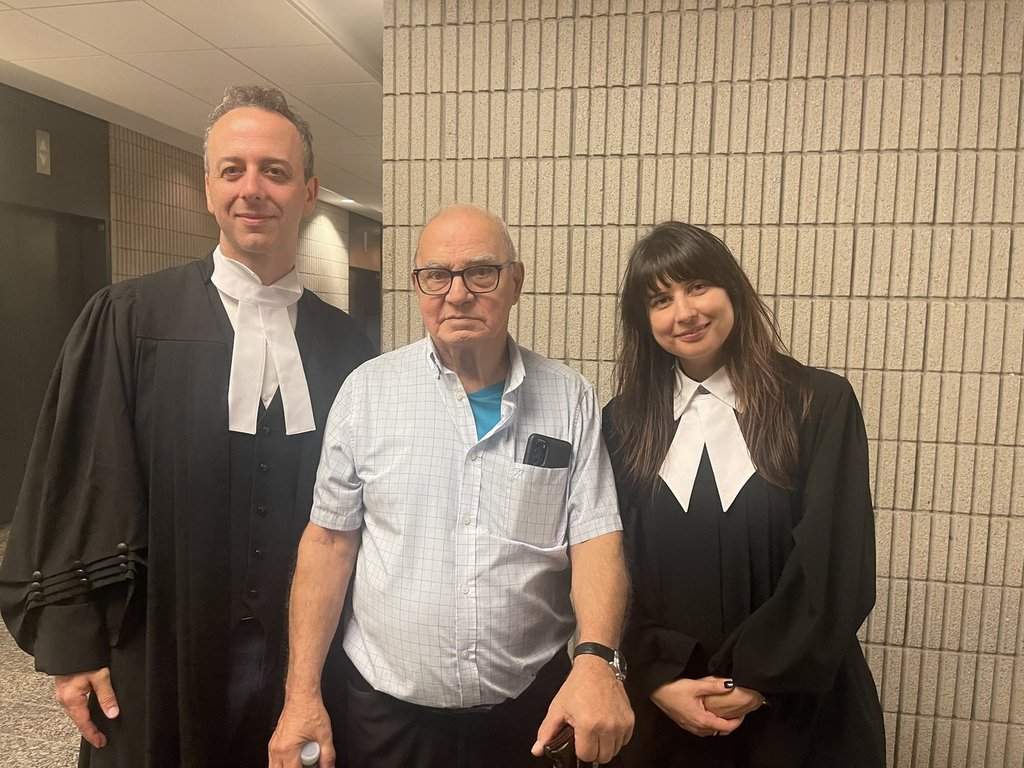
Claude Paquin spent forty-six years carrying the weight of a double murder he did not commit, enduring a judicial nightmare that culminated in a multimillion-dollar settlement with the City of Montreal and the provincial government.
The financial payout closes a civil lawsuit filed in Quebec Superior Court, but it fails to mend the institutional machinery that pulverized an innocent man’s life. Paquin was convicted in 1983 for the 1978 slayings of Ronald Bourgouin and Sylvie Revah in the Laurentians. He served eighteen years behind bars before securing parole in 2001, only to spend the next twenty-three years shackled to crushing release conditions that barred him from living a normal life. When his name was finally cleared after a federal review ordered a retrial, he was eighty-one years old. Meanwhile, you can read other stories here: Why Transit Safety Around Bloor Yonge Station Still Keeps Commuters on Edge.
The settlement avoids what would have been a catastrophic autumn trial for the state. It also shields police and prosecutors from having to publicly account for how a man was fed into an institutional grinder based on compromised intelligence.
The Anatomy of a Fabrication
To understand how a miscarriage of justice survives for nearly half a century, one must examine the fragility of criminal investigations from the late nineteen-seventies. The case against Paquin relied almost exclusively on the testimony of a prolific police informant named Bernard Provençal. To understand the complete picture, check out the detailed analysis by BBC News.
Informants are notoriously slippery instruments. In exchange for cash, leniency, or institutional protection, they often provide the exact narrative law enforcement officers want to hear. Court documents and subsequent investigations by Projet Innocence Québec revealed that Provençal received money and favors in return for his cooperation. His narrative claimed Paquin orchestrated the killings over a drug dispute, yet critical pieces of contradictory evidence were minimized or kept out of the original trial.
Investigators fell victim to confirmation bias. Once a theory took root within the police department, every ambiguous piece of data was contorted to fit the preconceived conclusion. Defense teams operating decades ago faced an uphill battle against closed files and uncooperative crown archives. The system protected its own conviction rate at the direct expense of truth.
The Extended Sentence
Prison walls do not define the entirety of a wrongful conviction. When Paquin walked out of maximum security on parole, his liberty remained heavily restricted.
For over two decades, he could not travel freely, held no passport, and had to report regularly to a parole supervisor. Every movement required bureaucratic permission. This invisible cage is often ignored by the public, who assume freedom begins the moment an inmate steps past the razor wire.
Legal experts point to Paquin's ordeal as holding a grim record for the longest unjustified deprivation of liberty documented in the province. Eighteen years locked in a cell is an atrocity. Adding decades of second-class citizenship under perpetual state surveillance compounds that cruelty into a multi-generational failure of governance.
The Cost of Avoidance
Neither the City of Montreal nor the Attorney General of Quebec admitted wrongdoing in their joint announcement of the settlement. Both entities hid behind standard boilerplate language, expressing hope that the agreement would help Paquin turn the page.
This refusal to accept explicit liability points to a broader institutional cowardice. Public bodies prefer to write large checks funded by taxpayers rather than subject their internal operations to judicial scrutiny. A full trial would have forced retired detectives, former crown prosecutors, and police administrators to take the stand under oath. It would have dragged decades of police culture into the harsh light of open court.
Instead, the file is closed with a signature and a nondisclosure clause. The financial terms remain hidden from public view, ensuring that the true cost of state negligence is quietly absorbed by municipal and provincial budgets without institutional reform.
Justice delayed is not merely justice denied. It is an active, ongoing erasure of human existence, settled quietly behind closed doors to protect the reputation of the state.