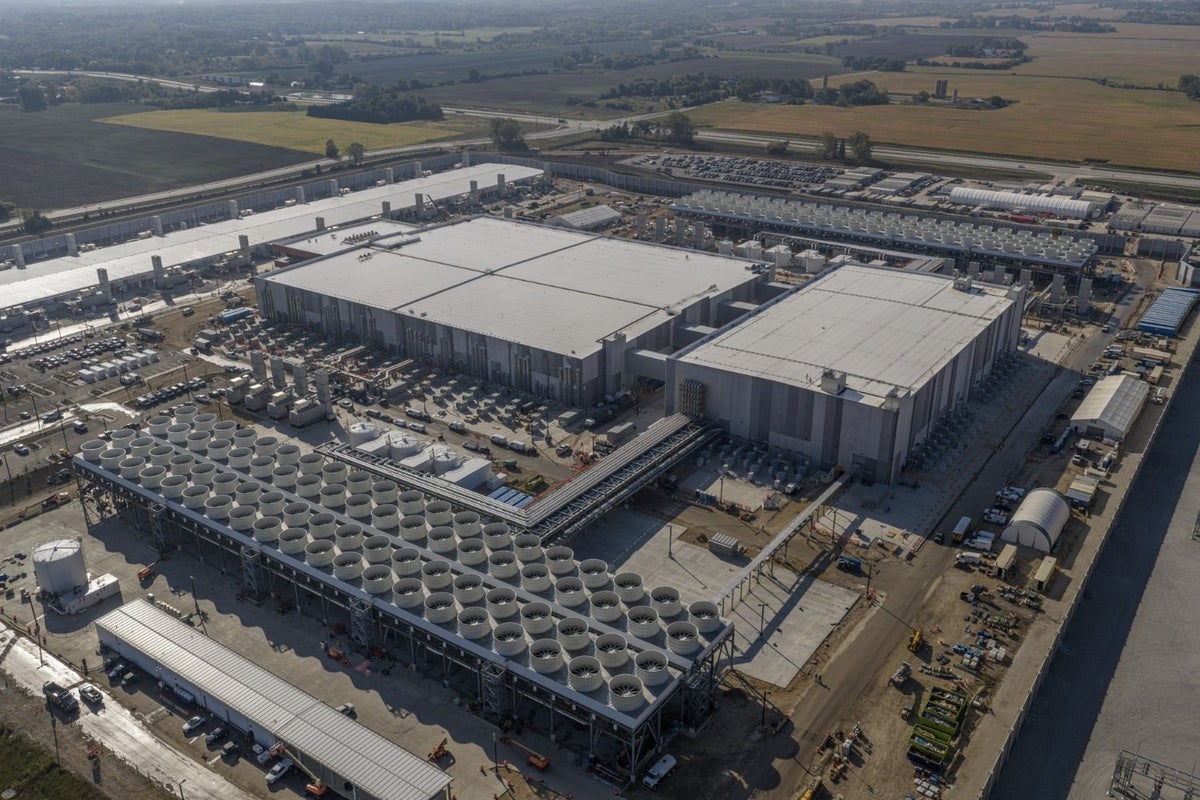
Scotland is quietly preparing to choke off the water and power lines feeding the UK's massive artificial intelligence ambitions. While Whitehall maps out a future reliant on sprawling, energy-hungry data hubs, Holyrood ministers are facing a brutal math problem involving local grid capacity and net-zero targets. The Scottish Government is actively reviewing planning frameworks to potentially freeze massive data center developments. This move threatens to fracture the unified British infrastructure strategy before the concrete even dries on its foundations.
The conflict reveals a fundamental disconnect between national technological ambition and local physical reality. For a different look, see: this related article.
The Gathering Grid Storm
Westminster views data centers as the essential factories of the next century. They are the physical structures required to train massive language models and run the automated economy. Yet these facilities possess an insatiable appetite for electricity and cooling water.
Scotland has long been marketed as an ideal destination for these projects. It offers cool ambient temperatures that reduce mechanical cooling needs and an abundance of renewable energy generation, particularly from offshore wind. Similar analysis on the subject has been published by TechCrunch.
But the power is rarely where the programmers need it to be. The Scottish grid is facing a severe transmission bottleneck. Green energy generated in the north cannot easily cross the constrained transmission lines running south toward major population centers.
Data center developers saw this as an opportunity. By plugging directly into the Scottish grid close to the source of generation, they promised to utilize "stranded" renewable energy that would otherwise be wasted due to curtailment.
The reality is far more complicated. Data centers do not operate intermittently; they require absolute, unyielding baseload power 24 hours a day. When the wind drops across the North Sea, a massive data center cluster cannot simply turn off. It draws from the wider grid, competing directly with domestic heating and industrial manufacturing.
Scottish policymakers are realizing that approving a handful of hyperscale data centers could instantly consume the entire regional carbon budget, wiping out years of progress toward statutory climate goals.
National Strategies Versus Municipal Limits
The tension between London and Edinburgh highlights a structural flaw in how infrastructure is planned across Britain.
The UK Government has designated data centers as Critical National Infrastructure. This status is intended to streamline planning, cut through local opposition, and fast-track construction to prevent Britain from falling behind the United States and continental Europe in computing capacity.
+------------------------------------------------------------+
|             THE INFRASTRUCTURE DISCONNECT                  |
+------------------------------------------------------------+
|  Westminster Ambition:       |  Holyrood Reality:          |
|  - Fast-tracked planning     |  - Localized grid strains   |
|  - Critical Infrastructure   |  - Water scarcity risks     |
|  - Rapid AI model scaling    |  - Strict net-zero targets  |
+------------------------------------------------------------+
This designation carries little weight within Scotland’s devolved planning system. Holyrood retains ultimate authority over local land use, environmental impacts, and water allocation. Scottish water authorities have grown increasingly nervous about the sheer volume of liquid required to keep server racks from melting.
Consider a standard evaporative cooling setup. A large facility can go through millions of liters of water per day. In areas already experiencing uncharacteristic summer droughts, diverting that volume away from agriculture or municipal drinking supplies is a political non-starter.
Local councils are caught in the middle. A new data center sounds like a massive capital investment on paper, often totaling hundreds of millions of pounds. But these facilities are notoriously poor job creators once the construction crews pack up. A building the size of three football pitches might ultimately employ fewer than thirty full-time technicians and security guards.
For Scottish planners, the economic calculus does not add up. They face all of the environmental degradation and infrastructure strain, while the high-value economic output—the software, the corporate tax revenues, and the corporate prestige—remains concentrated in London tech hubs.
The Technology Fallacy of Stranded Renewables
Tech conglomerates frequently claim their facilities will be entirely green, powered by dedicated power purchase agreements with wind farms. This narrative is financially convenient but technically misleading.
When a data center developer signs a contract with a wind farm, they are purchasing green certificates, not tracking the specific electrons entering their facility. The physical grid operates as a single pool. If a data center pulls 100 megawatts from the grid during a period of low wind, that power is inevitably supplemented by natural gas generation peaking elsewhere in the system.
- The Transmission Problem: Moving power from remote northern generation sites to urban consumption points requires massive investment in high-voltage direct current lines.
- The Battery Deficit: Industrial-scale storage technology is not yet capable of backing up a hyperscale data center through a multi-day wind lull.
- The Displacement Effect: Diverting existing renewable capacity to power AI chips means utilities must burn more fossil fuels to satisfy the baseline needs of ordinary citizens.
This displacement effect is driving the Scottish policy shift. Ministers are questioning whether Scotland's green energy surplus should be used to anchor local green manufacturing, such as green steel or Scotch whisky distilling, or whether it should be surrendered to power overseas algorithmic processing.
A Growing European Precedent
The Scottish hesitation is not happening in an international vacuum. Across Europe, the realization that data centers can quickly destabilize local infrastructure is forcing a regulatory rethink.
+-----------------------------------------------------------------+
|               EUROPEAN DATA CENTER RESTRICTIONS                 |
+-----------------------------------------------------------------+
|  Jurisdiction  |  Action Taken                                  |
+-------------------+---------------------------------------------+
|  Dublin, Ireland  |  De facto moratorium due to grid constraints|
|  Amsterdam, NL    |  Strict municipal zoning and power caps     |
|  Frankfurt, GER   |  Mandatory waste-heat recycling ordinances  |
+-------------------+---------------------------------------------+
Ireland serves as the ultimate cautionary tale for Scottish civil servants. Dublin became the data center capital of Europe due to low corporate tax rates and proximity to transatlantic fiber cables. Now, data centers consume roughly one-fifth of Ireland's total electricity supply. The Irish grid operator has been forced to impose a de facto moratorium on new grid connections in the Dublin region to prevent rolling blackouts.
Amsterdam instituted a similar pause on development after realizing that server farms were expanding faster than the municipal grid could be upgraded. Frankfurt followed suit, introducing strict zoning laws that force operators to redirect the waste heat generated by servers into municipal district heating networks.
Scotland is looking at these examples and recognizing that a hands-off approach leads directly to infrastructure failure. The UK national strategy assumes Scotland will act as a passive green battery and hosting ground for the wider union. Edinburgh's counter-strategy is an assertion of resource sovereignty.
The Sovereign Computing Tradeoff
A freeze on Scottish data center development would instantly derail the broader UK timeline for AI independence.
The current geopolitical climate has made sovereign computing capacity a matter of national security. Relying on cloud infrastructure located inside the United States or the European Union leaves British industries vulnerable to foreign regulatory shifts, data privacy disputes, and trade blockades. To build a resilient domestic tech sector, the UK needs physical ownership of the hardware.
If Scotland closes its doors to new builds, that pressure shifts entirely to the north and east of England. The English grid is already creaking under the weight of existing connections. The London edge-of-town clusters in Slough are entirely saturated, with developers now looking at sites further up the M1 corridor.
These regions lack the natural cooling advantages of the Scottish climate. Running identical server configurations in Yorkshire or the Midlands requires significantly more energy for mechanical chilling, reducing the overall efficiency of the infrastructure and driving up carbon emissions.
The Path to Grid Realism
The current impasse cannot be resolved through top-down mandates from London. For the UK AI strategy to survive, it must transition away from the model of unregulated speculative development toward a highly managed infrastructure framework.
Operators must be forced to move beyond financial accounting tricks and prove that their facilities are genuinely grid-neutral. This means mandating the co-location of massive, dedicated battery storage systems alongside any new server farm. If a developer wants to build a 50-megawatt facility, they must be legally required to install the storage infrastructure necessary to buffer their own demand during grid stress.
Furthermore, the concept of waste-heat integration must become a prerequisite for planning approval. Data centers reject vast amounts of low-grade thermal energy into the atmosphere. In a sensible planning regime, these facilities would only be permitted near existing district heating networks, public swimming pools, or agricultural greenhouses that can utilize that heat, turning an environmental liability into a localized asset.
The Scottish Government’s threat to freeze these projects is a rational response to an irrational, uncoordinated boom. It exposes the fiction that the virtual economy exists independently of physical geography. Without radical changes to how these digital factories integrate with local grids and water systems, the UK's grand AI ambitions will remain stalled at the planning stage, blocked not by a lack of imagination, but by a lack of power.