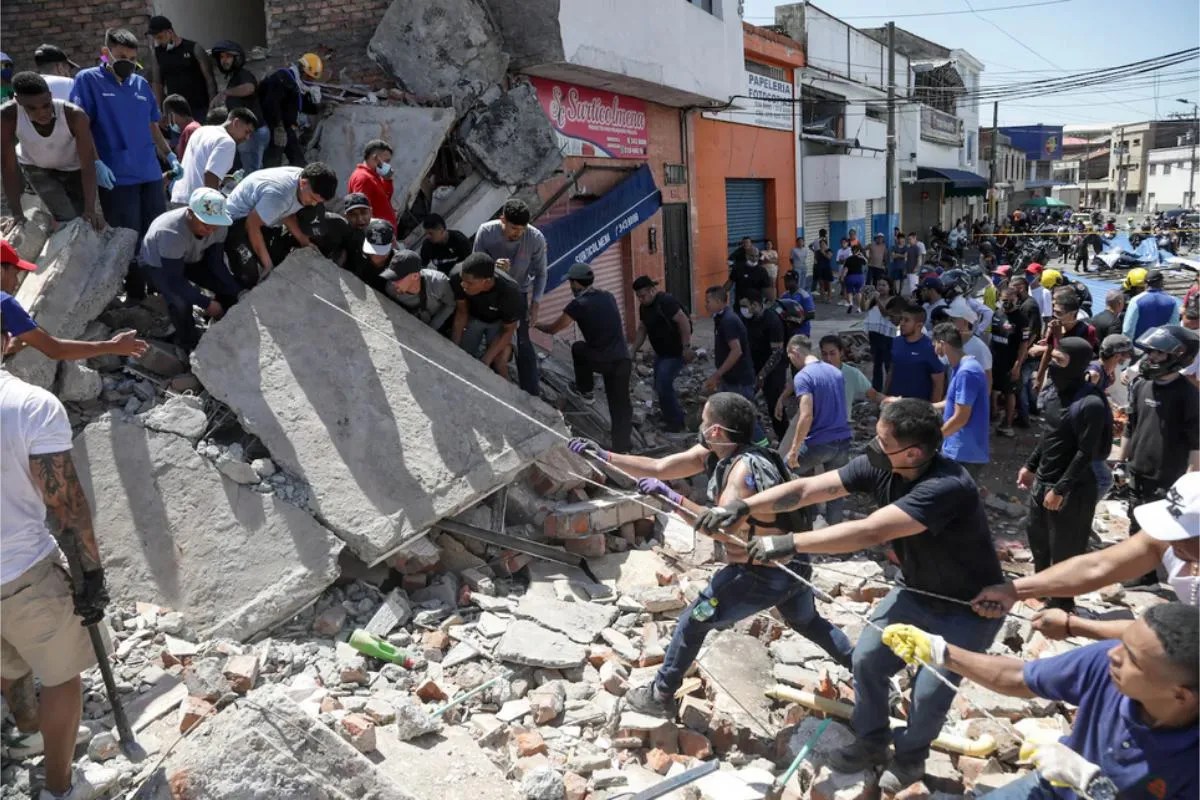
The ground beneath western Colombia did not just shake on August 10, 2026; it exposed a terrifying fragility in the nation’s urban backbone. With the death toll now confirmed at 319 following the magnitude 7.4 earthquake that originated in the department of Chocó, the focus has shifted from the initial shock to the agonizing question of why so much of the modern infrastructure failed.
While seismic activity is a known threat in the Andean region, the scale of this disaster—affecting 12 departments and crippling critical hubs in the "Coffee Axis"—is a stinging indictment of urban planning. Over 4,600 people are injured, and 260 remain missing. These are not merely statistics. They represent lives lost in environments that were supposed to be safe. When 97 percent of fatalities occur in departmental capitals, the conversation must move beyond the tremors and toward the integrity of the concrete and steel that housed the victims.
The Architecture of Failure
The geography of this disaster defies traditional earthquake expectations. The epicenter, located at an intermediate depth of roughly 110 kilometers, meant that the energy of the quake didn't just dissipate at the point of origin. Instead, it radiated outward, creating a broad, destructive footprint. However, the depth does not explain the sheer volume of structural collapses.
In cities like Pereira and Armenia, buildings did not just sustain cracks; they imploded. When a four-story structure crumbles or an airport tower fails, one must ask if the local enforcement of building codes has been treated as a suggestion rather than a requirement. We often hear about the power of nature, but nature is a constant. The variable is the human hand that designed the buildings. If a magnitude 7.4 event is enough to bring down 66 buildings and damage over 14,000 homes, the engineering standards of the previous decade require an immediate and public audit.
The Economic Mirage
Beyond the human tragedy, the financial implications are staggering. The Colombian government has initially pegged damages at 30 trillion pesos, or roughly 9.6 billion dollars. Economic analysts offer varying projections, with some suggesting a direct hit to the national GDP of up to 0.4 percent. These numbers ignore the secondary shockwaves.
When you destroy 298 roads and 44 bridges, you are not just destroying property; you are severing the arteries of commerce. The damage to over 2,600 educational institutions and 241 healthcare centers ensures that the recovery will not be a matter of weeks, but years. The "Coffee Axis" is a vital economic engine, and by targeting it, the earthquake has effectively created a localized recession that will drain federal resources for the foreseeable future. This is the hidden cost of prioritizing rapid urban expansion over structural resilience.
A Legacy of Neglect
We have been here before. Survivors of this disaster are drawing grim parallels to the 1999 seismic event that devastated the same region. That, too, was a moment where the country promised "never again." Yet, today, the same images appear on our screens: broken hospital wards, collapsed churches, and the desperate search for survivors in the wreckage of residential complexes.
Why does the cycle repeat? Institutional inertia is a powerful force. When memories of a disaster fade, the urgency for rigorous code enforcement often drifts to the bottom of the political agenda. It is cheaper to build for the immediate present than for the theoretical, violent future. Until municipal governments prioritize seismic retrofitting over cosmetic development, the next tremor will inevitably find the same weak points.
The Cost of Inaction
Rescuers continue to comb through the rubble of 15 departments, but the initial response phase is transitioning into a long-term humanitarian crisis. The sheer number of displaced households—exceeding 150,000—means that housing remains the most pressing secondary challenge.
Every failed beam and collapsed foundation is a record of a decision made years ago. Some might argue that no building can be truly earthquake-proof, and to a degree, they are correct. However, there is a massive gulf between a building that sustains damage and one that collapses entirely. If we continue to build in high-risk zones without radical upgrades to seismic isolation technologies and material standards, we are essentially gambling with the lives of the next generation. The 319 people whose lives ended in the rubble of Chocó, Pereira, and Armenia are the price of that bet. The only way to honor them is to stop treating seismic resilience as a luxury and start treating it as a non-negotiable requirement for human survival.