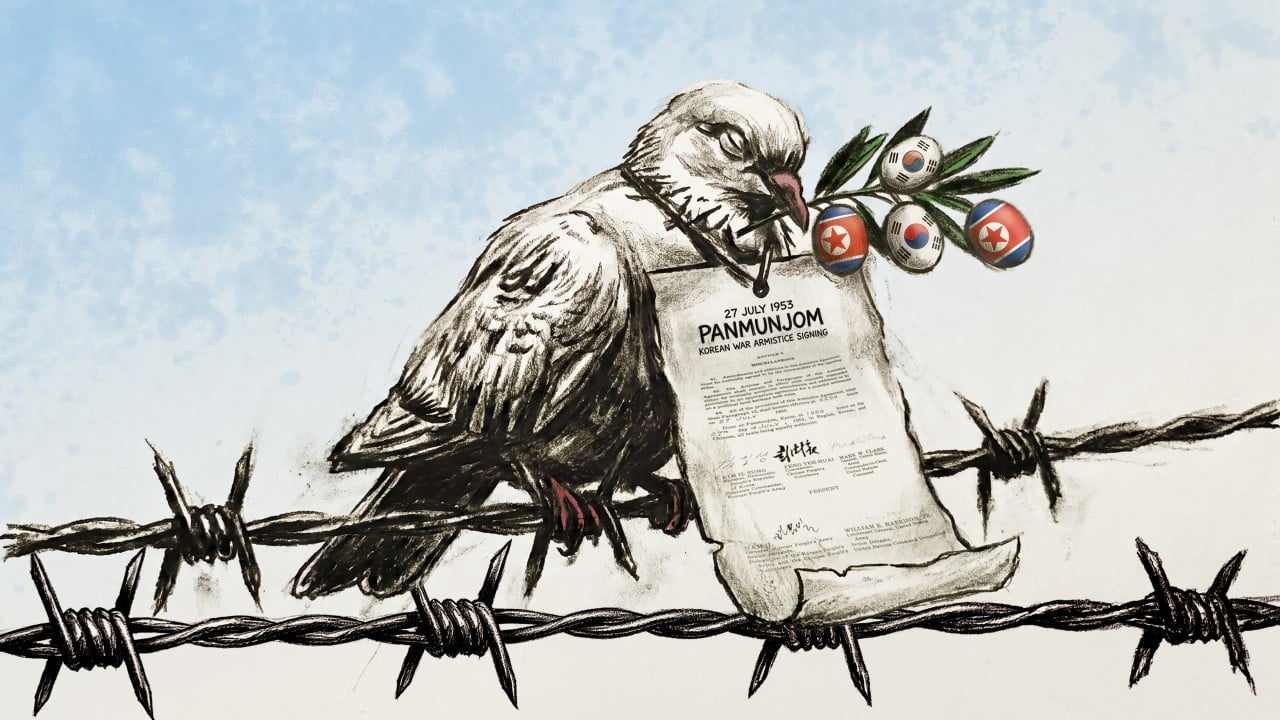
For decades, Washington has approached the Korean Peninsula through a lens of comforting self-deception. The official policy of the United States toward North Korea rests on a foundation of bureaucratic inertia, wishful thinking, and an institutional refusal to accept reality. The core premise remains frozen in time: that sustained diplomatic pressure, combined with incremental economic sanctions, will eventually force Pyongyang to abandon its nuclear arsenal.
It is a comforting fiction. Pyongyang has no intention of surrendering the nuclear deterrent it spent generations building. Every missile test, every artillery drill near the Northern Limit Line, and every vitriolic broadcast from state media serves as a direct message to the West. The regime views its nuclear weapons as the absolute guarantee of its survival. Until Washington confronts this foundational truth, America’s North Korea strategy will remain a cycle of expensive theater producing zero strategic progress.
The Anatomy of a Broken Doctrine
To understand why current policy fails, one must look closely at how the diplomatic machinery operates behind closed doors. For years, successive administrations have treated North Korea as a temporary diplomatic anomaly rather than a permanent nuclear-armed state. This misdiagnosis dictates every move. Sanctions are tightened, enforcement mechanisms are debated in the United Nations Security Council, and periodic envoys are dispatched with hopes of reviving stalled working-level talks.
Yet, the arithmetic of the situation has fundamentally changed. North Korea is no longer a developing nuclear program struggling with technical hurdles. It possesses a diversified, operational nuclear force complete with miniaturized warheads, solid-fuel intercontinental ballistic missiles designed for rapid deployment, and tactical nuclear systems tailored for regional conflict.
Sanctions were supposed to choke the regime into submission. Instead, they forced Pyongyang to adapt with ruthless efficiency. North Korea has constructed a shadow economy driven by state-sponsored cyber theft, cryptocurrency laundering, maritime smuggling networks, and lucrative military-technical cooperation with other isolated nations. The economic pressure points that Washington relies upon have lost their leverage. The ruling elite feels zero domestic political pressure to trade away their strategic insurance policy for promises of foreign aid or security guarantees that could vanish the moment a new administration takes office in the White House.
The Myth of Complete Denuclearization
The phrase "complete, verifiable, and irreversible denuclearization" rolls off the tongues of American diplomats with practiced ease. It sounds rigorous. It looks good in joint statements and congressional testimony. It is also an absolute fantasy.
No government in Pyongyang will ever voluntarily repeat the trajectory of Muammar Gaddafi in Libya. The lessons of the 2011 intervention resonate deeply within the walls of the Workers' Party headquarters. The calculation in Pyongyang is brutally simple: abandon your strategic deterrent and invite foreign intervention, or keep your weapons and ensure regime survival.
By tying all diplomatic engagement to the impossible precondition of total denuclearization, Washington effectively handcuffs its own hands. This absolutist stance prevents intermediate agreements that could actually reduce the risk of accidental escalation, limit the production of fissile material, or establish emergency communication channels to prevent a localized skirmish from spiraling into a catastrophic regional war.
Diplomacy requires a willing partner, but it also requires an objective assessment of what is negotiable. When Washington demands an outcome that North Korea perceives as existential suicide, negotiations become an exercise in performative frustration. The status quo persists not because both sides want it, but because American policy is trapped by its own rhetorical box.
The Geopolitical Realignment in Northeast Asia
The strategic landscape surrounding the Korean Peninsula has shifted dramatically, rendering traditional American deterrence mechanisms increasingly fragile. The post-Cold War consensus that once allowed for tentative international cooperation on non-proliferation has shattered.
Beijing views North Korea through the prism of its broader strategic competition with the United States. While Beijing has little love for erratic behavior from Pyongyang, it views a collapsed North Korean state—potentially resulting in a unified, pro-American Korea hosting United States military forces on its border—as an unacceptable geopolitical nightmare. Consequently, China has little incentive to enforce sanctions with the vigor Washington desires. Beijing prefers a managed, stable buffer state, even if that state remains heavily armed and defiant.
Simultaneously, Moscow and Pyongyang have forged a deeply transactional partnership born out of mutual isolation. The war in Ukraine opened a dark new chapter of cooperation. North Korea provides conventional artillery shells and ballistic missiles to feed the Russian war machine, receiving in return advanced aerospace technology, satellite assistance, and diplomatic shielding on the global stage.
This trilateral dynamic between Pyongyang, Beijing, and Moscow creates an environment where traditional American pressure tactics bounce off insulated shields. Washington can no longer rely on great-power consensus to isolate the regime. The diplomatic architecture designed in the late twentieth century is rusting away while regional adversaries adapt to a multipolar reality.
The Cost of Strategic Drift
Maintaining the current trajectory is not a neutral act. Every year that passes without a functioning diplomatic framework allows North Korea to refine its warheads, expand its fissile material stockpiles, and perfect its delivery systems. The qualitative leap from liquid-fueled missiles requiring hours of preparation to solid-fueled systems ready to launch on minutes' notice has fundamentally altered the strategic balance on the peninsula.
For the Republic of Korea and Japan, this evolution translates into acute anxiety. As the North Korean nuclear umbrella expands to threaten American cities, the credibility of the American extended deterrence commitment faces unprecedented scrutiny. Allies in Seoul increasingly whisper about sovereign nuclear options, questioning whether a distant superpower would risk Seattle to defend Seoul. This erosion of alliance trust is a direct byproduct of a stagnant American strategy that offers no credible path toward risk reduction.
Toward a Realistic Framework
Admitting failure is painful for foreign policy establishments. It requires dismantling comfortable dogmas and accepting messy compromises. Yet, the alternative is sliding blindly toward a crisis where miscalculation leads to the unthinkable.
A viable American strategy must abandon the illusion of immediate denuclearization and pivot toward pragmatic risk reduction. This means separating long-term disarmament goals from immediate, urgent crisis management.
Washington must explore arms control frameworks that freeze the production of new fissile material, establish verifiable caps on missile testing, and build robust crisis communication channels. These steps do not mean recognizing North Korea as a legitimate nuclear-armed power in legal theory. They mean acknowledging the physical reality on the ground in operational practice.
Detractors will argue that accepting a nuclear-frozen North Korea validates proliferation and demoralizes allies. That argument ignores the reality that North Korea is already a nuclear power, and the current policy of stubborn denial has only accelerated their arsenal's growth. Realism requires accepting the world as it is, not as policymakers wish it were.
The time for wishful thinking in East Asia has expired. Until Washington summons the political courage to discard outdated doctrines and face the brutal facts of the Korean Peninsula, American strategy will remain an exercise in managing decay while the threat grows unchecked in the shadows