The air inside a manufacturing plant has a specific vocabulary. It speaks in the low, rhythmic hum of heavy machinery, the sharp hiss of pneumatic valves, and the metallic tang of heated steel. To the people who work there, this cacophony isn’t noise. It is the sound of routine. It is the comforting acoustic proof that everything is going exactly as it did yesterday, and exactly as it will tomorrow.
On a crisp Tuesday morning in Port Angeles, Washington, that routine felt permanent. Workers at the Olympic Panel Products mill—a facility known for producing specialty plywood overlays—were deep into their shifts. Some were thinking about their lunch breaks. Others were planning their weekends. They were surrounded by the massive, pressurized equipment required to bind wood grains under intense heat and force.
Then, the hum stopped. It didn’t taper off. It was violently obliterated.
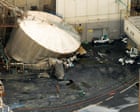
When a massive industrial pressure tank ruptures, there is no time to process the physics of the event. The atmosphere itself becomes an enemy. A catastrophic failure of this magnitude releases a shockwave that travels faster than the speed of sound, followed instantly by a wall of superheated steam and debris. In a fraction of a second, a workplace turns into a war zone.
The immediate aftermath was defined by a deafening, unnatural silence, quickly punctured by the screams of the injured and the wail of approaching sirens. First responders rushing toward the scene could see the plume from miles away. They knew they weren't driving toward a standard industrial accident. They were driving into a tragedy.
The Cost of the Heavy Industry
We live our lives insulated from the violent forces that build our world. The drywall in our living rooms, the pavement on our streets, and the engineered wood in our office buildings all require immense pressure and heat to exist. We demand these products, but we rarely think about the men and women who stand next to the machines that forge them.
Industrial manufacturing relies on an unspoken pact. Workers trade their sweat, their time, and their physical labor for a paycheck to support their families. In return, the machinery is supposed to be contained. The pressure is supposed to stay inside the steel.
When that pact breaks, it breaks absolutely.
Initial reports from the Port Angeles facility were chaotic, as they always are when disaster strikes. Early dispatches confirmed a massive explosion, but numbers fluctuated as emergency crews battled localized fires and structural instability. First, it was two confirmed dead. Then five.
As the hours stretched into days, the true scale of the horror began to crystallize. The search and rescue operation morphed into a grim recovery mission. First responders, trained to look for signs of life, found themselves navigating a labyrinth of twisted metal and collapsed roofing, knowing that every hour that passed reduced the probability of a miracle to zero.
The finality arrived when search teams recovered the bodies of the last remaining missing workers. The official death toll stalled at eleven. Eleven individuals who clocked in for a standard shift and never clocked out.
Consider what happens next in a small coastal community when eleven families simultaneously receive the knock on the door that every industrial worker’s spouse dreads. Port Angeles is not a faceless metropolis. It is a town where everyone is separated by a single degree of relation. You went to school with the victim’s brother. Your kids play Little League with the victim’s daughter. The cashier at the grocery store is grieving her uncle.
When eleven people die in a town like this, the loss isn't just a statistic. It is a tear in the fabric of the community itself.
The Anatomy of a Rupture
To understand what went wrong, we have to look at the silent mechanics of industrial failure. Large pressure vessels, like the tank that failed at Olympic Panel Products, are engineered with massive safety margins. They are built from thick, high-tensile steel, held together by welds that are scrutinized via X-ray technology, and monitored by redundant pressure relief valves.
But steel is not immortal.
Over years of constant operation, a pressure tank undergoes cyclic stress. It expands slightly when pressurized, and contracts when emptied. Imagine bending a paperclip back and forth. For a long time, nothing happens. The paperclip seems perfectly fine. But microscopically, the metal is fatiguing. Tiny, invisible fissures begin to snake through the grain of the steel.
If you combine cyclic fatigue with internal corrosion—often caused by the chemical byproducts of the manufacturing process—you create a ticking clock.
The terrifying reality of pressure vessel failure is that it often gives no warning. A pipe might leak before it bursts, offering a telling hiss or a puddle of fluid. A pressure tank, however, often fails through catastrophic tearing. The moment the internal pressure exceeds the degraded strength of the steel shell, the entire vessel rips open in milliseconds.
The energy released is equivalent to a military-grade explosive.
Investigators from the Occupational Safety and Health Administration (OSHA) and the U.S. Chemical Safety Board will spend months, perhaps years, analyzing the metal fragments from the Port Angeles plant. They will use electron microscopes to examine the failure points. They will audit maintenance logs, testing records, and corporate emails. They will reconstruct the final moments of the tank to find the exact root cause.
But these technical autopsies offer cold comfort to the families left behind. Finding out why a weld failed doesn’t bring back a father, a son, or a sister.
The Long Wake
The true weight of an industrial disaster is measured in the quiet days that follow the media's departure. The satellite trucks will pack up their dishes. The national reporters will move on to the next crisis. The yellow police tape will eventually be removed, leaving only a quiet, hollowed-out facility.
That is when the real mourning begins.
It happens in the kitchens where an extra plate is no longer set. It happens on Friday nights when a seat at the local diner remains empty. It is found in the sudden, suffocating financial anxiety felt by a family that has lost its primary breadwinner, forcing them to navigate the labyrinth of worker's compensation and legal battles just to keep their home.
We often talk about workplace safety as a bureaucratic check-the-box exercise. We view OSHA regulations as red tape that slows down business, or corporate safety briefings as tedious meetings to be endured.
They are not. They are the thin line between a regular Tuesday and a mass casualty event.
Every safety regulation on the books is written in someone’s blood. Every rule exists because someone, somewhere, died because it wasn't followed. When companies cut corners on maintenance, when inspectors rush through evaluations, or when warning signs are ignored to keep production lines moving, the cost isn't measured in dollars. It is measured in human lives.
The eleven souls lost at Olympic Panel Products were not martyrs for a cause. They were ordinary people doing extraordinary, difficult work to build the infrastructure of our country. They deserved to come home.
As the community of Port Angeles gathers to bury its dead, a heavy silence hangs over the Olympic Peninsula. The mills will eventually restart. The machinery will hum once more. But for eleven families, the silence left by the blast will never truly be filled.
A single, worn leather work boot rests in the dirt near the perimeter fence of the facility, overlooked by the cleanup crews. It is caked in sawdust and grime, completely still, waiting for a foot that will never step into it again.