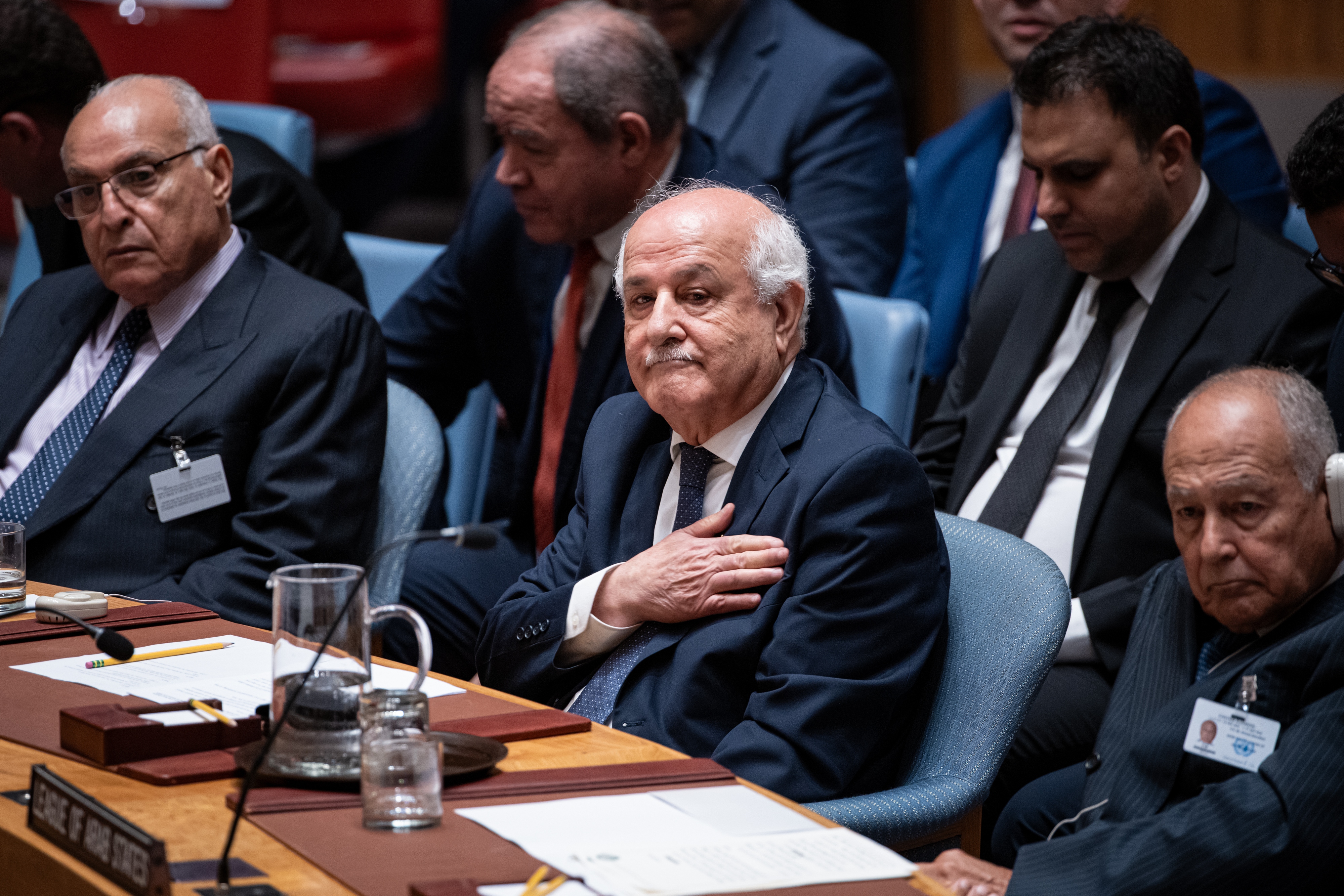
The United States Department of State operates on an unspoken hierarchy of leverage, where administrative mechanisms frequently substitute for open military or economic coercion. The sensitive but unclassified diplomatic cable issued on May 19, 2026, targeting the Palestinian Authority (PA) leadership in Jerusalem, represents a pure application of this mechanism. By threatening to revoke the visas of the Palestinian delegation to the United Nations unless Permanent Observer Riyad Mansour withdraws his candidacy for one of the 16 Vice President positions of the General Assembly (VPGA), Washington has exposed the structural friction between host-country statutory obligations and bilateral grand strategy.
This conflict is not merely a diplomatic spat; it is a calculated optimization problem. The U.S. executive branch is balancing its commitments under the 1947 U.N. Headquarters Agreement against the preservation of structural barriers to Palestinian institutional ascension. Deconstructing this event requires analyzing three distinct pillars: the structural mechanics of the host-country agreement, the strategic cost function of the Vice Presidential bully pulpit, and the operational leverage points of economic and administrative pressure.
The Host-Country Friction Vector
The legal foundation governing the presence of foreign diplomats in New York City is the 1947 United Nations Headquarters Agreement. Under Section 11 of the agreement, the United States is legally obligated to permit the transit of foreign representatives to and from the headquarters district, irrespective of bilateral relations. However, the U.S. maintains a parallel statutory framework under the Immigration and Nationality Act (INA), which grants the executive branch broad authority to deny or revoke visas based on national security, foreign policy objectives, or terrorism-related grounds.
The current escalation follows a clear trajectory of administrative containment:
- August 2025 (The Initial Denial): The State Department under Secretary of State Marco Rubio denied and revoked visas for PA President Mahmoud Abbas and approximately 80 other senior officials ahead of the U.N. General Assembly high-level week.
- September 2025 (The Conditional Waiver): The administration exercised executive waiver authority to insulate the permanent New York-based Palestinian Observer Mission from these sanctions, maintaining basic compliance with host-country obligations.
- May 2026 (The Revocation Threat): The current demarche explicitly signals that the September 2025 permanent mission waivers are under review. The explicit phrasing in the cable—"It would be unfortunate to have to revisit any available options"—reveals that the administration views the host-country agreement not as an absolute statutory boundary, but as a variable that can be reassessed when bilateral friction spikes.
[Statutory Framework Tension: INA Executive Authority vs. 1947 UN Headquarters Agreement]
The Cost Function of the Vice Presidential Bully Pulpit
To understand why the U.S. is willing to risk an unprecedented host-country crisis over a secondary leadership post, one must calculate the institutional power mechanics of the U.N. General Assembly (UNGA). While the President of the General Assembly (PGA) commands the primary agenda-setting authority, the 16 Vice Presidents are not purely ceremonial figures. They form the General Committee, which dictates the structural flow of the session, and crucially, they are deputized to chair the main plenary sessions when the president is unavailable.
The State Department cable explicitly outlines what it classifies as a "worst-case scenario": a future PGA assisting the Palestinian delegation by assigning them to preside over high-profile debates regarding the Middle East or during the high-level UNGA summit week in September.
This creates a triple-threat scenario for U.S. and Israeli diplomacy:
- Procedural Discretion: A Palestinian representative occupying the chair can rule on points of order, manage speaker lists, and set the temporal parameters of highly contested debates. This shifts the structural neutrality of the podium into an active vector for narrative control.
- Symbolic Legitimacy: Occupying the central podium of the UNGA accelerates the "backdoor statehood" strategy pursued by the PA. This strategy aims to accumulate the procedural trappings of full sovereign status without securing a formal UN Security Council recommendation, which the U.S. consistently blocks via its veto power.
- Strategic Amplification: Amb. Mansour has consistently labeled ongoing military operations in Gaza as a documented genocide. Elevating an official with this rhetorical posture to the formal leadership of the assembly would, in the estimation of the State Department, systematically undermine the current administration's 20-point comprehensive plan for Gaza and the establishment of its proposed Board of Peace.
Compounding Leverage: The Economic Sub-Text
The diplomatic cable reveals that visa revocation is only the primary tool in an escalating matrix of pressure. A secondary, highly tactical mechanism detailed in the instructions to U.S. diplomats involves the exploitation of the PA’s structural fiscal vulnerability.
Under a section of the cable designated "if raised," American diplomats are instructed to link the PA's compliance at the U.N. to the recovery of its withheld tax and customs revenues. Under the Paris Protocol of 1994, the Israeli government collects clearance revenues (tariffs and taxes) on behalf of the PA, transferring them monthly. These funds account for approximately 60% of the Palestinian Authority's total public revenue, serving as the financial baseline for civil service salaries and security infrastructure.
Since October 2023, Israel’s Finance Ministry has systematically blocked the transfer of these funds, driving the PA to the brink of fiscal collapse. The U.S. demarche intentionally positions these withheld revenues as a bargaining chip. The structural logic dictated by Washington is clear: if the PA continues to "internationalize" its disputes via U.N. candidacies or international judicial bodies like the International Criminal Court (ICC), the U.S. will cease any diplomatic mediation required to unlock the financial lifelines held by Jerusalem.
Strategic Forecasting and Systemic Limitations
The immediate tactical objective of the U.S. is to force a withdrawal before the formal UNGA elections on June 2, 2026. The PA is currently running as part of an agreed slate within the Asia-Pacific regional group, alongside nations such as Afghanistan, Iraq, and Mongolia.
The primary limitation of the U.S. strategy is the risk of institutional blowback. Expelling or disabling a recognized U.N. permanent observer mission via targeted visa manipulation damages U.S. diplomatic credibility among non-aligned states and invites structural countermeasures. It validates historical grievances that the physical location of the U.N. headquarters gives the host nation an asymmetrical and unfair veto over the composition of international bodies.
However, the PA operates under extreme structural constraints. Unlike its successful institutional maneuvers in 2012 (securing Non-Member Observer State status) or September 2024 (gaining enhanced seating privileges), the current confrontation pits a symbolic multilateral title against the immediate physical survival of its diplomatic mission in New York and the fiscal liquidity of its administration in Ramallah.
The preceding logic dictates that the Palestinian Authority will ultimately calculate that the marginal return of a symbolic UNGA vice presidency is vastly outweighed by the structural costs of complete diplomatic isolation and fiscal insolvency. Expect Ramallah to quietly alter its slate composition or withdraw Mansour's bid before the May 22 deadline set in the demarche, prioritizing institutional self-preservation over multilateral prestige.