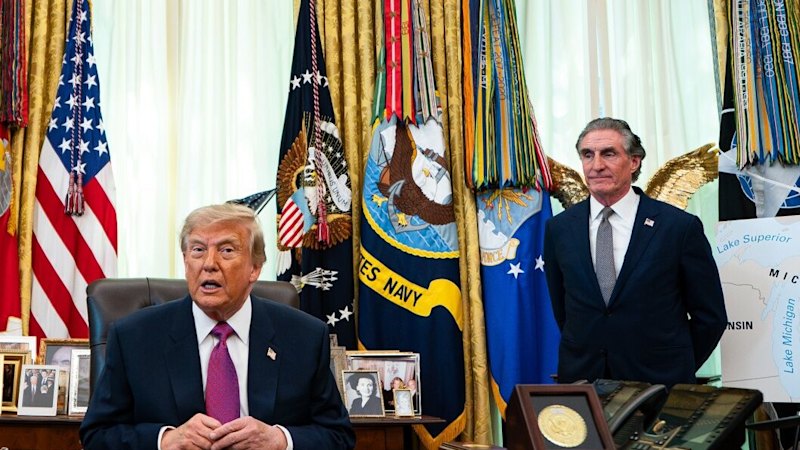
The American experiment was written by men who spent too much time reading ancient Roman history and too little time imagining a television star with a spray tan.
They designed a machine with heavy gears, slow pulleys, and long levers. They assumed the people operating the levers would feel a quiet, stubborn reverence for the room itself. They built an office for a gentleman farmer, a stern lawyer, a cautious general. They did not build it for an arsonist who discovered that burning down the courtroom brings bigger ratings than winning the case.
Consider what happens when a system built on norms encounters someone who views norms merely as doors to kick down.
For two centuries, the presidency functioned on a terrifyingly fragile foundation: mutual agreement. The Constitution is a remarkably short document. It tells you who gets to sleep in the building and how long they can stay, but it relies almost entirely on invisible ink. It assumes a shared baseline of shame. It assumes that if a leader is caught in a lie, the blood rushes to their face. It assumes that a subpoena carries the weight of a drawn sword.
What happens when the blood never rushes? What happens when the leader looks at the sword and decides to use it to clean his fingernails?
We watched this play out in slow motion over years of midnight social media posts, shattered precedents, and institutional gasps. Legal scholars sat in quiet television studios, blinking behind their glasses, pointing to clauses written in 1787 as if recitation alone could conjure a ghost to stop a living man. They treated the Constitution like a magical spell. Read the right words from the parchment, they believed, and the monster must vanish into smoke.
The monster just kept tweeting.
To understand why the system feels like it is tearing at the seams, you have to look at how power was actually meant to flow. The Founders feared a king. They split the authority into three separate branches, locking them in a perpetual, frustrating tug-of-war. Congress holds the purse strings. The courts hold the scales. The executive holds the sword.
It was a brilliant design for a nation of farmers who moved at the speed of a trotting horse. It was a terrible design for a nuclear-armed superpower navigating an age of instant communication and unchecked executive expansion.
Over the decades, Congress grew tired. Writing laws is hard. Taking votes on controversial issues requires courage, and courage is bad for reelection. So, lawmakers slowly, lazily handed their power over to the Oval Office. They let the executive branch write the regulations. They let the executive branch wage undeclared wars. They turned the presidency into an imperial throne, convincing themselves that their own party would always be the one sitting on it.
Then the chair was pulled out, and an outsider took the seat. Not a statesman. An anti-politician whose entire superpower was treating the sacred rituals of statecraft like garbage.
Think about the sheer psychological shock of an executive who treats the Department of Justice not as an independent sanctuary of law, but as his personal law firm. Think about the Attorney General being treated like a defense attorney whose primary job is keeping the client out of handcuffs. The founders had a name for this. They called it tyranny. But they assumed the tyrant would look like George III, draped in velvet and demanding obedience to the crown. They never imagined a tyrant wearing a red hat, broadcasting his grievances directly into the living rooms of millions of citizens who felt the country was already being stolen from them.
This is where the cold legal analysis of the evening news misses the human heart of the disaster.
The system was never built for an outlaw because an outlaw operates outside the shared reality that gives the system its power. If you play chess, and your opponent calmly picks up the rook, hits you over the head with it, and declares that the plastic horse is now the King of England, you can quote the rulebook until your voice goes hoarse. You are still bleeding on the carpet.
We saw this during the impeachment trials. We saw it during the grand juries. We saw it in the endless parade of federal indictments that read like crime thrillers written by a terrified historian. Each new charge was met not with contrition, but with a fund-raising email. The crimes were converted into currency. The institutional guardrails did not break because they were weak; they broke because they were never meant to absorb a politician who weaponized his own corruption as proof of his authenticity.
The average citizen looks at this and feels a deep, churning nausea. It is the feeling of walking across a frozen lake and hearing the ice crack beneath your boots. You look back at the shore, and the adults are standing there arguing about whether the lake is legally allowed to melt.
There is a comforting lie we tell ourselves about the rule of law. We teach children that nobody is above the law, printing it on posters in elementary school libraries right next to pictures of Abraham Lincoln. But the adult truth is far darker and far more fragile. The law only works if most people agree to pretend it has teeth, even when they could easily run away from it. It is a shared hallucination of order.
When a man steps into the highest office in the land and loudly announces that the hallucination is fake—that the judges are corrupt, that the press is an enemy, that the elections are rigged, that the laws only apply to the weak—the spell shatters.
And once the spell is broken, you cannot simply glue the wand back together.
You are left in the cold light of day, looking at a government machine that requires an operator of good faith, trapped in the hands of someone who discovered that breaking the machine makes you famous, wealthy, and untouchable. The founders left us a house with sturdy oak doors, but they forgot to install locks that can withstand someone willing to bring a sledgehammer to his own front porch.
The trial continues. The appeals wind their slow, pathetic way through courts that feel simultaneously too powerful and utterly helpless. But the real verdict was never going to be delivered by a jury of twelve peers in a drab Manhattan courtroom.
The verdict is being written every single day in the quiet realization of a public that watches the machinery of democracy grind to a halt, waiting for a savior who isn't coming, and realizing that the only thing keeping the ceiling from falling in is a set of rules that everyone has finally learned how to ignore.