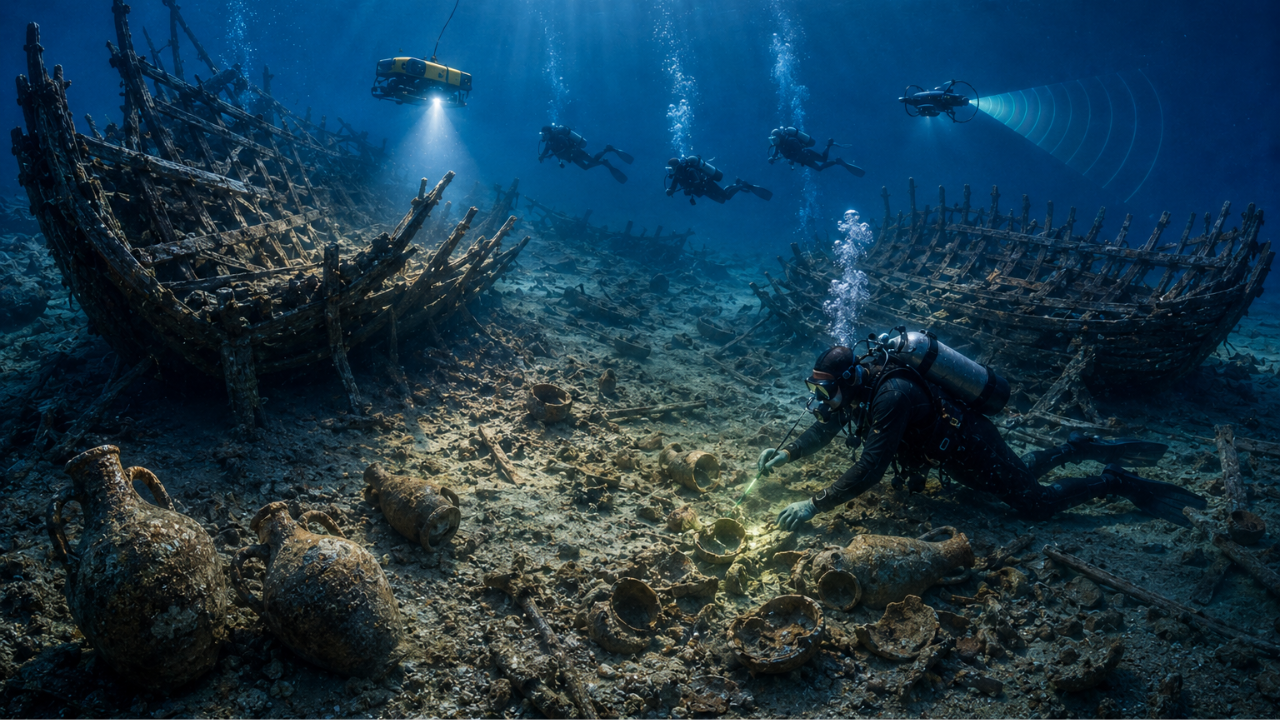
Stop celebrating the discovery of 150 shipwrecks in the Strait of Gibraltar as a victory for history. It isn't. It’s a symptom of a stagnant field that prioritizes counting barnacles over actual discovery. The mainstream media treats these "graveyards" like a chest of gold at the bottom of a cereal box, but anyone who has spent time analyzing maritime logistics or underwater survey data knows the truth. These sites aren't time capsules. They are industrial junkyards.
The romanticized narrative of the "Hidden 150" relies on the assumption that quantity equals significance. It doesn't. In the Strait of Gibraltar—a 36-mile gauntlet where the Mediterranean meets the Atlantic—finding a shipwreck is about as impressive as finding a used coffee cup on a subway platform. We are looking at a maritime bottleneck that has seen heavy traffic for three millennia. Of course there are wrecks. The real tragedy isn't that they sank; it’s that we are still pretending that finding them constitutes a "breakthrough."
The Physics of Failure in the Strait
The Strait of Gibraltar is a hydrographic nightmare. You have a massive inflow of Atlantic water layered over a dense, salty Mediterranean outflow. This creates a vertical shear that can toss a modern freighter, let alone a Phoenician galley or a 17th-century merchantman.
When a ship goes down in these waters, it doesn't land softly in a bed of silt to be preserved for eternity. It gets shredded. The Venturi effect—where water flow accelerates as it’s squeezed through a narrow opening—turns the seabed into a high-pressure sandblaster.
Most of these 150 "discoveries" are likely nothing more than scattered ballast stones, eroded anchors, and degraded hulls that offer zero new data to historians. We are obsessing over the debris of human error rather than the artifacts of human achievement.
The Underwater Survey Industrial Complex
Why do these stories keep surfacing? Follow the funding. Deep-sea exploration is expensive. To justify the burn rate of a Remotely Operated Vehicle (ROV) or a side-scan sonar array, you need numbers. "We found three culturally significant vessels" doesn't get the same headlines or grant renewals as "We discovered a massive graveyard of 150 wrecks."
This is the numbers game of marine archeology. By grouping disparate, low-value wreck sites into a singular "graveyard," explorers create a false sense of scale. They are inflating their assets.
I have seen private exploration firms burn through eight-figure budgets chasing "anomalies" that turn out to be discarded shipping containers or 19th-century coal barges. The industry is addicted to the hunt but allergic to the actual work of conservation and analysis. If you find 150 ships but lack the budget to excavate, stabilize, or even properly document 149 of them, you haven't discovered a graveyard. You’ve just mapped a landfill.
The Myth of the Time Capsule
People ask, "Don't these wrecks tell us about ancient trade routes?"
No. They tell us where ships sank.
A trade route is defined by the points of origin and destination, the economic forces driving the cargo, and the navigational logs of successful voyages. A shipwreck is a data point of failure. It is an outlier. Relying on shipwrecks to reconstruct history is like trying to understand the global aviation industry by only looking at black box recordings from crashes. You get a skewed, morbid, and fundamentally inaccurate picture of the "status quo."
Furthermore, the Gibraltar waters are a geopolitical mess. With overlapping claims between Spain, the UK, and Morocco, any significant find immediately becomes a legal hostage. The Nuestra Señora de las Mercedes case taught us that even if you find actual treasure, the lawyers will strip it cleaner than the currents ever could. These 150 ships will sit in a database, untouched and unstudied, while bureaucrats argue over who owns the rights to the rot.
Stop Looking for Ships, Start Looking for Systems
If we actually cared about history, we would stop chasing hull shapes and start looking at the logistics of the Strait itself.
The obsession with "the wreck" is a 20th-century hang-up. We should be using autonomous underwater vehicles (AUVs) to map the shifting sediment patterns that buried the ancient Phoenician and Roman ports along the coast. That is where the real history lies—in the infrastructure that worked, not the vessels that failed.
The "150 ships" headline is a distraction. It appeals to our primitive desire for "sunken treasure" and "mysteries of the deep." But the real mystery is why we continue to dump millions into discovering what we already know is there.
The High Cost of Discovery
Let’s talk about the math. To properly excavate and conserve a single wooden shipwreck from the 16th century, you are looking at a ten-year commitment and millions in chemical treatments (like Polyethylene Glycol) to prevent the wood from crumbling into dust the moment it hits the air.
Multiply that by 150.
It is physically and financially impossible to "save" these wrecks. By "discovering" them and publicizing their coordinates, we aren't protecting history. We are ringing the dinner bell for looters and trophy hunters. Professional treasure hunters don't care about the "150 hidden shipwrecks." They care about the one or two that might have a high-value cargo. The other 148 are just obstacles.
The Counter-Intuitive Truth
The best thing we can do for maritime history is to stop looking for more wrecks.
Leave them buried. The oxygen-depleted silt is a better preservative than any museum on land. Every time an ROV shines a high-intensity LED on a wreck site or a diver kicks up sediment, the clock starts ticking on its destruction.
We don't need another list of ships. We need a fundamental shift in how we value the past. A shipwreck isn't a monument; it’s a site of trauma and failure. The fact that the Strait of Gibraltar is full of them isn't a "discovery"—it’s a historical certainty.
Stop being impressed by the count. Start asking what we are actually doing with the data. If the answer is "nothing," then these 150 ships might as well have stayed hidden.
The sea doesn't give up its secrets for free, and right now, we are paying a premium for information that doesn't change a single page of the history books.
Walk away from the "graveyard." The real story is on the shore, in the archives, and in the trade patterns that actually survived the journey.