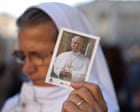
Silence in Rome does not arrive gently. It drops like stone into a marble well.
When the Vatican confirms that Pope Leo has lung cancer and that surgeons have removed the lower lobe of his right lung, the headlines strip the event down to clinical geometry. Diagnosis. Lobectomy. Right lower lobe. A bulletin printed on crisp paper, read aloud by men in black cassocks, translated within minutes into forty languages by reporters standing under the colonnades of St. Peter’s Square. Recently making waves recently: What Pope Leo XIV's Lung Cancer Diagnosis Reveals About Vatican Secrecy and Modern Medicine.
Yet a bulletin cannot hold the weight of a single breath.
Breath is how a shepherd speaks to a billion people without a microphone feeling like a wall. It is the fuel behind a blessing given in chilly morning air, the quiet pause before an apology, the slow expansion of ribs when a man is seventy or eighty or tired to his marrow. Remove a lobe of a lung, and you do not merely alter a CT scan. You alter the physical cadence of a life. Additional information on this are covered by WebMD.
I know what that alteration feels like from the inside of a hospital gown, though my name never appeared in a wire dispatch. Years ago, sitting in a fluorescent-lit consultation room while my own father waited on pathology results after a suspicious spot showed up on a routine chest X-ray, I learned how quickly time divides into before the scan and after the surgeon’s mark. The air in that small room smelled faintly of lemon floor wax and sharp alcohol. Every cough from down the hall sounded like a verdict.
That memory makes the Vatican’s announcement feel less like distant church politics and more like a room we have all stood inside.
The Quiet Architecture of a Single Breath
To understand what losing the lower lobe of the right lung actually means, strip away the robes and the Latin and look at the body as a bellows.
Your right lung is divided into three sections—upper, middle, and lower lobes—while your left lung has two to make room for the heart. Each lobe is a sponge of delicate air sacs called alveoli, where oxygen crosses a membrane thinner than tissue paper into the bloodstream and carbon dioxide leaves it. The lower lobes do heavy lifting when you stand upright; gravity pulls blood toward the bases of the lungs, making those lower regions rich in circulation and volume.
When a surgeon performs a lobectomy—removing an entire lobe rather than just a tiny wedge—they are taking out roughly twenty to twenty-five percent of that single lung, or around ten to twelve percent of total lung capacity, depending on exact anatomy and prior function.
Numbers look tidy on a chart. Twelve percent sounds small. You can walk across a room with twelve percent less lung volume. You can answer a question. You can sign your name.
Then try climbing a steep stone staircase in summer heat. Try speaking for forty-five minutes in a drafty basilica while a crowd surges and sways beneath a dome designed to echo every whisper. Try sleeping flat when your chest feels subtly lopsided, as if one side of an accordion has lost a pleat.
Consider what happens next in the weeks after surgery: the remaining lobes do not simply sit idle. Under the right conditions, the remaining lung tissue expands slightly to fill space in the chest cavity, and the diaphragm and intercostal muscles adapt. Pulmonary rehabilitation—slow, deliberate breathing exercises, gentle walking, sometimes measured incentive spirometry—teaches the body how to draw deeper, steadier breaths from what remains. Recovery is rarely a straight line. Some days the chest aches along the incision or rib line; other days the fatigue hits at two in the afternoon like a heavy wool coat dropped over the shoulders.
I still remember watching my father practice slow exhales in his armchair three weeks after thoracic surgery. His knuckles were white on the wooden armrests. "It takes work just to get to the kitchen," he admitted quietly, looking out at the rain on the patio. He wasn't complaining. He was naming a new physics.
What "Lung Cancer" Actually Means When the Word Is Spoken
The phrase lung cancer carries a dread that predates modern oncology. For decades, a lung cancer diagnosis sounded like an immediate closing door, largely because so many cases were discovered late, after symptoms like persistent cough, weight loss, or shortness of breath had already appeared.
Today, medicine is more nuanced—and more complicated. Lung cancer is not one disease; it is a family of malignancies with distinct cell types, growth rates, and genetic signatures. When caught early enough to be treated surgically with a lobectomy, removal of the affected lobe remains a primary curative-intent option for localized disease, often paired with thorough lymph node sampling so doctors know whether microscopic cells have traveled beyond the lobe itself.
Even then, uncertainty lingers like morning fog over the Tiber.
A biopsy and pathology report answer crucial questions—what kind of tumor it was, how deep it grew, whether margins were clear, whether targeted therapies, immunotherapy, or close surveillance are warranted—but answers do not erase anxiety. They reshape it. A family or a household learns to live in three-month or six-month intervals, measuring life by follow-up scans and blood panels.
To make the emotional stakes concrete, picture a hypothetical character—let’s call him Matteo, a retired parish sacristan in northern Italy who spent forty years lighting candles and ringing bells before dawn. When Matteo was told a shadow on his lower right lobe needed to come out, his first fear wasn't death on the operating table. His first fear was that he wouldn't be able to pull the heavy bell rope without gasping, or that his voice would thin out when reading aloud at evening prayer.
Matteo’s story is invented, a composite drawn from real conversations with patients and caregivers, yet his worry is real enough to touch. Public figures live under a sharper spotlight, of course. Every public appearance by Pope Leo will now be watched with forensic intensity. Did he pause longer between sentences? Did he sit when he usually stood? Did a slight tremor or breathlessness appear during a blessing?
There is an unfairness built into public life when illness strikes: the patient is trying to heal while millions of strangers treat every exhale as a diplomatic signal.
Beyond the Headlines: Why This Moment Matters
Why does a single medical update from the Vatican pull at people who may never set foot in Rome, or who don't share the Catholic faith?
First, because power and fragility rarely share the same frame so openly. We build institutions around permanence—ancient walls, centuries-old rituals, offices meant to outlast any single human being. Then a surgeon’s scalpel reminds everyone that the person inside the office is made of fragile tissue, vessels, and nerve endings, subject to the same cellular lottery as anyone else.
Second, because lung health touches an invisible vulnerability we all carry. You cannot see your own alveoli. Most of us take breathing for granted until something narrows the airway, dulls the breath, or puts a sharp ache beneath the ribs. Seeing a prominent leader confront lung cancer and lobe removal forces an uncomfortable reflection: What would change in my own daily rhythm if ten percent of my breathing capacity vanished tomorrow?
Consider what happens next when a high-profile diagnosis enters public view: misinformation spreads almost as fast as prayer. Rumors inflate a localized surgery into an imminent collapse, or minimize a serious cancer diagnosis into a routine snag. Real clarity lives in the middle ground—acknowledging the gravity of lung cancer and major chest surgery without surrendering to sensationalism.
There is also a quieter lesson about care. Behind every official statement stands a medical team—thoracic surgeons, anesthesiologists, oncologists, pulmonologists, nurses, physical therapists—working in coordinated precision while keeping a human being steady. And behind the patient stand caregivers who notice the small things: whether water is within reach, whether a draft from an open window is chilling the back of the neck, whether sleep came easily or in short, broken stretches.
When my father finally walked to the end of our driveway without stopping to catch his breath, nobody threw a parade. We just stood there on the gravel, listening to birds in the oak tree, letting the silence feel earned rather than heavy.
A lower lobe gone does not mean the song is over. It means the breath has to be gathered with more intention, given with more care, and received with a deeper gratitude for every quiet inhale that follows.
At dusk over St. Peter’s Square, as lamps flicker to life against deepening blue stone and a single voice rises into the evening air, the question isn't whether the lung has changed.
It is how fiercely that next breath is used.