The air inside the bridge of a modern container ship smells of stale coffee, ozone, and the quiet anxiety of thirty thousand tons of steel navigating a shifting maze.
For decades, the lifeblood of global trade has run through a suffocatingly narrow, sun-baked bottleneck. Sailors call it the Malacca Dilemma. To understand why nations like China and South Korea are suddenly looking at the frozen, unforgiving top of the world, you have to understand the sheer vulnerability of the waters they are trying to escape. For an alternative view, check out: this related article.
Picture a massive, modern vessel slicing through the tropical heat of the South China Sea. It is carrying microchips, electric vehicle batteries, or heavy industrial machinery destined for Rotterdam. To get there, it must squeeze through the Strait of Malacca, a waterway that narrows to just 1.7 miles at its tightest point. It is crowded, plagued by piracy, and politically volatile. If a geopolitical conflict or a freak maritime accident plugs that choke point, the economic pulse of East Asia drops instantly.
For Beijing and Seoul, that vulnerability is no longer acceptable. Related insight on this trend has been provided by TIME.
So, they turned their eyes north. To the Arctic. To a frozen wilderness that is rapidly turning into the world's newest, and most controversial, superhighway.
The Shrinking Map
Trade is a brutal game of time and fuel.
Under normal circumstances, a cargo voyage from a port like Busan in South Korea to a major European hub takes roughly 35 to 40 days via the traditional southern route through the Suez Canal. It is a journey plagued by rising transit fees, regional instability, and unpredictable delays.
Now, consider the Northern Sea Route, which hugs the icy coastline of Russia.
By cutting straight through the Arctic Circle, that same voyage drops to around 20 to 25 days. A nearly 40 percent reduction in travel time. For a massive shipping conglomerate, saving two weeks of journey time is not just a minor victory. It translates to millions of dollars saved in marine fuel, reduced labor costs, and the ability to squeeze more round trips into a single calendar year.
But the Arctic has never been open for business. For centuries, it was a graveyard for explorers, a place where pack ice crushed wooden hulls like eggshells and trapped crews in perpetual darkness.
What changed? The planet did.
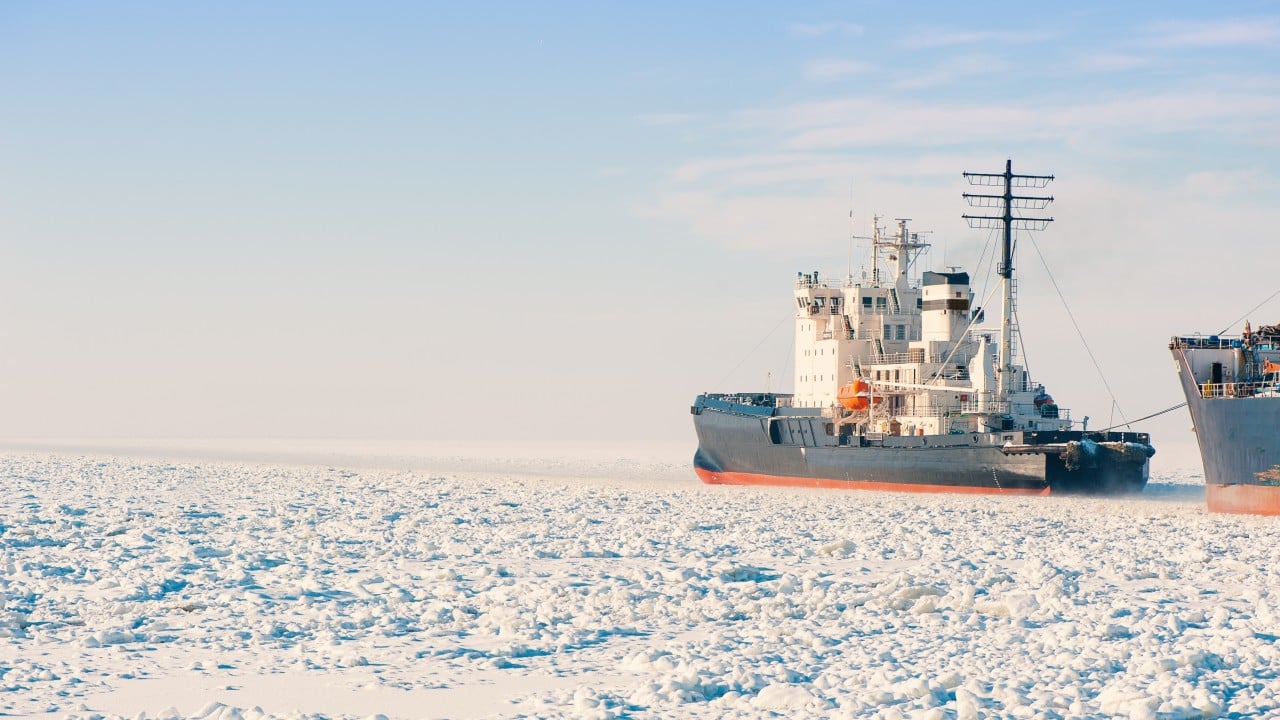
The ice is thinning at a rate that alarms scientists and excites boardrooms. Massive stretches of water that were once frozen solid year-round are now navigable during the summer and autumn months. What used to require specialized, heavily reinforced icebreakers can now be managed by commercial cargo vessels equipped with ice-strengthened hulls.
China recognized this shift early, declaring itself a "Near-Arctic State" in a bold geopolitical move designed to secure a seat at the table. They began investing heavily in the "Polar Silk Road," a vision of northern trade infrastructure backed by Chinese capital and Russian cooperation.
Yet, while China’s Arctic ambitions have drawn the lion’s share of global headlines, South Korea has been quietly building the actual foundation of this frozen frontier.
The Shipyards of Geoje Island
To understand South Korea's stake in the Arctic, you have to leave the frozen waters behind and travel to the humid, clangorous shipyards of Geoje Island on the country's southern coast.
Here, the air tastes of salt and industrial welding fumes. The scale of human engineering on display is dizzying. Gantry cranes as tall as skyscrapers lift blocks of steel weighing thousands of tons, assembling the behemoths that keep global commerce alive.
South Korea does not just want to sail the Arctic. They build the Arctic.
The country's shipbuilding giants—companies like HD Hyundai, Hanwha Ocean, and Samsung Heavy Industries—possess a near-monopoly on the construction of high-tech, ice-breaking commercial vessels. When the world needs a ship capable of carrying liquefied natural gas (LNG) through sub-zero waters without the aid of an independent icebreaker, they look to Seoul.
Consider the hypothetical scenario of a South Korean naval architect designing one of these vessels. Every weld must be calculated to withstand temperatures that can plummet to minus 50 degrees Celsius. Normal steel becomes brittle like glass under that kind of extreme cold. The shipyards must use specialized, expensive alloys and complex double-hull designs to ensure that if the ship strikes a stray chunk of multi-year pack ice, the hull flexes rather than fractures.
This gives South Korea a unique dual advantage.
As a manufacturing and export powerhouse, its economy relies entirely on sending goods outward. If the Northern Sea Route becomes a stable, predictable reality, South Korean exporters gain a massive competitive edge in reaching European markets. Simultaneously, even if the route takes decades to fully mature, South Korean shipyards win either way by building the highly specialized fleet required to test those icy waters.
The Shadow of the Bear
But this is not a story of clean, efficient corporate triumph. The Arctic is a geopolitical minefield.
The vast majority of the Northern Sea Route falls within Russia’s Exclusive Economic Zone. Moscow views this waterway as its ultimate national economic asset, a future toll road that can fund the state and bypass Western sanctions. To sail these waters, international shipping lines have historically had to request Russian permission, hire Russian ice pilots, and pay substantial transit fees.
This creates a profound moral and political dilemma for Asian powers.
China, operating under a policy of strategic partnership with Moscow, has shown little hesitation in deepening its Arctic cooperation with Russia. Chinese energy companies have poured billions into Siberian LNG projects like Yamal and Arctic LNG 2, ensuring a steady flow of natural gas directly to Chinese cities via northern waters.
For South Korea, the calculus is far more delicate.
Seoul is a close ally of the United States and the West. Following the geopolitical fracturing of recent years, South Korean companies have had to walk a razor-thin tightrope. They cannot afford to alienate their Western allies by openly bankrolling Russian state enterprises. Yet, they cannot afford to be left behind while China secures a monopoly on the shortest maritime route to Europe.
The stakes are entirely invisible from the comfort of a grocery store aisle or an electronics shop, but they dictate the price of everything we touch.
The Toll of the Cold
There is a human cost to this northern pivot that rarely makes it into the dry economic reports of maritime think tanks.
Sailing the Arctic is a psychological grind. On the traditional southern route, crews look out at blue water, passing ships, and the occasional distant coastline. It is predictable.
In the high Arctic, the world shrinks. The landscape is a monotonous, blinding expanse of white and grey. Fog can descend instantly, obliterating the horizon and reducing visibility to zero. The sun either refuses to set, destroying the crew’s natural sleep cycles, or vanishes entirely for months at a time.
Navigation equipment can behave erratically so close to the magnetic pole. The threat of a mechanical failure takes on a terrifying weight. If a ship loses power in the Indian Ocean, help is usually a few hours away. If a ship loses power in the Laptev Sea, hundreds of miles from the nearest human settlement, rescue could be days or weeks away.
Furthermore, the environmental stakes are catastrophic.
The Arctic ecosystem is incredibly fragile. A major heavy fuel oil spill in these cold, remote waters would be virtually impossible to clean up. The bacteria that naturally break down oil in warmer climates do not exist or work painfully slowly in sub-zero temperatures. The oil would become trapped under moving ice sheets, poisoning whale calving grounds, seal populations, and indigenous fishing waters for generations.
Many environmental organizations have called for a complete ban on commercial shipping in the region. Some major Western consumer brands and shipping lines have even pledged never to use the Arctic routes.
But the economic gravity of the East is pulling hard in the opposite direction.
The Long Game
It is tempting to look at the current numbers and dismiss the Arctic shipping boom as hyperbole. The total volume of cargo moved through the Northern Sea Route is still a tiny fraction of the immense tonnage that passes through the Suez Canal every day. The northern season is short, lasting only a few months of the year, and the costs of insurance and ice-class vessels remain prohibitively high for routine, low-margin goods like textiles or plastic toys.
But Asian planners do not think in financial quarters. They think in decades.
They see a world where global climate patterns are fundamentally altered, where traditional maritime choke points are increasingly unstable, and where the nation that controls the fastest trade routes controls the flow of global wealth.
They are willing to endure the high costs, the political scrutiny, and the technological hurdles today because they want to ensure they aren't locked out of the world's newest ocean tomorrow.
Back on the bridge of that cargo ship, the captain watches the radar screen. A faint, glowing line indicates a break in the ice pack a few miles ahead. The engines hum, a deep, vibrating thrum that rattles the floorboards, pushing thousands of tons of metal through a passage that, for the entire history of human civilization, was impassable.
The ice groans against the steel hull, a metallic shriek that echoes across the empty, frozen expanse, signaling the quiet, relentless rewriting of the global map.