For decades, mainstream macroeconomics operated like a weather forecaster who could tell you a storm was coming, but had zero idea how individual raindrops behaved. The field relied on crude, aggregate equations that treated national economies as massive, unthinking blobs. When inflation spiked or unemployment surged, central banks pulled massive policy levers in the dark, often crashing the system into deeper recessions.
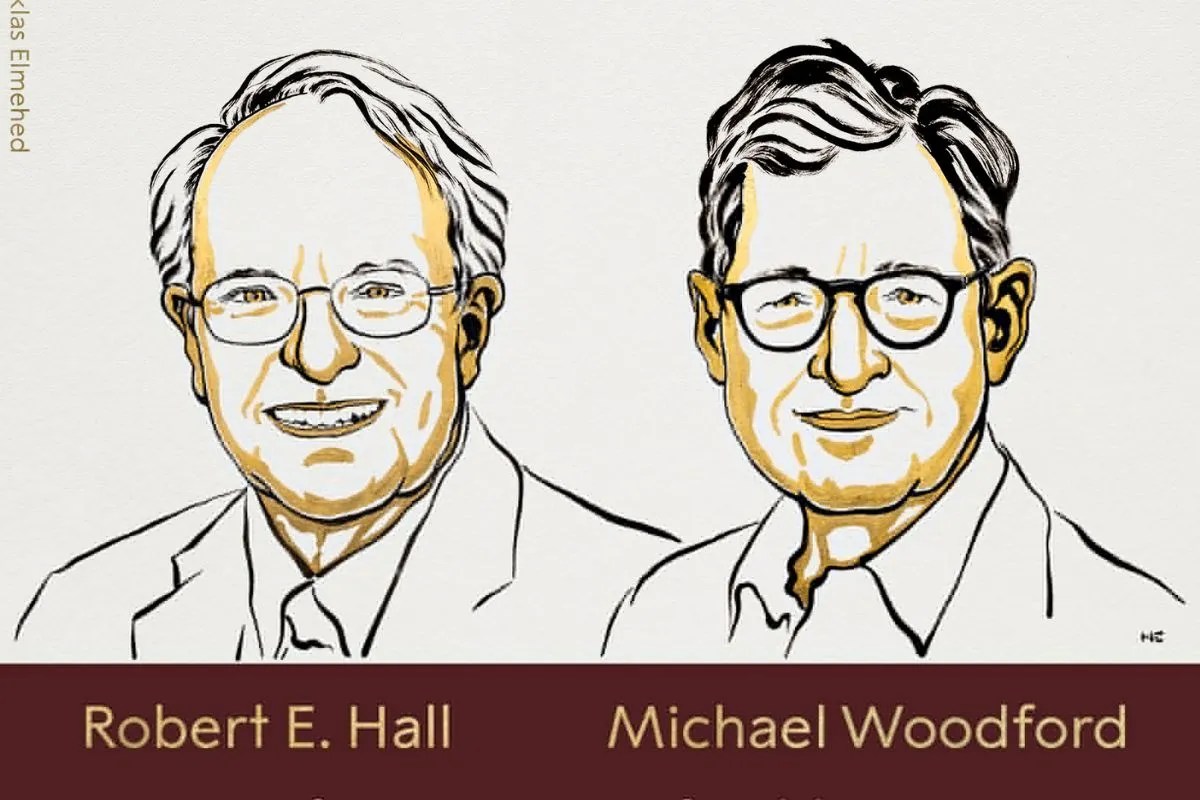
The Royal Swedish Academy of Sciences fundamentally shifted that reality by awarding the 2026 Sveriges Riksbank Prize in Economic Sciences in Memory of Alfred Nobel to two American economists: Robert E. Hall of Stanford University and Michael Woodford of Columbia University.
They received the prize "for microeconomic foundations of macroeconomic stabilisation".
Translation? They figured out how individual human choices and expectations build the engine of the entire national economy. Without their decades of theoretical architecture, modern central banks would still be flying blind during global crises.
The Broken Machinery of Old Macroeconomics
To understand why Hall and Woodford’s work matters, look backward. For a long time, traditional Keynesian economics treated households and businesses as passive aggregates. Governments assumed that if you pulled a specific fiscal or monetary lever—like lowering interest rates—consumers would respond in a predictable, mechanical fashion.
It worked reasonably well until the 1970s. Then reality struck.
Stagflation arrived. Economies suffered simultaneously from stagnant growth, soaring joblessness, and runaway inflation. Traditional models broke down entirely. Central bankers tried to stimulate growth, but instead of reducing unemployment, they poured fuel on an inflation fire. Disillusionment swept the profession. Many critics argued that macroeconomic intervention did more harm than good and should be abandoned altogether.
The core issue was a missing link. Macroeconomists were trying to manage a system-wide machine without understanding the micro-level gears driving it. They lacked a credible theory of how regular people actually make decisions about spending, saving, and anticipating the future.
Robert Hall and the Consumption Puzzle
Robert Hall entered this intellectual vacuum with a radical proposition. In a landmark 1978 paper, Hall turned traditional research upside down.
Before Hall, economists believed they could forecast consumer spending by tracking historical trends and expected future income changes. Hall argued the exact opposite. He demonstrated that if consumers are rational and forward-looking, changes in consumption cannot be predicted using past data.
Think about how people behave in the real world. A worker does not blindly spend based on last year's paycheck. Instead, they react to new information—an unexpected layoff, a sudden promotion, or an abrupt shift in economic policy. Because truly new information is inherently unpredictable, changes in consumer spending are equally unpredictable.
This insight solved a decades-old puzzle. It established the modern foundation for how economists analyze consumption, proving that aggregate demand is heavily driven by shifting expectations rather than mechanical formulas.
Michael Woodford and the Architecture of Expectations
If Hall provided the crucial building block regarding consumer behavior, Michael Woodford supplied the master blueprint for the entire monetary system.
By the 1990s and early 2000s, Woodford integrated these microeconomic insights into what became known as New Keynesian models. He formalized how monetary policy actually works through the lens of expectations.
Consider a hypothetical scenario. Imagine a central bank announces it will keep interest rates low for the next three years to combat a slowing economy. Under older models, the public only cared about what the interest rate was today. Woodford proved that what matters just as much—if not more—is what people believe the interest rate will be tomorrow, next year, and five years from now.
This theoretical breakthrough birthed forward guidance, the modern communication strategy where central banks use clear public statements to steer financial markets and stabilize economic activity before a crisis even fully materializes. Woodford showed that monetary policy is largely management of expectations. If financial markets believe a central bank is credible, the mere promise of future action alters current spending and investment behavior immediately.
Why This Matters Beyond Wall Street
It is easy to dismiss these Nobel-winning theories as ivory-tower abstractions. Yet, their real-world fingerprint is everywhere.
When the 2008 global financial crisis hit, and later when the COVID-19 pandemic threatened total economic collapse, central banks around the world did not repeat the blind mistakes of the 1970s. Armed with New Keynesian frameworks rooted in Hall and Woodford's foundations, policymakers deployed aggressive stabilization strategies. They acted with an understanding of how household balance sheets, liquidity constraints, and market psychology interact.
Recessions and inflation spikes have not vanished from the earth. But because of these two scholars, modern downturns are less frequently compounded by catastrophic policy errors. The global economy is equipped with shock absorbers that did not exist half a century ago.
The next time a central bank announces a shift in policy rates and markets react instantly before a single dollar changes hands, remember the quiet revolution engineered by Hall and Woodford. They mapped the invisible network connecting human psychology to the global balance sheet, permanently changing the way the world survives a crisis.