The smell of gasoline and hot iron has a way of violently pulling you back to childhood. For decades, the American Saturday sounded like a collective, roaring chorus of two-stroke engines. We accepted the ritual without question. You drag the heavy steel machine out of the garage, yank a frayed pull-cord until your shoulder aches, and spend two hours walking in mind-numbing circles while inhaling particulates and deafening the neighborhood.
We called it character building. In reality, it was just a tax on our finite time.
Consider David. He is not a statistic; he is your neighbor. He is the guy who works fifty hours a week, manages a mortgage, and tries desperately to stay present for his two young daughters. Last July, on a suffocatingly humid afternoon, David stood in his backyard, sweat stinging his eyes, staring at a patch of crabgrass that seemed to grow faster than his savings account. His lower back throbbed from hauling bags of clippings. His daughters were inside, asking for the third time if he could come play.
"In a minute," he called out.
But minutes are the currency we can never earn back. That evening, as David nursed a glass of water and a sore lumbar spine, he looked out at the lawn. It looked fine. Not perfect, just fine. He realized he had traded his only free afternoon of the week for a slightly shorter uniform patch of green.
That is the exact moment the idea of a robot mower stops being a lazy luxury and starts looking like an act of desperation.
The Ghost in the Grass
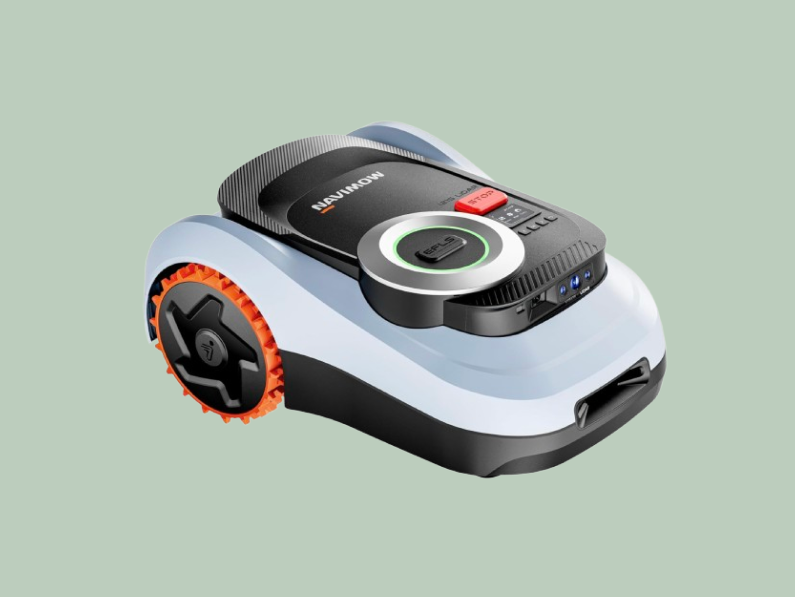
When people first see a robotic lawn mower, the reaction is almost always the same. They laugh. It looks like an oversized, hyper-futuristic ladybug wandering aimlessly across the turf. It lacks the terrifying, aggressive blades of a John Deere. It does not roar. It purrs.
But beneath that unassuming plastic shell lies a massive shift in how we interact with our immediate environment.
To understand why these machines work, you have to understand how traditional mowing actually harms your lawn. We are conditioned to let the grass grow long, hack off three inches at once, bag it, and throw it away. This shocks the plant. It creates a cycle of stress, requiring more fertilizer, more watering, and more intervention to keep the grass looking healthy.
The robot operates on a completely inverted philosophy. It lives on the lawn. Every single day, it ventures out, slicing off mere millimeters of grass at a time.
These tiny, microscopic clippings do not need to be bagged. They drop straight down into the soil, decomposing within hours. This is a natural process called grasscycling. The clippings act as a constant, free, organic fertilizer, rich in nitrogen.
The result is a strange paradox. The machine that looks like a toy actually produces a turf quality that rivals a golf course. Because the grass is never shocked by a massive cutting, it grows thicker. Weed seeds are choked out before they ever see the sun.
The Invisible Fence and the Brains Behind It
The biggest hesitation David had—and perhaps you have too—was the logistics. How does it not end up at the bottom of the swimming pool? How does it avoid the family dog or the stray soccer ball left in the driveway?
For years, the technology relied on a physical perimeter wire. You, or an installer, had to pin a low-voltage wire around the entire edge of your property, mapping out flowerbeds, trees, and patios like a subterranean electric fence. If the wire broke because a rogue mole chewed through it, you were stuck playing detective with an AM radio finder to locate the break. It was tedious. It was frustrating.
The industry shifted. Today, the choice splits down a clear technological fault line.
On one side, you still have the perimeter wire models. They are cheaper, remarkably reliable once installed, and completely immune to trees blocking satellite signals. On the other side lie the wireless, GPS-driven machines. These units utilize Real-Time Kinematic (RTK) network systems. By communicating simultaneously with satellites and a fixed base station on your roof, they can pinpoint their location to within a single centimeter.
You map your yard using an app on your phone, tracing the boundaries like you are playing a video game. The robot remembers. It navigates around the old oak tree, pauses for a curious cat, and returns to its charging dock when rain begins to fall.
But this brings us to the hard, unvarnished truth about the investment.
The Cold Math of Free Time
Let us look at the numbers because sentimentality does not pay the bills. A decent, reliable robotic lawn mower requires an upfront investment anywhere from $800 to upwards of $3,500 for massive, complex yards with steep slopes.
That number stings. It is significantly higher than a standard gas-powered push mower.
+--------------------------+---------------------+---------------------+
| Feature                  | Traditional Gas     | Robotic Wireless    |
+--------------------------+---------------------+---------------------+
| Upfront Cost             | $300 - $600         | $800 - $3,500       |
| Annual Maintenance       | Gas, Oil, Spark     | Replacement Blades  |
|                          | Plugs (~$60)        | (~$20)              |
| Human Labor Required     | 1-2 Hours / Week    | Virtually Zero      |
| Lifespan                 | 8 - 10 Years        | 5 - 8 Years         |
| Noise Level              | 90 - 100 dB         | 55 - 60 dB          |
+--------------------------+---------------------+---------------------+
A gas mower demands fuel, spark plugs, air filters, and oil changes. The robot runs on electricity. Charging it costs pennies a week. The only recurring physical maintenance is swapping out the small, razor-like blades every few months, a process that takes five minutes and a standard screwdriver.
But the real calculation is not financial. It is behavioral.
If you value your time at even $25 an hour, and you spend two hours a week mowing and edging for thirty weeks of the year, you are spending $1,500 worth of your life annually on lawn care. Within two seasons, the robot has not only paid for itself; it has handed you back sixty hours of your life.
What is the catch? There is always a catch.
Robots are maintainers, not reclaimers. If you let your yard grow into a primordial jungle over three weeks of vacation, a robot cannot save you. Its tiny blades will stall in five-inch-tall grass. It requires you to have a relatively clean yard—free of deep potholes, fallen branches, and toys.
Slopes can also be a brutal adversary. While premium four-wheel-drive models can handle inclines up to 45%, standard models will lose traction on steep hills, spinning their wheels until the battery dies, leaving them stranded like a flipped turtle.
The Friction of the Neighborhood
There is an unexpected psychological cost to adopting this technology. It changes how people look at you.
When David first set his robot loose, his neighbor from across the street, an older gentleman named Frank who took immense pride in his pristine lawn, stood at the edge of the asphalt and watched with crossed arms. Frank’s expression was a mix of skepticism and mild offense. To Frank, mowing the lawn was a civic duty. It was proof of discipline. Letting a machine do it felt like a moral failure, a symptom of a generation looking for shortcuts.
Then, three weeks passed.
Frank’s lawn looked good, as it always did, though it had those distinct, slightly browned tips that happen when a heavy tractor blade rips through the grass. David’s lawn, however, looked immaculate. It looked like a velvet carpet. Because the robot cut a fraction of an inch every day, the yard never looked overgrown, even after three days of heavy rain that kept Frank trapped indoors.
One evening, David saw Frank standing by the fence, staring intensely at the little machine as it quietly trimmed the border along the hydrangeas.
"Doesn't make much noise, does it?" Frank asked, not looking up.
"About the same as a refrigerator," David replied.
Frank nodded once, a slow, conceding gesture. The old guard was recognizing that the ritual was changing.
The True Cost of Silence
We live in a world that is incredibly loud. We are bombarded by notifications, traffic, and the low-frequency hum of anxiety. The traditional weekend was always an extension of that noise.
The real transformation happens on a Sunday morning. You sit on your back porch with a cup of coffee. The sun is just starting to burn off the dew. Usually, this is the window where someone down the block starts up their loud machinery, shattering the peace.
Instead, you watch a small, silent device glide across your grass. It clips a blade here, a blade there. A robin hops along behind it, completely unbothered, picking earthworms out of the freshly trimmed canopy.
You are not working. You are not sweating. You are just watching your life happen, unburdened by a chore that was passed down to you simply because our ancestors didn't have a better option.
David finally went inside that hot July day. He left the backyard to the machine. He sat on the floor of the living room and helped his daughters build a sprawling, structurally unstable blanket fort. They laughed until their stomachs hurt. Outside, the silent machine kept moving, erasing the evidence of neglect, yard by yard, hour by hour, giving a father his afternoon back.