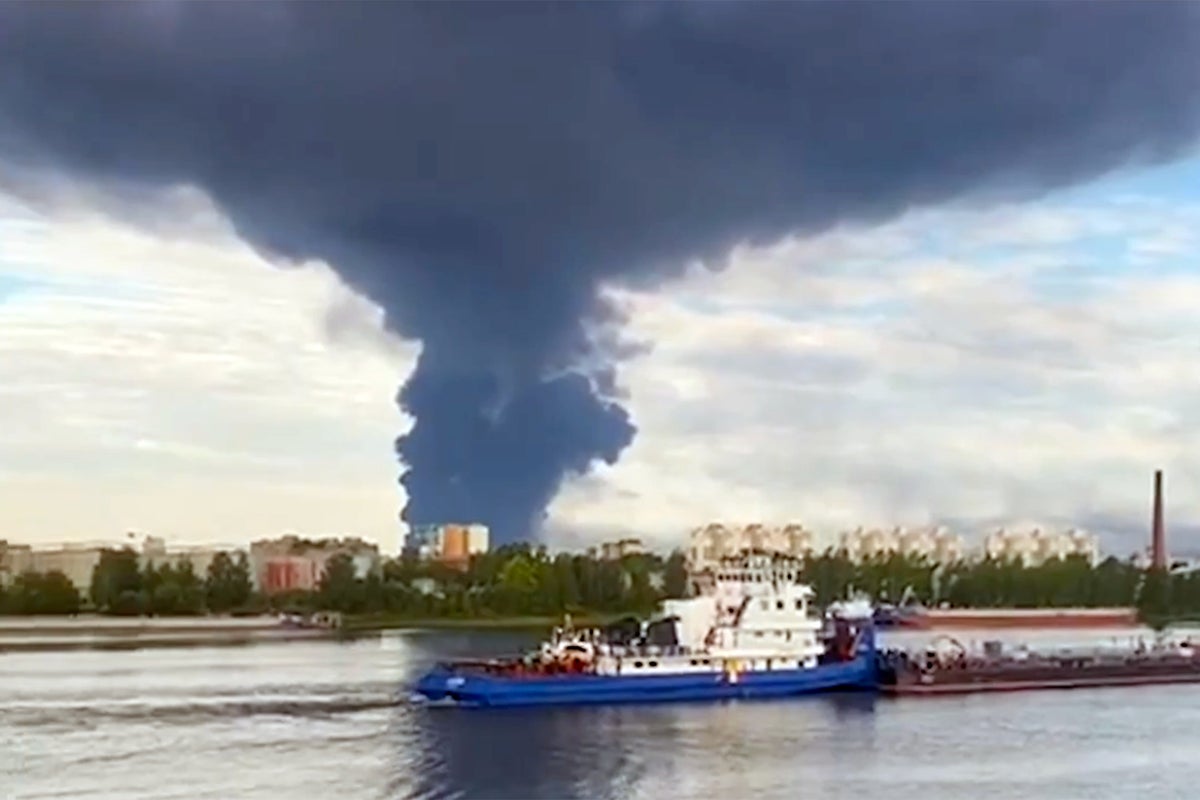
Ukraine has executed a drone strike against a Russian oil refinery located more than 1,300 kilometers behind the front line, an operation confirmed by President Volodymyr Zelenskyy that fundamentally shifts calculations about strategic depth in modern armed conflict.
Distance was once an absolute shield. Major powers operated under the assumption that industrial assets tucked deep within continental landmasses remained safe from direct kinetic attack unless targeted by intercontinental ballistic missiles or stealth strategic bombers. That doctrine is dead. A constellation of inexpensive, long-range unmanned aerial vehicles is rewriting the geography of war, turning vast territorial space from a protective cushion into an administrative liability.
When a low-cost, propeller-driven aircraft can cross twelve hundred miles of heavily monitored airspace to strike a multi-billion-dollar distillation column, the entire equation of modern deterrence collapses. Traditional air defense systems, engineered over decades to intercept fast-moving fighter jets and supersonic cruise missiles at high altitudes, face an acute geometric crisis when confronted by slow, low-flying drones skimming tree lines at commercial flight speeds.
The Logistics of Deep-Targeting
Operating an unmanned aircraft across a thirteen-hundred-kilometer vector requires more than simply strapping explosives to a fiberglass frame. Navigation systems face relentless electronic warfare interference, meaning onboard computers must rely on terrain-matching optical guidance and inertial navigation systems that function entirely independently of GPS.
The logistical footprint is remarkably decentralized. Unlike a conventional military airbase requiring hardened runways, fuel bowsers, and specialized maintenance crews, long-range kamikaze drones often launch from modified civilian transport trucks parked in unremarkable industrial parks or secluded rural clearings. This modularity strips away the defender's ability to preemptively neutralize launch sites. You cannot bomb every square mile of forest or secondary road network.
Refineries represent particularly fragile nodes in this equation. These sprawling industrial complexes are difficult to harden against vertical attack. Distillation towers, catalytic crackers, and atmospheric fractionators are massive, open-air installations exposed to the elements. They cannot be placed inside concrete bunkers without halting the continuous chemical processes required to refine crude oil into usable fuel.
[Launch Point] ---> [Terrain-Matching Navigation] ---> [Electronic Warfare Jamming Resistance] ---> [Target Impact: Distillation Column]
Economic Attrition by Design
Strategic bombing campaigns of the twentieth century relied on heavy strategic bombers carrying tens of thousands of pounds of ordnance, costing millions of dollars per sortie. The current asymmetric model turns that economic logic inside out.
Building a long-range one-way attack drone costs a fraction of the missile interceptor required to shoot it down. When an air defense battery fires a multi-million-dollar surface-to-air missile to destroy a ten-thousand-dollar drone, the defender is losing an unsustainable financial war of attrition, even if every single incoming threat is successfully intercepted.
Russia's internal fuel market has absorbed sustained shockwaves as these attacks accumulate. Regional shortages, export bans, and emergency repair delays compound over time. Spare parts for advanced cracking units often rely on Western technology that remains difficult to source under stringent economic sanctions. Replacing a specialized valve or digital control system requires months of circuitous smuggling through third-party intermediaries, leaving damaged facilities operating at reduced capacity or sitting idle entirely.
The Shrinking Safety Bubble
Military planners across the globe are currently redrawing their maps. The sanctuary of interior airspace has vanished. Command nodes, logistics hubs, and manufacturing centers previously considered safe from conventional attack now find themselves exposed to cheap, autonomous threats launched by adversaries operating from hundreds of miles away.
This reality forces a massive diversion of military resources. Air defense assets that were once concentrated exclusively along active front lines must now be pulled back to protect domestic infrastructure, electrical grids, and fuel depots. Every Patriot system, every Pantsir battery, and every electronic warfare station redeployed to defend an oil refinery deep within the interior is a system absent from the tactical battle zone where infantry units are fighting for ground.
The strategic doctrine of depth is being replaced by the doctrine of omnipresence. If every square kilometer of territory can be reached by low-cost autonomous munitions, national security ceases to be about holding geographic distance and becomes entirely about active, localized detection and mitigation.
The smoke rising from distant distillation columns is not merely the aftermath of a localized tactical strike. It is the visible sign of a structural transformation in how industrialized nations wage war against each other's economic lifeblood, proving that distance is no longer a defense against imagination and ingenuity