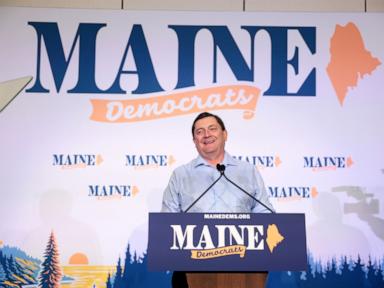
Political party apparatuses operate under strict structural constraints when facing mid-cycle candidate displacement. The nomination of former Maine Senate President Troy Jackson by a state party convention in July 2026 demonstrates how institutional machinery absorbs candidate failure, reallocates accumulated delegate capital, and recalibrates general election strategy within tight statutory windows.
The structural crisis emerged from the withdrawal of the original Democratic nominee, Graham Platner, following external allegations. This event ruptured the primary-winning coalition, leaving a temporal vacuum just days before the state's legal deadline to substitute a candidate on the November ballot. The party structure utilized a rapid, county-level delegate selection process to channel residual momentum into a replacement mechanism.
The Three Structural Pillars of the Jackson Consolidation
The rapid transition from primary chaos to convention consensus was driven by three distinct operational advantages held by Jackson relative to alternative contenders.
- Pre-Existing Organizational Infrastructure: Having finished third in the state's gubernatorial primary just weeks prior, Jackson retained active voter networks, donor loops, and an aligned bloc of county-level delegates who transitioned directly into the Senate replacement effort.
- Geographic Identity Arbitrage: As a fifth-generation logger from northern Maine, Jackson commands a regional credibility profile that mirrors the geographic base of five-term incumbent Republican Senator Susan Collins. This positioning neutralizes the geographic penalty typically suffered by urban-centric progressive candidates in northern counties.
- Labor Movement Alignment: Institutional backing from organized labor provided an immediate ground-game engine, bypassing the need to construct a grassroots mobilization framework from zero during a compressed 101-day general election cycle.
The Cost Function of Campaign Compression
Operating a senatorial campaign on a truncated timeline introduces severe resource constraints and operational bottlenecks.
[Primary Disruption] -> [Delegate Realignment] -> [Resource Compression] -> [General Election Exposure]
The financial mechanics of this replacement present an asymmetric disadvantage. While external conservative super PACs, including the Senate Leadership Fund, have committed substantial capital reserves exceeding forty million dollars to target the seat, Jackson enters the contest with lower baseline fundraising velocity. Furthermore, public distancing from national party leadership structures—exemplified by Jackson stating he would not support Senator Chuck Schumer continuing as Democratic leader—creates friction with national campaign committees responsible for independent expenditure parity.
Strategic Cause and Effect in the General Election
The matchup between Jackson and Collins hinges on voter segmentation across Maine's unique political geography. Collins has historically captured crossover independents and moderate Democrats by maintaining an image of localized independence. Jackson’s strategy relies on shifting the voter calculus from personal brand loyalty to economic class lines.
By emphasizing progressive economic interventions—such as Medicare for All, corporate taxation structures, and labor protections—alongside rural working-class identity, the campaign attempts to recapture the working-class demographic that split between populist economic messaging and traditional conservative voting patterns.
However, external vulnerabilities remain quantifiable. Republican messaging focuses on tying Jackson to the abandoned campaign he inherited, characterizing his platform as fiscally unsustainable, and highlighting past volatile interactions in the state legislature. The efficacy of these counter-narratives will determine whether independent voters view Jackson as a viable populist alternative or a departure from mainstream political norms.
Operational Execution for the General Election Cycle
To optimize resource allocation over the final quarter before the election, the campaign must execute two primary operational priorities:
- Geographic Resource Targeting: Deploy coordinated labor ground-operation teams exclusively within high-density working-class districts in northern and eastern Maine to counter the incumbent's entrenched institutional familiarity.
- Fiscal Risk Mitigation: Establish direct-to-voter digital fundraising streams to offset the anticipated influx of multi-million-dollar external opposition advertising without relying on traditional national leadership funding channels.