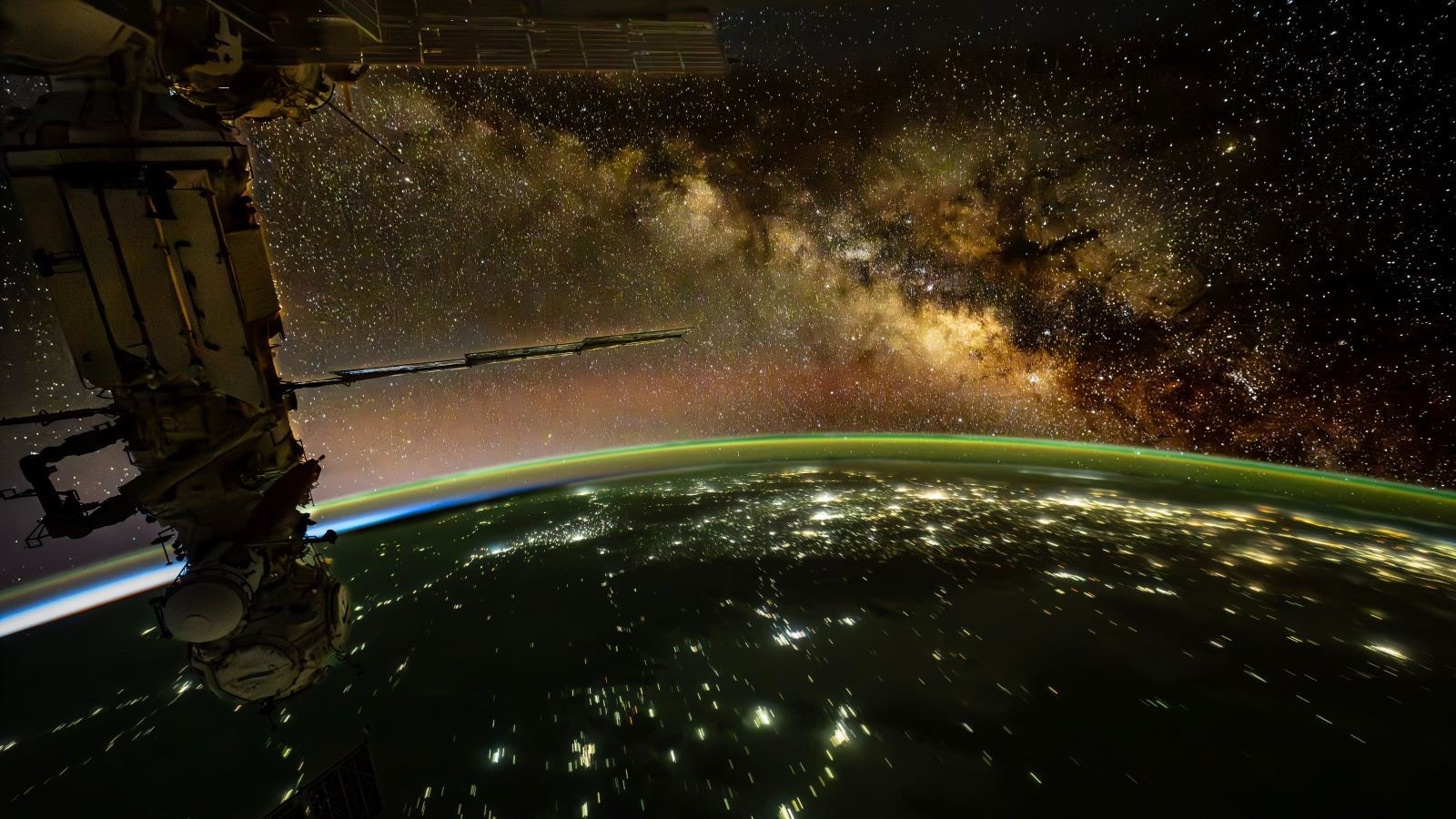
When a NASA astronaut points a camera out of a multi-million-dollar orbital window to capture the Milky Way, they are not simply snapping a vacation picture. They are operating high-end digital equipment under brutal, hostile conditions that would ruin consumer gear in seconds.
The mechanics of orbital astrophotography require fighting orbital velocity, thermal radiation, and atmospheric distortion from low Earth orbit. A recent viral image shared by a crew member aboard the International Space Station sparked public fascination. Behind that single frame lies a masterclass in low-light physics, long-exposure tracking compensation, and specialized sensor technology.
Let us look past the viral social media post. Let us examine the exact hardware, the physics of shooting at seventeen thousand five hundred miles per hour, and why standard commercial cameras need severe modifications to survive the vacuum of space.
The Physics of Orbital Astrophotography
To understand why capturing the Milky Way from the International Space Station is an engineering nightmare, you must first understand the primary enemy of long-exposure photography: speed.
The International Space Station orbits Earth at roughly seventeen thousand five hundred miles per hour. At this velocity, the station completes a full orbit every ninety minutes. This means an astronaut looking out the Cupola module experiences a sunrise or sunset every forty-five minutes. Total darkness is a luxury that lasts for only half of each orbit, and even then, stray light from cities, auroras, and the moon constantly floods the frame.
When shooting stars from the ground, photographers mount their cameras on heavy, motorized star trackers. These mounts slowly rotate in opposition to Earth's rotation, counteracting our planet's spin to keep stars pin-sharp during exposures lasting twenty seconds or longer.
In low Earth orbit, standard star tracking is useless. The platform itself is tumbling, vibrating, and moving at hypersonic speeds relative to the stars.
If an astronaut sets a camera on a tripod inside the Cupola and opens the shutter for ten seconds, the resulting image is not a sharp field of stars. It is a streak of chaotic light smears. The station's micro-vibrations—caused by life support pumps, attitude control thrusters, and crew movement—compound the issue.
To freeze the Milky Way, astronauts rely on wide-angle lenses, ultra-fast apertures, and high ISO settings combined with short shutter speeds. They must keep exposures under a few seconds when shooting handheld or fixed-mounted, relying on the sheer light-gathering capability of modern back-illuminated sensors to pull faint nebulae and dust lanes out of the black void.
Hardware in the Vacuum
You cannot walk into a consumer electronics store and buy an off-the-shelf camera system capable of enduring long-term spaceflight.
NASA equips its crews primarily with high-end digital single-lens reflex and mirrorless cameras, predominantly modified models from Nikon and Sony. These bodies undergo rigorous testing protocols to ensure they can handle extreme thermal shifts. On the sunlit side of Earth, external metal components can reach scorching temperatures, while the shaded side drops into sub-zero freezing ranges.
Sensors degrade rapidly in space due to cosmic radiation. Energetic particles streaming through the upper atmosphere strike the silicon wafer of a camera sensor, leaving permanent bright spots known as hot pixels. NASA's imaging technicians maintain extensive dark-frame subtraction libraries and coordinate firmware updates to map out these radiation scars.
Lenses present another set of optical hurdles. Glass elements must be treated with specialized coatings to prevent internal fogging and outgassing. Outgassing occurs when glues, plastics, and lubricants inside a lens vaporize in a vacuum, condensing on the interior glass elements and ruining optical clarity forever.
When an astronaut attaches a fast prime lens—often a 24mm or 50mm f/1.4 piece of glass—they are utilizing commercial off-the-shelf optics that have been vetted for structural integrity. The mechanical focus rings and aperture blades must function smoothly without lubricants that could freeze or drift.
Decoding the Shot
The viral image that caught the public eye was not captured by accident. It required precise orbital timing, camera settings calculation, and post-processing calibration.
When photographing the galactic core from space, the primary advantage astronauts have over terrestrial astrophotographers is the absence of thick, polluted air. Earth's atmosphere scatters artificial light pollution and absorbs crucial wavelengths of starlight. From four hundred kilometers up, the station flies above the densest ninety-nine percent of the atmosphere.
Starlight hits the camera sensor with pristine intensity. However, this creates a secondary problem: glare.
The Earth below is intensely bright. Even on the night side, city lights, lightning storms, and airglow create an ambient greenish-orange haze. If an astronaut points their camera too close to the horizon, the airglow washes out the faint dust lanes of the Milky Way.
To isolate the galaxy, the composition must point outward, away from the planetary limb, framing the stars against the absolute blackness of deep space.
Let us break down the typical technical parameters used for these orbital captures:
- Shutter Speed: Kept between one and four seconds to prevent motion blur induced by station movement.
- Aperture: Opened wide to f/1.4 or f/1.8 to flood the sensor with as many photons as possible in a short window.
- ISO: Pushed aggressively to ISO 6400 or higher, trusting modern noise-reduction algorithms during ground processing.
- Lens Choice: Fast wide-angle primes that minimize corner distortion while capturing a massive swath of the night sky.
The resulting RAW files are transmitted down to ground stations at the Johnson Space Center. There, imagery specialists process the files, balancing white balance against the artificial orange haze of atmospheric sodium lights and calibrating contrast to reveal the intricate tapestry of stars.
The Human Element Behind the Lens
We often talk about space exploration through the lens of engineering milestones, propulsion physics, and geological sampling. We forget that astronauts are human beings floating in a metal tin, staring out a window at a universe that humbles the ego.
Photography in space serves a psychological purpose. Crew members document their journey not merely to satisfy public relations quotas or feed social media algorithms, but to process the surreal reality of their environment.
When an astronaut spends months away from Earth, the visual anchor of the home planet framed against the infinite expanse of the Milky Way shifts their perspective. That visceral experience gets translated into raw pixel data, saved onto a flash card, and beamed across millions of miles of vacuum so that millions of people sitting in rooms with walls can look up and remember what lies just beyond the thin blue line.
The camera is a recording instrument. The astronaut is the interpretive filter. And the image is the proof that we are still looking out into the dark, trying to figure out where we belong.