The Mediterranean does not care about your papers. It does not care about the quiet promises made in crowded rooms or the desperate currency folded into plastic bags before dawn. To the sea, a boat is just a whisper of wood or fiberglass against a terrifying, indifferent vastness.
Salt crusts on eyelashes long before the sun clears the horizon. You learn to taste it in your throat, a constant reminder that you are suspended between a life you had to flee and a future that looks like nothing at all.
Off the rugged southern coast of Crete, eighty-five souls found themselves suspended that way.
When the Horizon Disappears
Dawn on the open water rarely arrives as a gentle awakening. It hits like a bruise. The light stretches thin and gray over the surface, exposing the fragility of anything smaller than a cargo ship.
Imagine a wooden hull riding the crest of a swell, water sloshing ankle-deep around freezing feet. (Note: this hypothetical reconstruction mirrors the verified accounts of maritime patrols in the Libyan and Cretan basins). Eighty-five human beings—men, women, children—packed into a vessel designed for a fraction of that weight. Every wave is a physical threat. Every groan of the timber sounds like a breaking bone.
They had been drifting for hours, perhaps days, after their engine gave up its frantic cough and died. Silence on the water is heavier than noise. It is the silence of realization. When you are twenty miles off Gavdos or the southern shores of Crete, the scale of the world becomes violently clear. You are small. The water is deep. And the people on the shore are drinking coffee, entirely unaware that the horizon holds a desperate, silent plea.
Then comes the speck.
A speck that grows into gray steel. A Hellenic Coast Guard vessel slicing through the whitecaps, turning a chaotic expanse of gray into a stage for rescue.
The Mechanics of Survival
We talk about migration in statistics. We tally numbers in quarterly reports, policy briefs, and evening news crawls. Eighty-five rescued. Eighty-five processed. Eighty-five accommodated or redirected.
The numbers are shields. They protect us from the unbearable weight of looking an individual in the eye.
When the rescue vessel pulls alongside, the operation is a ballet born of grim routine. Crew members in orange survival suits shout instructions in languages that echo across the wind. Ropes drop. Life jackets—often the cheap, ineffective foam kind bought in coastal alleyways—are traded for proper flotation gear.
Consider what happens next. The frantic scramble of hands reaching upward. The terror of a child being passed across a churning gap of water between two shifting hulls. If you miss, there is no second chance. The water is cold enough to steal the breath from your lungs in minutes. Hypothermia does not wait for bureaucracy.
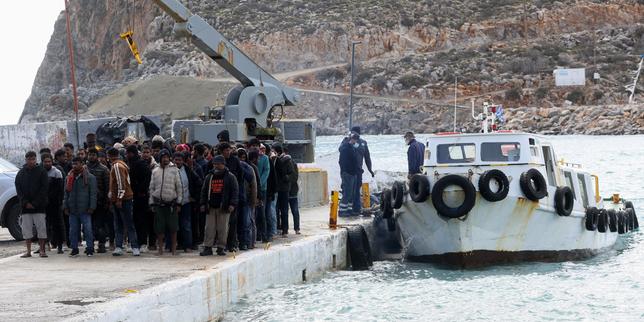
The Greek authorities confirmed the operation near Crete, pulling the group aboard safety decks. Blankets were handed out. Water bottles were drained in seconds. Medical checks began immediately for exhaustion and dehydration.
These are the bare facts of the dispatch. But facts are the skeleton; the flesh and blood of the event live in the trembling hands wrapping around a hot cup of tea, and the sudden, overwhelming silence of people who have just realized they are going to see tomorrow.
The Geography of Desperation
Why Crete? Why the southern fringe of Europe’s island bastion?
Look at a map of the eastern Mediterranean, but squint past the holiday brochures, the whitewashed villas, and the sun-drenched tavernas. Trace the maritime corridors stretching upward from the coasts of North Africa, particularly Libya and Egypt. As northern routes face heavier patrols, smugglers push further west and north, aiming for isolated outposts like Gavdos and southern Crete.
It is a longer crossing. It is more dangerous. The winds here, known locally as the Etesians or simply the meltemi, can turn a calm basin into a graveyard of white water with terrifying speed.
People do not choose this route because it is safe. They choose it because every other door has been locked from the outside.
I remember talking to a man who survived a similar crossing years ago. He told me about the middle of the night, when the moon hid behind clouds and the sea swallowed the stars. He said the scariest part wasn't the fear of drowning. It was the absolute certainty that if he vanished, nobody would even look for the ripples.
That is the invisible stake in every one of these headlines. It is not just about border policy, geopolitical tension, or rescue logistics. It is about the fundamental human terror of erasure.
The Aftermath on Solid Ground
The cutter docks. The concrete of the Cretan port is solid beneath trembling legs, yet the ground still feels like it is rolling.
For these eighty-five individuals, the rescue is not an end. It is a threshold. Ahead lies the labyrinth of identification, temporary housing, asylum applications, and the long, grinding uncertainty of legal limbo. They will sleep in makeshift shelters or reception centers, their wet clothes drying on makeshift lines, their futures hanging on stamps and signatures administered by strangers who speak a tongue they do not yet understand.
Yet, for tonight, the salt is washed from their skin.
Across the harbor, the lights of the town twinkle against the hills. Somewhere, a church bell rings out the hour, indifferent to the drama that just played out a few miles beyond the breakers. The sea settles into a dark, glossy calm, hiding everything it almost took.