The air inside a modern oil tanker smells faintly of sulfur, stale coffee, and anxiety. For three months, thousands of sailors have been sitting on iron hulls in the Persian Gulf, floating over a blue abyss, waiting for permission to move. They are trapped in a geopolitical chokehold.
When the war erupted in late February, the world looked at maps. Diplomats looked at ledgers. But the men on those ships looked at the horizon, watching for the flash of Iranian drones.
More than eight hundred vessels are paralyzed. The Strait of Hormuz, a narrow curve of water that handles twenty percent of the global oil supply, has become a silent parking lot. For the crews on board, the grand strategy of Washington and Tehran boils down to a simpler reality: running out of fresh water, missing births back home, and listening to the rhythmic hum of generators that might at any moment be silenced by a missile.
Then came the words from Washington that shifted the ground beneath everyone’s feet.
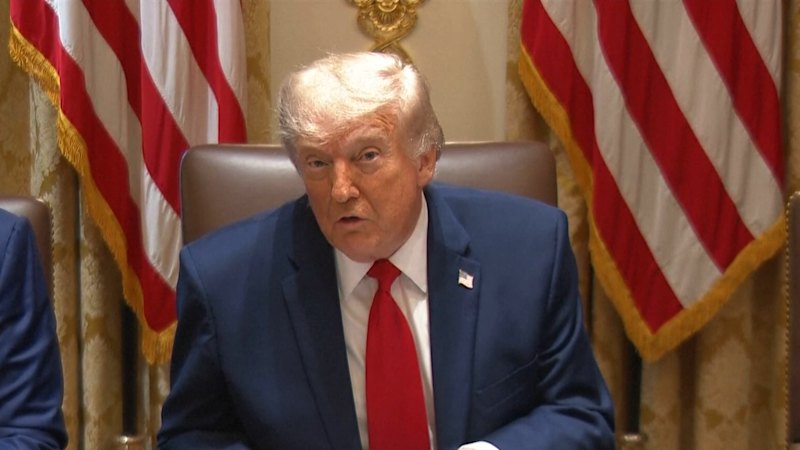
During a routine cabinet meeting, surrounded by the quiet luxury of the White House, the American president was asked about a rumor. Rumors are currency in a blockade. This one suggested that Iran and Oman—a quiet, historically neutral American ally—were drafting a backdoor deal to jointly manage the strait and charge passing ships a fee.
The response was not delivered in the measured cadence of statecraft. It was delivered like an ultimatum in a waterfront dive bar.
"Oman will behave just like everybody else," the president said, his voice flatly conversational through the television speakers of a thousand crew messes. "Or else we’ll have to blow them up. They understand that. They’ll be fine."
To understand how a casual threat of annihilation arrives at the doorstep of Muscat, one has to understand the desperate anatomy of a deadlock.
The United States and Israel launched strikes against Iran to halt its nuclear ambitions and punish a domestic crackdown. Iran countered by slamming the gate on the global economy, dropping an iron curtain across the world's most vital energy artery. Since then, the conflict has settled into a grinding, agonizing stalemate.
The White House is desperate for an exit that looks like a victory. Gas prices are climbing. The Pentagon has already burned through billions of dollars, with requests for hundreds of billions more pending. A temporary ceasefire brokered by Pakistan offered a brief gasp of hope, but the strait remained stubbornly closed.
Enter the Omani temptation.
For two centuries, the Sultanate of Oman has played the role of the Middle East’s ghost diplomat. It is the quiet room where enemies go to whisper when they cannot be seen talking in public. They have hosted secret talks for decades, balancing a close military alliance with the United States against the reality of sharing a maritime border with Iran.
But three months of a total maritime blockade changes the math for everyone.
Behind closed doors, Iranian officials proposed a solution: the creation of a new maritime authority. They called it a system of "fees" for services rendered, carefully avoiding the word "toll," which is explicitly forbidden under international maritime law. For Oman, a country watching its regional neighborhood fracture, the prospect of a slice of that revenue—and more importantly, a hand on the steering wheel of regional peace—became a powerful incentive.
To the legal scholars at the US Naval War College, the distinction between a fee and a toll is a dangerous fiction. They call it a protection racket, a mafia-style shakedown on the high seas. If you allow two nations to demand a permit for international waters, the principle of free navigation dies.
The president's blunt rhetoric was designed to shatter that fiction before it could crystallize into policy.
Consider the vertigo felt in Muscat. This is not an adversary. This is a nation that signed a defense cooperation agreement in 1980 allowing American forces to use its airbases. This is a country currently watching a five-hundred-million-dollar luxury Trump resort and golf course rise from its own cliffs.
The state department rushed to publish the transcript of the president’s remarks, leaving no room for the usual diplomatic clean-up crews to claim he had misspoken or meant "Iran." The brutality of the phrasing was the point. It was a message wrapped in a calculation: in a war of economic attrition, allies are only as valuable as their compliance.
But the real problem lies elsewhere.
Threatening to flatten an old friend might project strength to a domestic audience or rattle a sultan’s advisors, but it does nothing to clear the water. Iran’s Revolutionary Guard responded to the rhetoric with their own familiar script, promising to turn the southern Gulf into a graveyard for aggressors. They know the American administration is trapped between the political ruin of a prolonged fuel crisis and the military quagmire of a full-scale invasion.
A naval blockade is an exercise in waiting for the other side to lose its nerve. The tragedy is that the people doing the waiting are never the ones making the threats.
On the bridge of the trapped tankers, the radar screens remain cluttered with static targets. The sailors look out over the gray-green waters of the Musandam Peninsula, where the cliffs of Oman face the jagged coast of Iran across an expanse of water less than thirty miles wide.
They do not see a grand chessboard of international law or the shifting alliances of the Abraham Accords. They see a trap. They know that when empires begin threatening to blow up the bystanders, the room for error has vanished completely.
The generators keep humming, burning through the very oil the world is waiting for, while the men who command the oceans trade ultimatums over their heads.