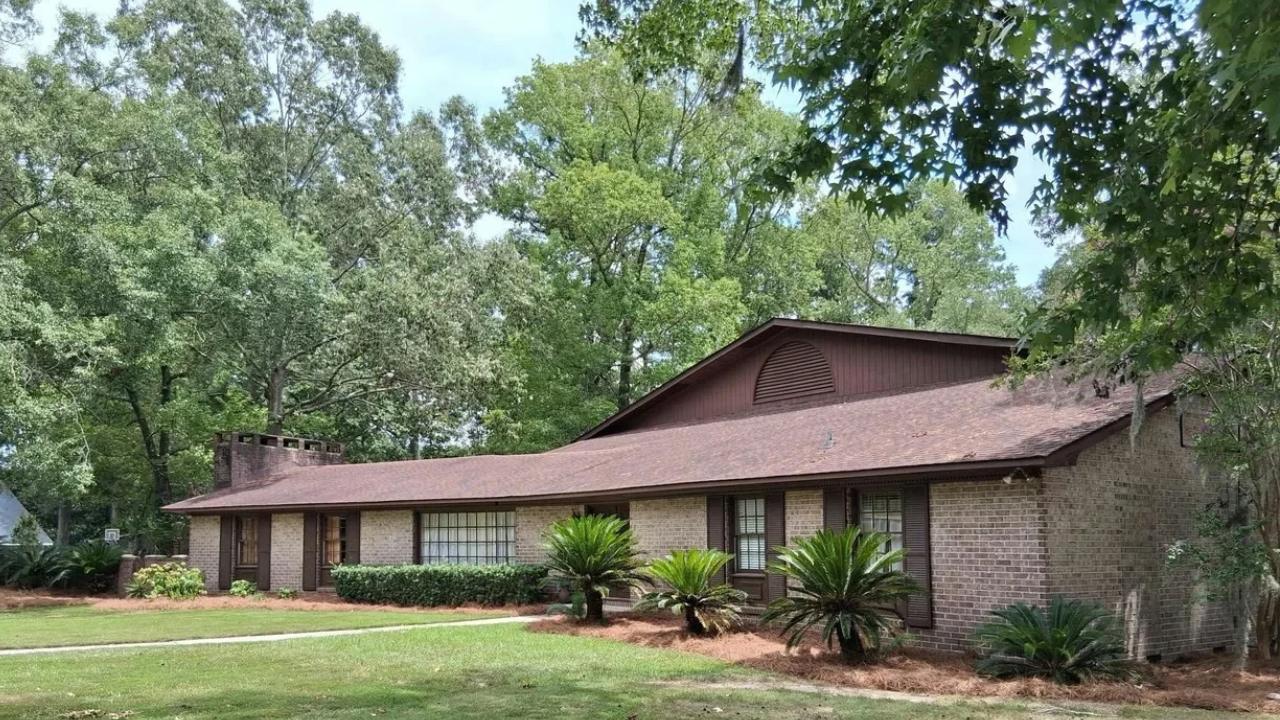
Walk into a house built in 1958 and the air smells different. Not stale, not musty, but faintly like cedar shavings and optimism from a decade that thought aluminum foil was the future and every backyard deserved a conversation pit.
Now imagine that house has a seven-figure price tag.
Goose Creek Estate has hit the market for $1.227 million. To a real estate bot scanning listing feeds, that sentence is a complete meal: quirky 1958 ranch, $1.227 million, licensed short-term rental. Done. Scroll on.
Numbers.
That is all a listing sheet gives you. Square footage, roof age, tax assessments, permitted occupancy caps. Yet houses are not spreadsheets with siding. They are containers for human longing, engineered out of timber, glass, and whatever strange convictions the original builder held dear at two in the morning over a pot of coffee.
When a mid-century ranch with an oddball streak and a short-term rental license appears at $1.227 million, something much quieter and much sharper is happening beneath the surface. Two worlds are colliding inside the same four walls. One world belongs to the restless architect or eccentric homeowner of 1958 who refused to build a box like everyone else's box. The other world belongs to modern travelers paying a steep nightly rate to sleep inside someone else's personality for a weekend, and to the investors trying to figure out whether charm pays the mortgage when interest rates bite.
I have stood inside houses like that. Floors that tilt just a hair toward the creek. Windows cut low enough that if you sit on the rug, you are eye-level with tall grass and dragonflies. Places that make you feel slightly off-balance in the best possible way, as if the builder winked at you through sixty-eight years of time and said, Go on, try living sideways for a few days.
At the same time, I know the cold sweat of owning a quirky property with high expectations attached to it. A funny angle in a roofline looks adorable on a Saturday afternoon with sunlight slanting across oak boards. Come November, when wind howls through vintage glazing and a guest texts at 10 p.m. asking why one corner of the living room feels like a walk-in cooler, that charm can suddenly look like a line item with teeth.
So why does a property like Goose Creek Estate command $1.227 million? And what are you actually buying when the headline says "quirky 1958 ranch" and "licensed short-term rental" in the same breath?
Why 1958 Still Pulls at Our Sleeves
To understand a 1958 ranch, you have to step back from modern open-concept drywall and look at what post-war builders were reacting against.
Victorian homes were fortress-like—heavy parlors, dark wood, small rooms meant to hold warmth and formality. By the late 1950s, postwar prosperity and new materials—plate glass, slab foundations, low-pitched roofs, simpler framing—gave builders permission to stretch out horizontally. A ranch house hugged the earth. It promised ease. You stepped out of the kitchen onto a patio without climbing three flights of stairs carrying a tray of iced tea.
Yet "ranch" can mean anything from a cookie-cutter starter home to a weird, wonderful one-off. When a listing calls a 1958 ranch quirky, pay attention. Quirky usually means someone broke the template. Maybe the hallway angles off toward a creek view instead of running straight as an arrow. Maybe the fireplace sits off-center like a sculpture, or the kitchen cabinets have strange, clever hardware that no modern contractor quite knows how to replace without swearing softly under their breath.
Modern houses often feel assembled rather than imagined. You can walk into a brand-new build and guess where every outlet is before you even open the front door. A quirky 1958 house resists that kind of instant predictability. It has opinions. It asks you to notice the light at 4 p.m. It makes you slow down because the layout wasn't designed to funnel you from garage to couch to bed in ninety seconds flat.
People starve for that friction. After a week spent staring at flat glass screens where every button looks identical, stepping into a room with odd proportions and genuine mid-century bones feels like drinking cold water from a hose in summer.
The Invisible Value of a License
Then comes the second half of the equation: licensed short-term rental.
On paper, those three words sound like a neat business perk. In reality, a valid license on a distinctive property is often the difference between a dream that bleeds cash and a property that pays for its own keep.
Many communities have tightened rules around short-term rentals over the past several years. Neighbor complaints over noise and parking, housing affordability pressures, municipal caps, zoning battles—getting a new permit in desirable pockets can be slow, expensive, or outright impossible depending on local ordinances.
(Note: Let's use a hypothetical scenario here to see how the math plays out in real life.)
Suppose Priya and Rohan are a couple in their late thirties who have spent five years saving for a weekend retreat near water and trees. They find a house like Goose Creek Estate at $1.227 million. Priya loves the mid-century bones and the creekside setting; Rohan, the more cautious half of the pair, immediately starts penciling out property taxes, insurance, maintenance, and loan payments. A six-figure down payment and a hefty monthly obligation can turn a romantic escape into a source of quiet dread if the house sits empty twenty-five days a month.
A licensed short-term rental changes the emotional weather around that spreadsheet. It gives the owners a legal lever. When Priya and Rohan aren't using the house themselves, they can host guests who specifically hunt for character-rich stays rather than generic hotel rooms. Even a modest stretch of booked weekends or peak-season stays can cushion the carrying costs of a $1.227 million asset.
Still, a license is not a magic wand. It is permission, not profit.
Guests who pay top dollar for a unique getaway bring high expectations. They notice chipped paint around vintage window frames. They care about water pressure, Wi-Fi speed, clean linens, and whether the driveway is easy to navigate after dark. A quirky house has to deliver quirky charm, not quirky neglect. If a latch sticks because it's charmingly old, you oil it; if it sticks because the frame is rotting, guests leave four-star reviews with three-star complaints that sting for months.
The Tension Inside the $1.227 Million Price Tag
A price of $1.227 million—oddly specific, right down to the last thousand—forces a reckoning. Round numbers feel like guesses; specific numbers feel like someone did the math, or at least held firm to a number they felt the place deserved.
When buyers look at a property in that bracket with a mid-century pedigree and hospitality potential, they are really weighing three competing stories:
- The purist's story: This is an architectural time capsule worth preserving carefully, even if preserving old materials costs more than slapping down vinyl and gray paint.
- The host's story: Every square foot should earn its keep, delighting travelers who want an unforgettable escape from standard lodging.
- The practical homeowner's story: A roof still has to keep rain out, plumbing still has to move water without drama, and taxes still arrive every year regardless of how dreamy the view is.
Here is where many buyers stumble. They fall in love with Story One, buy the house on the strength of Story Two, and get ambushed by Story Three.
Let's be honest: mid-century charm and short-term rental wear-and-tear can pull in opposite directions. A delicate 1958 feature that brings a tear to a design lover's eye might take a beating from suitcases, wet towels, and groups celebrating birthdays. Conversely, over-renovating a vintage ranch into a sterile modern box can strip away the exact eccentricity that made people willing to pay $1.227 million in the first place.
Think of a classic vinyl record played on a well-tuned turntable versus played with a dull needle. The music is there either way, but care determines whether you hear warmth or scratchy static.
What Guests Are Actually Buying
Why do people book a place like Goose Creek Estate instead of a standard hotel or a bland suburban rental?
Nobody wakes up on a Tuesday morning thinking, I really need to spend my savings on a rectangular room with beige carpet and an ice machine down the hall. People book distinctive places because they want a shift in state. They want a weekend that feels like a chapter break in their own lives.
A quirky 1958 ranch near a creek offers built-in theater. Morning coffee on the porch while water slips past stones. Late-afternoon light hitting angled wood ceilings. Kids or friends exploring corners of a layout that doesn't look like every other house on the block. When a property has that kind of atmosphere, guests don't just rent shelter; they rent a story they get to star in for seventy-two hours.
Yet that intimacy cuts both ways. Hosting strangers in a house with personal character requires clear boundaries and steady upkeep. You have to decide what stays sacred—locked owner closets, cherished family pieces, delicate original fixtures—and what is built to handle traffic.
Questions That Separate Dreamers from Buyers
If you are looking at a listing like Goose Creek Estate—whether you're eyeing it as a personal retreat, an income-producing getaway, or simply studying how value forms in niche real estate—price alone tells you very little.
Look past the headline figure and ask sharper questions. How old are the mechanical systems hiding behind those mid-century walls? How do local short-term rental rules treat license transfers upon sale—does the permit stay with the property, or does the buyer have to reapply or meet new conditions? How seasonal is demand around that specific location, and how much of the year will the property rely on your own budget versus rental income?
Most of all, ask yourself how you feel when the novelty wears off.
Every house eventually becomes normal. Even a quirky 1958 ranch with a creek view and a short-term rental license will one day just be the place where you forgot your charger or where the garden hose needs replacing. The real test of a $1.227 million decision isn't how thrilling it feels during the first tour. It's whether you still like the view on a gray Tuesday morning when nothing special is happening.
Somewhere near Goose Creek, late afternoon light is sliding across old timber and cool water is moving over stone without asking anyone's permission. The price tag is $1.227 million. The real question is who is ready to step across the threshold and carry the story forward.