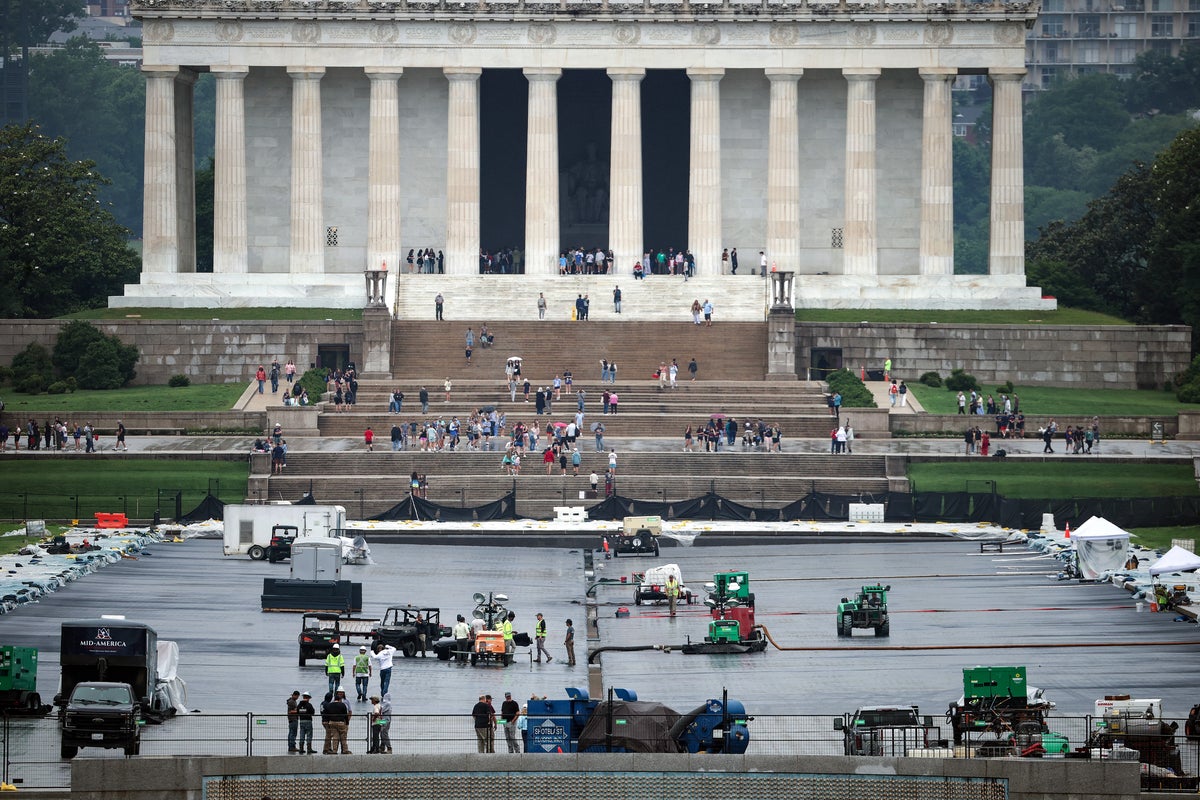
The National Mall in the dead of winter is a place of ghosts. If you stand at the base of the Lincoln Memorial and look out toward the Washington Monument, the world splits into perfect halves of stone and sky. Between them lies the Reflecting Pool. On a good day, it does exactly what it was built to do: it holds up a mirror to the nation’s ideals, smooth and unbroken.
But water is a restless, destructive thing. It seeps into concrete. It expands in the frost. It rots the infrastructure beneath the spectacle.
When the pool began to leak, losing thousands of gallons into the swampy Potomac soil below, it wasn't just an engineering problem. It was a crisis of American imagery. Bureaucrats panicked. The response to that panic, buried deep inside federal procurement records, reveals a story not about structural engineering, but about how power, money, and urgency collide when no one is watching.
A routine audit eventually exposed the friction. A lone government contractor walked away with an extra $850,000 above the typical market rate for a project of this scale. The mechanism was a no-bid contract, pushed through under the banner of national urgency during the Trump administration.
To understand how a taxpayer's pocket gets picked by nearly a million dollars on a single monument repair, you have to look past the spreadsheets. You have to look at how Washington behaves when it decides it cannot afford to wait.
The Mirage of the Urgent
Imagine a small-business owner named Sarah. She runs a commercial roofing company. If the local high school roof collapses, the school board doesn't just hand her the contract based on a handshake and a promise. They put out a public tender. Three different companies spend late nights calculating costs, trimming profit margins, and sharpening their pencils to offer the lowest possible price. Competition keeps everyone honest. It forces efficiency.
In the federal government, this process is called "full and open competition." It is the bedrock of public trust.
Then comes the exception: the sole-source, or no-bid, contract.
This is the emergency break on the bureaucratic train. If a hurricane destroys a military base, or if a cyberattack cripples a federal agency, there is no time for a ninety-day bidding war. The government picks up the phone, calls a contractor they trust, and says, "Fix it. We’ll settle the bill later."
The Lincoln Memorial Reflecting Pool became an emergency.
The water was draining. The pumps were failing. The monument looked neglected. In the eyes of an administration obsessed with optics and rapid turnarounds, the slow, grinding gears of standard government procurement were an unacceptable bottleneck. They invoked the emergency clause. They bypassed the line.
When you eliminate competition, you eliminate the incentive to be reasonable. The contractor, holding all the leverage, named a price. The government, desperate for a quick win before the tourist season or the next major rally, signed the check. The resulting premium was an extra $850,000 over what a competitive process would have yielded.
That money didn't buy better concrete. It didn't buy faster pumps. It bought speed, or rather, the illusion of it.
The Chemistry of Waste
Every dollar spent by a government agency carries a quiet weight. Think of it as a ledger of trade-offs.
An extra $850,000 handed to a single contractor for a pool repair is not just an abstract number on a congressional report. It is a series of choices made in the dark. It is the funding for three community health clinics in rural West Virginia. It is the cost of replacing toxic lead pipes in a dozen Midwestern elementary schools. It is the salary of fifteen rookie national park rangers who will spent their careers protecting the land.
When we look at government waste, we often look for the villain. We look for the corrupt official slipping cash into a briefcase. But real bureaucratic waste is far more clinical. It is sterile. It happens in clean, air-conditioned offices through the typing of justification memos.
Consider the paperwork required to bypass federal law. An official must write a "Justification and Approval" document. They must argue that the public interest is harmed by waiting. They must prove that only one specific company in the entire United States possesses the unique capability to fix a pool.
It is a legal fiction.
There are hundreds of firms capable of pouring concrete and sealing water basins. The unique capability wasn't expertise. It was proximity and availability. The contractor was there, the administration was in a hurry, and the taxpayer was absent from the room.
The Invisible Stakes
We have grown numb to numbers. We hear about trillions in national debt, billions in foreign aid, and millions in corporate bailouts. A figure like $850,000 barely registers on the radar of public outrage. It feels like a rounding error.
But the real cost is measured in legitimacy.
When a citizen works a double shift at a warehouse, or spends their Sunday night balancing the family budget to ensure their taxes are paid on time, they are participating in a social contract. They surrender a portion of their labor to the state with the expectation that it will be handled with stewardship.
Every time a report emerges showing a backroom, no-bid deal that pads a corporate pocket, that contract fractures.
The damage isn't the missing money. The damage is the cynicism that rushes in to fill the void. It reinforces the deeply held suspicion that the system is rigged, that rules are for the small, and that the closer you stand to the center of power, the less the laws of economics apply to you.
The Reflecting Pool was designed by Henry Bacon to be shallow. It is only about two feet deep at the sides, tilting slightly deeper toward the center. It was built that way intentionally, so that even a slight breeze wouldn't create waves large enough to distort the image of the sky. It requires stillness to function.
The irony is thick enough to choke on. The very symbol of clear, transparent reflection became the site of a murky, opaque financial transaction.
The Mechanics of the Premium
Why does a no-bid contract cost so much more? The answer lies in how businesses calculate risk.
In a competitive market, a company bears the risk of losing the job. They lower their price to the absolute floor to win the contract. Once they win, they manage their expenses ruthlessly to ensure they still make a profit.
In a no-bid scenario, the risk shifts entirely to the buyer—the government. The contractor knows they are the only option on the table. They factor in massive contingencies. They price in the cost of potential delays, materials fluctuations, and bureaucratic hassle, then add a generous layer of profit on top. They do this because they can.
The government, driven by political timelines rather than fiscal reality, accepts the terms.
Consider what happens next: the project gets completed. The ribbons are cut. The water returns, clean and blue, reflecting the marble face of Abraham Lincoln. The tourists return with their cameras. To the casual observer, the project is a resounding success. The system worked. The monument is saved.
The waste remains completely invisible unless someone chooses to dig through the national archives, comparing labor hours and material costs against industry averages. The premium is buried beneath the water.
The Mirror's True Edge
The report detailing the $850,000 overpayment will eventually be filed away into a digital archive, joined by thousands of other Inspector General reports that gather dust in the corners of the internet. No one will go to jail. The contractor will keep the money. The officials who signed the paperwork have likely moved on to other agencies or lucrative consulting gigs in the private sector.
But the next time you stand on those steps, looking out across the water toward the Washington Monument, look closely at the surface.
The pool does its job. It reflects the grandeur of the capital. It reflects the ambition of a nation that wanted to build a sanctuary for its most revered president.
But if you understand the history of the stone and the concrete beneath the water, you see something else. You see the true price of urgency. You see the cost of a system that, when pushed by politics, chooses convenience over fairness, and speed over stewardship. The mirror doesn't just show us our ideals. If we look deep enough into the shallow water, it shows us exactly who we are when we think no one is watching.