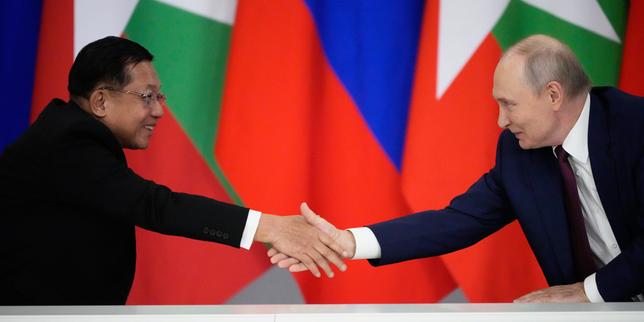
Every time a Singaporean premier shakes hands with an Indian finance minister, the press rooms hyperventilate. Headlines churn out identical clichés about strategic convergence, deep-seated historical affinities, and mutual economic alignment. The lazy consensus states that Lawrence Wong meeting Nirmala Sitharaman signals a golden era of bilateral integration, a natural marriage of Southeast Asian financial efficiency and South Asian demographic scale.
It is a comforting narrative. It is also entirely wrong. If you liked this article, you should look at: this related article.
When you strip away the diplomatic theater, the photo-ops, and the rehearsed communiques about fintech cooperation and supply chain resilience, you find a relationship built on mismatched incentives, regulatory friction, and a fundamental misunderstanding of how capital actually flows across borders. I have watched corporate boards blow millions trying to force joint ventures between these two distinct economic engines based purely on ministerial optimism. They treat state-level communiques as operational blueprints. That mistake kills margins.
Let us dismantle the core falsehoods driving the current geopolitical hype. For another perspective on this story, check out the recent coverage from BBC News.
The Myth of the Natural Economic Twin
The standard diplomatic pitch claims Singapore and India are economic complements. Singapore needs growth vectors; India needs capital conduits.
The reality on the ground looks entirely different. Singapore is a hyper-lubricated, ultra-low-tax jurisdiction governed by absolute legal predictability and a rigid rule of law. India is a high-friction, decentralized, politically dynamic federal structure where tax codes mutate annually and dispute resolution can span decades.
When ministers discuss deepening ties, they focus on top-down mechanisms like bilateral agreements and digital payment linkages. They ignore the friction at the transactional level. A Singaporean family office does not pour capital into India because of a ministerial delegation. They look at risk-adjusted returns, currency volatility, and exit liquidity. On all three fronts, India remains a headache for foreign institutional allocators who prefer the predictability of Western markets or the domestic stability of ASEAN neighbors like Vietnam or Indonesia.
Ministerial handshakes do not lower withholding taxes or speed up land acquisition. They provide PR wins for politicians facing domestic constituencies who love hearing about global reach.
Capital Does Not Flow Where Diplomats Point
Follow the actual money, not the press releases. Singapore remains the top source of Foreign Direct Investment into India, a statistic that state media loves to weaponize as proof of integration.
Dig into the mechanics. A staggering percentage of that capital is actually domestic Indian money making a round trip through Mauritius-style corporate structuring or Singaporean holding companies for tax optimization and legal protection. It is round-tripping, not foreign expansion. Calling this a bilateral achievement is like praising a person for sending money to their own left pocket via their right hand.
The real friction points never make the ministerial agenda:
- Arbitration Hurdles: Singaporean firms frequently find Indian contract enforcement opaque and painfully slow, regardless of high-level treaties.
- Regulatory Nationalism: India's persistent protectionism in digital services and retail directly clashes with Singapore's ethos of absolute open-market free trade.
- Tax Disputes: Retroactive tax ghosts still haunt foreign investors who remember past battles with the Indian exchequer.
The Talent Traffic Jam
Another favorite talking point of the bilateral cheerleaders is talent mobility. We hear endless praise about tech professionals, financial analysts, and corporate leaders moving seamlessly between Changi and Mumbai.
Seamless? Ask any human resources executive trying to transfer a mid-level specialist between these two jurisdictions. Visa caps, local hiring quotas, and credential recognition create massive bottlenecks. Singapore has tightened its foreign labor policies significantly to appease local voters concerned about wage suppression and housing inflation. India wants outbound investment, not brain drain or structural job export.
The structural mismatch means that while elite executives fly business class between the two financial hubs for high-profile summits, the actual working-class mechanics of cross-border labor remain choked by bureaucratic red tape.
What Actually Works
If you want to stop losing money trying to surf the wave of official bilateral hype, you must ignore the macro narrative and focus entirely on hyper-niche execution.
Stop viewing Singapore and India as a unified economic corridor. Treat them as two entirely separate planets that happen to share a diaspora network and historical trading routes. If you are building a business between them, do not rely on government-backed corridors or state-sponsored business councils. Build direct, private-equity-backed legal structures that bypass local regulatory logjams entirely.
The next time you read a breathless report about ministerial delegations discussing ways to deepen ties, ask yourself a simple question. Are they solving a problem that institutional investors actually care about, or are they just posing for the cameras because the alternative is admitting that state-level diplomacy has very little to do with how wealth is actually generated?
The bilateral relationship is not a rocket ship taking off. It is a slow, grinding negotiation between two wildly different economic cultures where the press release never matches the ledger.
Stop reading the communiques. Look at the balance sheet.