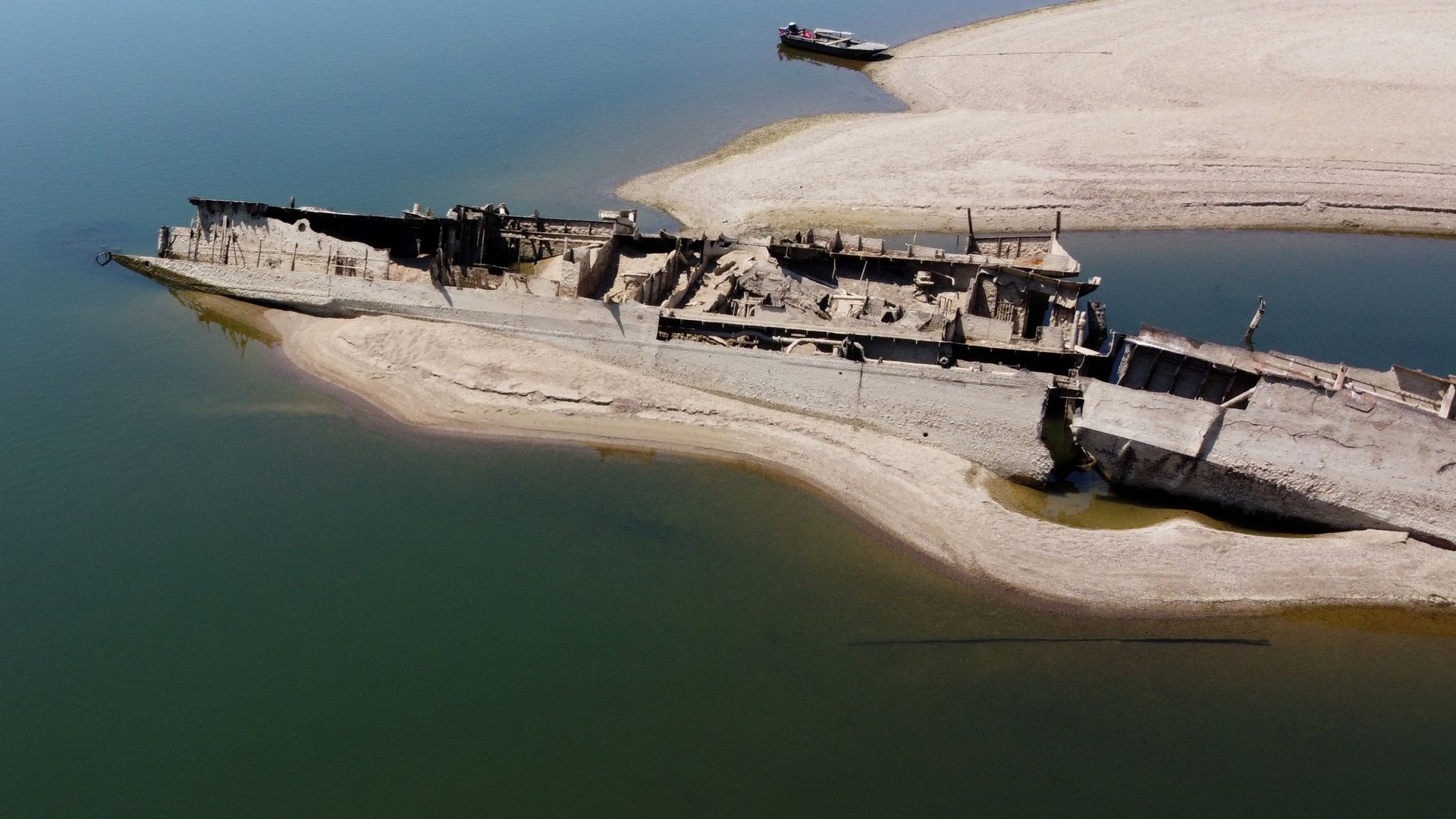
Hydrological recessions do not merely reveal the past; they expose structural vulnerabilities in modern infrastructure, trade corridors, and geopolitical resource management. When historical artifacts emerge from riverbeds during extreme dry spells, public discourse typically fixates on the novelty of the wreckage. This surface-level observation obscures the underlying systemic failure. The appearance of World War II-era German warships near Prahovo, Serbia, during the severe droughts of recent years serves as an empirical indicator of a critical ecological and economic constraint: the collapse of inland navigation capacity under multi-year precipitation deficits.
Analyzing the exposure of these sunken assets requires moving past historical curiosity to examine the mechanics of fluvial transport systems. Rivers like the Danube function as high-capacity economic corridors. When water levels drop below operational thresholds, the cost function of riverine logistics undergoes a discontinuous shift. Shippers must reduce cargo payloads to prevent grounding, which degrades throughput efficiency and forces freight onto road and rail networks that lack the capacity to absorb sudden volume surges. Understanding this phenomenon demands a framework that isolates the drivers of drought-induced transport bottlenecks, the physical variables governing riverbed exposure, and the long-term operational adaptations required for industrial navigation.
The Fluvial Transport Cost Function
The primary economic impact of a hydrological drought is the immediate compression of cargo capacity. Commercial vessels operating on inland waterways rely on a predictable draft, which is the vertical distance between the waterline and the bottom of the hull. Under standard operating conditions, barges maximize gross tonnage to minimize the per-unit cost of transport.
When regional precipitation decreases and evaporation rates rise, the available draft diminishes. River administrators establish maximum authorized draft limits based on daily bathymetric surveys. Exceeding these limits risks hull breaches or permanent grounding on submerged obstacles, including the very munitions-laden German fleet scuttled by the retreating Black Sea fleet in 1944.
Standard Operation: [Normal Water Level] -> [Maximum Draft] -> [Optimal Unit Cost]
Drought Condition:  [Reduced Water Level] -> [Capped Draft]    -> [Elevated Unit Cost]
To maintain compliance, vessel operators must lighten their loads. A reduction in draft of just thirty centimeters can force a standard cargo barge to shed up to thirty percent of its deadweight tonnage. This operational constraint alters the economics of supply chains reliant on the Danube, which connects Central Europe to the Black Sea.
Bulk commodities such as coal, grain, steel, and petroleum products face immediate cost escalation. Because alternative overland routes lack the volume capacity of a fully loaded barge fleet, logistics managers experience severe modal shift frictions. Rail infrastructure operates near capacity under normal conditions, meaning a sudden migration of freight from water to rail triggers terminal congestion, equipment shortages, and skyrocketing spot rates.
Geopolitical and Environmental Hazards of Exposed Ordnance
The emergence of the Prahovo warships highlights a secondary vector of risk: the interaction between climate anomalies and legacy military hardware. The vessels in question are part of the Schwarzmeerflotte scuttled in 1944 to prevent capture by advancing Soviet forces. Many of these hulls still contain unexploded ordnance, including thousands of kilograms of high explosives, artillery shells, and fuel residues.
Under permanent submersion, these materials remain relatively stable due to limited oxygen exposure and low kinetic disturbance. However, sub-aerial exposure and shallow water conditions introduce severe risks:
- Structural Degradation: Decades of sub-aqueous corrosion weaken steel hulls, making them vulnerable to structural collapse if exposed to air currents or shifting sediment loads.
- Navigation Hazards: Hull protrusions restrict the navigable channel width, forcing commercial traffic into narrower vectors and increasing the probability of collisions or secondary groundings.
- Intervention Costs: Removal operations require specialized marine engineering, explosive ordnance disposal teams, and substantial capital outlays by national governments that often lack dedicated budgetary allocations for legacy hazard mitigation.
European Union authorities and local governments have periodically attempted to dredge and remove these obstructions, but the scale of the engineering challenge is immense. The financial cost of systematic clearance often exceeds the short-term economic loss of narrowed shipping lanes, creating a policy stalemate where hazards are left in place until extreme weather forces action.
Systemic Vulnerabilities in European Waterways
The vulnerability of the Danube is not an isolated meteorological anomaly. It reflects a broader European hydrological stress trend characterized by shrinking Alpine snowpacks, shifting rainfall distribution patterns, and rising mean temperatures that accelerate evaporative loss.
When evaluating fluvial reliability, infrastructure planners utilize flow velocity, discharge volume, and sediment transport rates. During prolonged dry periods, discharge rates drop to fractions of their historical medians. This reduces the river's self-cleansing capacity, leading to sediment accumulation in critical bottlenecks.
These sediment bars compound the draft limitations caused by low water. Even if a vessel encounters a stretch of river with sufficient volume, localized shallow points created by accumulated silt act as physical gates that determine the maximum allowable draft for the entire transit route. Consequently, the effective capacity of the river is determined not by its average depth, but by its shallowest navigable choke point.
Long-Term Strategic Adaptations for Industrial Navigation
Mitigating the economic fallout of recurrent droughts requires a transition from reactive emergency dredging to proactive infrastructural and operational redesign. Traditional methods, such as continuous mechanical dredging, offer diminishing returns when base water volumes are structurally depressed.
Fleet operators and port authorities are evaluating alternative hull designs. Traditional flat-bottomed river barges are being retrofitted or replaced with wider, shallower vessels that distribute weight across a larger surface area, maintaining cargo capacity at lower drafts. While these vessels incur higher capital expenditure, they insulate operators against total revenue collapse during low-water regimes.
Simultaneously, industrial facilities situated along major waterways are diversifying their supply chain inputs. Relying exclusively on single-mode fluvial logistics creates unacceptable operational risk in an era of climate volatility. Companies are investing in multimodal storage facilities, enabling them to stockpile critical raw materials during high-flow periods to buffer against summer and autumn transport restrictions.
Capital investment must also target real-time bathymetric mapping and predictive hydrological modeling. By deploying advanced sonar arrays and automated depth-monitoring stations, logistics networks can dynamically adjust load planning days in advance of transit bottlenecks.
The appearance of submerged warships serves as a visible marker of environmental change, but the true metric of concern is the systematic erosion of transport reliability. Securing the future of inland water transport demands rigorous capital allocation toward shallow-draft vessel innovation, automated channel management, and resilient multimodal logistics networks capable of functioning when historical water baselines fail.