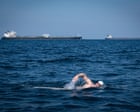
Swimming across one of the world's busiest oil chokepoints sounds like a death wish. Yet British endurance swimmer Lewis Pugh recently tackled the length of the Strait of Hormuz to force a conversation nobody in geopolitics wants to have—what armed conflict actually does to marine ecosystems.
You won't find this angle on cable news. When tensions flare in the Middle East, coverage fixates on crude oil prices, naval blockades, and global supply chains. The ocean underneath those tankers gets treated like an empty blue highway. It isn't.
Why the Strait of Hormuz Matters Beyond Oil Prices
Most people only hear about the Strait of Hormuz when barrel prices spike. Roughly a fifth of the world's petroleum passes through this narrow channel between Oman and Iran every single day. At its tightest point, the waterway is only about 21 nautical miles wide, with shipping lanes squeezed into two-mile-wide corridors.
That bottleneck makes it a geopolitical powder keg. It also makes it an ecological trap.
Because the Persian Gulf is shallow and nearly landlocked, water exchange with the open Arabian Sea happens painfully slowly. Pollutants that enter this basin don't just wash away into the deep ocean. They linger. They accumulate in coastal mangroves, coral reefs, and seagrass beds that support dugongs, sea turtles, and commercial fisheries feeding millions of people across the Gulf states.
When Lewis Pugh—who serves as the UN Patron of the Oceans—decided to swim the strait, he wasn't chasing another Guinness record. He's spent decades swimming in vulnerable waters from Antarctica to the Red Sea to put human faces on abstract environmental threats. Here, the threat isn't just slow-moving climate change. It's the immediate, toxic fallout of military conflict and maritime warfare.
The Hidden Environmental Cost of Naval Conflict
Warfare at sea leaves scars that last decades after ceasefires get signed. We already have the receipts from history.
During the 1991 Gulf War, retreating forces deliberately released millions of barrels of crude oil into the Persian Gulf, creating the largest oil spill in human history. Over 700 miles of coastline were coated in thick sludge. Even thirty years later, researchers studying Saudi Arabian salt marshes found pockets of unweathered oil buried just beneath the surface, continuing to stunt local marine recovery.
Modern conflict in and around the Strait of Hormuz carries similar risks, even without intentional spills. Consider what happens when commercial vessels, oil tankers, or naval ships get struck by missiles, drones, or sea mines:
- Toxic cargo releases dump heavy fuel oil, chemical fertilizers, and industrial solvents directly into shallow spawning grounds.
- Sunken hulls become ticking time bombs, slowly corroding on the seabed and leaking trapped bunker fuel for years.
- Acoustic trauma from underwater explosions, sonar, and heavy naval traffic disrupts whale and dolphin navigation, causing strandings and permanent hearing damage.
- Unexploded ordnance litters the seafloor, leaching heavy metals and carcinogenic compounds like TNT and RDX into the food chain.
Honestly, environmental ministries rarely get a seat at the table when military commanders plan naval operations. Defense comes first. Everything else gets pushed to an afterthought. By putting his own body into the water right alongside massive supertankers and military patrols, Pugh forced diplomats and journalists to look at the water itself rather than just the ships floating on top of it.
What Most People Get Wrong About Endurance Stunts
Whenever an activist does something extreme—whether it's scaling a skyscraper or swimming through a militarized strait—cynics roll their eyes. They call it performative. They ask how swimming 60-plus miles in hot, salty water actually stops a single missile from launching.
That misses the entire point of strategic advocacy.
Policy doesn't change just because scientists publish another peer-reviewed paper in a marine biology journal. Diplomats and politicians respond to media pressure, public attention, and undeniable visual storytelling. When a British swimmer steps onto the shore after days in scorching, jellyfish-infested waters to meet directly with regional leaders, cameras show up.
Pugh uses what he calls "speedo diplomacy." Instead of lecturing governments from a podium in Geneva or New York, he endures the physical reality of the ecosystem first, then sits down with ministers while salt is still drying on his skin. That sequence creates moral leverage that standard lobbying simply can't match.
The Physical Reality of Swimming in the Gulf
If you've never swum in warm, hyper-saline open water, it's easy to underestimate how brutal this environment is. People assume cold water is the only real enemy for endurance swimmers. It's not.
Water temperatures in the Strait of Hormuz routinely climb past 30°C (86°F). At that heat, your body can't shed thermal energy efficiently while exercising at high output. Heat exhaustion becomes a serious risk even while submerged. Add intense UV exposure, blinding glare off the surface, high salinity that chafes skin raw within hours, and dense blooms of stinging jellyfish, and you're looking at a grueling physical ordeal.
Then there's the traffic. Navigating across active shipping lanes means coordinating closely with coast guards and support boats so a 300,000-ton supertanker doesn't miss seeing a human head bobbing in the swell. One communication failure ends the swim—or worse.
How International Law Fails Marine Ecosystems in Wartime
You might assume international treaties already ban blowing up oil tankers or poisoning shared waterways during conflicts. On paper, they do. In practice, enforcement is basically nonexistent.
The Geneva Conventions—specifically Additional Protocol I—prohibit methods of warfare expected to cause "widespread, long-term and severe damage to the natural environment." The United Nations Environmental Assembly has also passed resolutions urging states to protect ecosystems during armed conflict.
Here's the catch. That legal threshold ("widespread, long-term and severe") is set so absurdly high that almost no military action ever gets prosecuted under it. Unless an attack wipes out an entire region for decades, belligerents argue their strikes were proportional military necessities.
Because the Strait of Hormuz is bordered by nations with deeply strained diplomatic relationships, regional environmental cooperation often stalls whenever security tensions rise. Marine life doesn't recognize maritime borders. A spill off one coast rides the currents straight onto another nation's desalination intakes.
And desalination is the elephant in the room. Gulf countries rely on seawater desalination plants for up to 90% of their municipal drinking water. A major conflict-driven oil or chemical spill in the Strait of Hormuz wouldn't just kill coral reefs and sea turtles. It could shut down drinking water supplies for millions of people within days.
Practical Ways to Track and Support Ocean Protection in Conflict Zones
You don't need to swim across a shipping lane to push for stronger protections around vulnerable marine chokepoints. If you want to follow this issue seriously or support organizations doing real on-the-ground monitoring, focus on verifiable data and policy action rather than viral outrage.
- Follow independent conflict-environment monitors. Organizations like the Conflict and Environment Observatory (CEOBS) track the ecological fallout of wars in real time using satellite imagery and open-source intelligence. Their reports give you concrete data instead of political spin.
- Watch marine spill tracking platforms. Tools like SkyTruth use radar satellite data to detect bilge dumping, leaking wrecks, and conflict-related oil slicks across the Persian Gulf and Red Sea before authorities officially admit a spill occurred.
- Support regional marine conservation frameworks. Look into initiatives backed by the UN Environment Programme's Regional Seas Programme, specifically ROPME (the Regional Organization for the Protection of the Marine Environment), which brings Persian Gulf states together on shared water quality standards despite political friction.
- Demand environmental accounting in defense reporting. When following coverage of maritime security crises, look for whether journalists and policymakers address desalination security, wreck removal liability, and marine habitat damage alongside oil futures.
Protecting marine ecosystems in militarized waterways requires treating ecological security as national security. Until governments factor poisoned water supplies and dead fisheries into the true cost of conflict, swimmers like Lewis Pugh will keep having to put their bodies in the water just to make leaders look down.