The red clay of Georgia holds onto everything. It stains the cuffs of your jeans, clings to the treads of your boots, and remembers every footstep that ever crossed it.
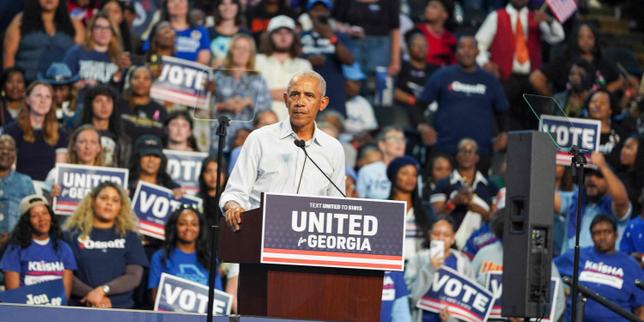
Stand outside an auditorium in Atlanta on a humid October evening in 2026, and you can feel that memory pressing in from every side. The air smells of damp asphalt, diesel exhaust from idling campaign buses, and roasted peanuts from a vendor two blocks down. Inside, three thousand people are packed shoulder to shoulder, waiting for two men who represent two entirely different chapters of the American experiment. One is a former president whose voice still carries the cadence of 2008—a time that feels, to many in the room, like a half-remembered dream. The other is a thirty-nine-year-old United States Senator fighting for his political survival in a state that never stays still for long.
Barack Obama has come back to Georgia. He is standing beside Jon Ossoff in the final, breathless stretch of the 2026 midterm elections.
If you read the standard political dispatches from Washington, this moment gets reduced to cold arithmetic. Pundits talk about turnout models, suburban margins in Gwinnett and Cobb counties, and the historical curse that haunts whichever party holds the White House during a midterm cycle. They treat an election like a spreadsheet.
They miss the heartbeat.
The Weight of a Borrowed Hope
To understand why Obama stepping onto a stage in Georgia matters right now, you have to understand the quiet exhaustion sitting in the chests of ordinary voters.
Picture a composite figure—let’s call her Denise—a fifty-four-year-old middle school principal living just outside Decatur. Denise isn’t a political junkie. She doesn't watch cable news panels scream at each other over split screens. She worries about teacher retention, the price of groceries at the local Kroger, and whether her youngest son will be able to afford rent in the city where he grew up. In 2020, and again in the January 2021 runoff that shocked the country, Denise stood in line for hours to send Jon Ossoff to the Senate. She believed, with a fierce and fragile optimism, that showing up once would fix things permanently.
Then came the slow grind of governance. Bills stalled. Prices climbed. The noise grew louder while the results felt smaller. By the autumn of 2026, Denise isn't angry; she’s tired. And in midterm elections, exhaustion is deadlier than opposition.
This is the invisible wall Jon Ossoff is running into. When Ossoff first ran for the House in 2017—and lost a special election that cost more than any House race in American history—he was a thirty-year-old documentary filmmaker with a sharp suit and a steep learning curve. By January 2021, at just thirty-three, he became the youngest Democrat elected to the U.S. Senate since Joe Biden in 1972, riding a historic wave alongside Raphael Warnock that flipped Georgia blue for the first time in a generation.
Being the underdog is exhilarating. Being the incumbent is a slog.
You can no longer run on pure promise when you have six years of roll-call votes attached to your name. Every compromise disappoints someone. Every delay feels like a betrayal to voters who expected miracles by Tuesday. Ossoff knows this. You can see it in the way he campaigns now—less like a insurgent knocking on the door, more like a builder trying to convince neighbors not to tear down the house before the roof is finished.
Why the Closer Still Matters
So why call in Barack Obama?
In politics, most former presidents fade into sepia-toned nostalgia, brought out for ceremonial ribbon-cuttings and polite applause. Obama operates differently. Even years after leaving the Oval Office, he remains the Democratic Party’s most potent emotional translator.
Think of a political coalition like an old wooden bridge spanning a wide, rushing river. Over six years, the planks warp. Sun and rain split the timber. People stop trusting it to hold their weight. A policy speech tries to fix the bridge by handing out engineering blueprints to the pedestrians. Obama walks onto the planks, reminds people why they built the crossing in the first place, and dares them to take the next step together.
When Obama takes the microphone in Atlanta, the temperature in the room shifts immediately. Watch the faces in the crowd. The cynicism doesn't vanish—people are too bruised for that—but it softens.
Obama doesn't pretend the last few years have been effortless. That would insult the intelligence of a room full of people balancing checkbooks at midnight. Instead, he frames frustration as the natural friction of democracy itself. Progress, he reminds them, is never a single dramatic leap; it is a series of stubborn, unglamorous inches won by people who refuse to go home.
And then he turns toward Jon Ossoff.
The gesture is deliberate. In American politics, charisma cannot be transferred like a wire deposit, yet endorsement is a form of lending credibility. By standing shoulder to shoulder with Ossoff in the final days before November, Obama is telling skeptical voters—the ones like Denise, standing near the back of the gym with her arms crossed—that this young senator is not a fleeting experiment. He is the continuation of a long, unfinished argument about who gets counted in the American South.
The Anatomy of a Battleground
Georgia in 2026 is no longer the political anomaly it was six years ago. It is the crucible.
For decades, the state was reliably crimson, locked down by a suburban coalition around Atlanta that voted Republican like clockwork. Then demographics shifted, industries poured in, and grassroots organizers—led largely by Black women who spent ten years registering voters in church basements and barbershops—rewrote the map.
Yet flipping a state once is an upset. Holding it twice is a realignment.
Midterm elections have always punished complacency. Historically, the electorate shrinks between presidential cycles, skewing older, whiter, and more conservative. In 2022, Raphael Warnock survived a bruising runoff against Herschel Walker only because Democratic turnout machinery held together by sheer grit. Four years later, in 2026, the margin for error is razor-thin.
Ossoff’s campaign has spent months building an operation focused on hyper-local kitchen-table issues: federal investments in Georgia manufacturing, battery plants rising out of rural counties, protections for reproductive healthcare, and lower prescription drug costs. It is disciplined, methodical work.
Still, spreadsheets don't knock on doors in the rain. Emotion does.
You can feel that tension backstage before the rally begins. Campaign staffers, twenty-somethings running on lukewarm coffee and adrenaline, stare at county-by-county early voting trackers on glowing laptop screens. Every percentage point in DeKalb County matters. Every rural precinct in south Georgia where Ossoff can shave two points off the Republican margin matters. Outside those doors, however, numbers turn back into human beings carrying doubts, memories, and quiet hopes.
The Echo Across Generations
There is a specific kind of electricity when two political eras share four feet of stage space.
Obama steps to the podium at sixty-five, silver-haired, lean, carrying the scars and authority of eight years in the presidency. Beside him stands Ossoff, born in 1987—a man who was in college when Obama first ran for the White House in 2008.
Listen closely to how they speak, and you hear both the inheritance and the evolution.
Obama speaks in broad historical arcs, connecting the civil rights marches of the 1960s through the streets of Atlanta to the ballot boxes of 2026. His rhythm is musical, unhurried, built on pauses that force the audience to lean forward. He mocks political apathy with a dry, knowing grin that makes the crowd laugh at their own excuses.
Ossoff speaks faster, sharper, with the urgency of someone whose generation has known only political crisis, climate anxiety, and economic disruption. When Ossoff talks about protecting voting rights or investing in clean energy jobs across Georgia, he isn't speaking in metaphors. He is talking about the air his young daughter will breathe and the institutions she will inherit.
Critics on the right paint this alliance as desperation—an incumbent senator leaning on a bygone star because he cannot stand on his own record. That reading misses the psychology of the moment entirely. Voters don't punish leaders for having allies; they punish leaders who seem isolated from the people they represent. Seeing Obama in Georgia doesn't make Ossoff look small. It places him inside a lineage.
What Happens When the Lights Go Down
I have watched enough campaigns to know that rallies rarely change the minds of sworn opponents. Nobody walks into a Democratic arena in Atlanta wearing a red cap and walks out converted.
That isn't the point.
Rallies are about conversion of energy, not ideology. They take isolated, anxious individuals who feel powerless scrolling through bad news on their phones at night, and put them in a room with three thousand neighbors who feel the exact same way. Suddenly, the fear shrinks. The isolation breaks.
Consider what happens the morning after Obama’s plane lifts off from Hartsfield-Jackson International Airport.
The banners come down. The Secret Service motorcade disappears onto the interstate. The television trucks pack their cables and head to the next swing state. What remains in Georgia is the quiet, unglamorous work of the final stretch.
A retired postal worker in Savannah puts on comfortable sneakers and walks three precincts with a clipboard. A college student at Spelman texts ten friends to make sure they have a ride to an early voting location. And Denise—our composite principal outside Decatur—stops by her local library branch on her drive home from school, waits twenty minutes in line, and slides her ballot into the scanner.
None of those moments will make the evening news. There will be no swelling music, no spotlight, no former president raising anyone’s hand in triumph.
Yet those silent choices are the only reason the spotlight exists at all.
In the final days of the 2026 midterms, Georgia sits once again on a knife’s edge, carrying the weight of a divided nation on its red clay shoulders. Obama came to strike the match, reminding a weary electorate what fire feels like. Whether that warmth lasts through Election Day—and whether Jon Ossoff remains in the United States Senate—now rests entirely in the hands of millions of ordinary Georgians deciding, one quiet morning at a time, to step forward into the booth.