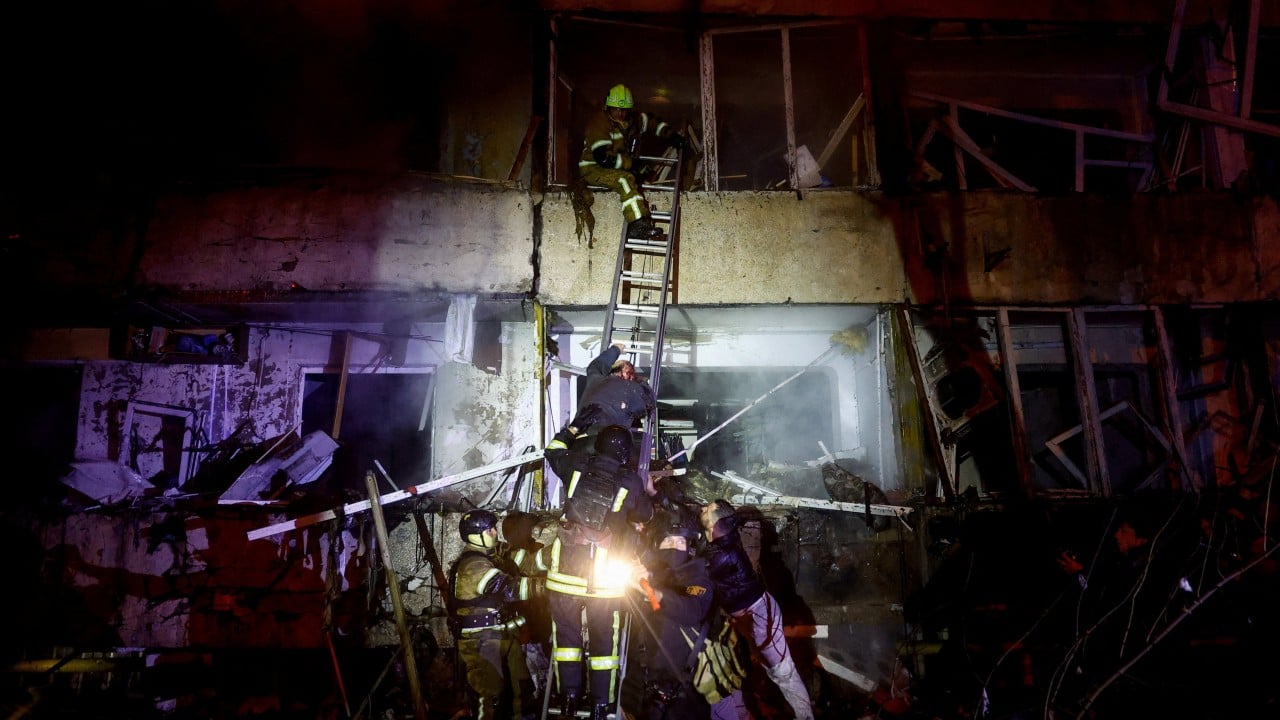
The lazy consensus writes itself. Another winter rolls in. Another wave of missiles and drones hits substations and thermal plants. Another headline ties every flickering bulb in Kyiv to the latest diplomatic friction in Washington.
It makes for tidy cable news. It is also grid engineering malpractice. If you enjoyed this piece, you might want to read: this related article.
Electric grids do not run on diplomatic warmth. They run on voltage, frequency, switchgear, transformers, line losses, and protection relays. When a headline frames grid resilience around bilateral political friction, it skips the physical layer where electricity actually lives or dies. Worse, it hands policymakers a convenient alibi: blame friction in Washington when a feeder trips, rather than looking at spare-part lead times, autotransformer scarcity, substation protection geometry, and industrial demand load-shedding discipline.
I have spent years watching energy programs, defense briefings, and infrastructure turnarounds burn tens of millions of dollars chasing headlines instead of bottlenecks. I have seen teams obsess over grand political agreements while leaving a single high-voltage autotransformer unguarded or unbacked by regional spares. Political alignment can speed up approvals, unlock export credits, or open doors to equipment markets. It cannot bend Kirchhoff's laws. For another angle on this development, check out the latest update from NPR.
The Wrong Question Everyone Keeps Asking
Most coverage asks a deceptively neat question: How much strain between Kyiv and Washington can Ukraine's power grid survive?
That question assumes the grid is a single fragile glass vase held up by one diplomatic arm. Real transmission and distribution networks do not behave like glass vases. They behave like interconnected meshes with weak links, bottlenecks, and adaptive pathways.
A more useful question is this: Which specific physical failure modes break regional power balance under sustained strikes, and how fast can operators reroute power or swap hardware?
When commentators treat diplomatic friction as the primary cause of blackouts, they confuse political theater with electrical physics. A shipment of circuit breakers or surge arresters delayed by bureaucratic red tape is a logistics and procurement problem. A strike that knocks out step-up transformers at a generation site or high-voltage substations along a main corridor is a physical and topological problem. Lumping both into "growing strain with the US" flattens two completely different problems into one vague narrative.
What People Actually Ask (And Why the Premise Often Misses)
- "Will the grid collapse completely if political support cools?" Complete, permanent nationwide collapse of a large interconnected power system is rare unless cascading frequency or voltage instability goes unchecked and destroys major synchronous assets simultaneously. Rolling blackouts, localized islanding, and industrial rationing are far more common than total permanent erasure. Asking whether the grid will simply vanish misses how operators shed load to keep the rest of the system alive.
- "Can air defense alone save power facilities?" Air defense raises the cost of every strike and intercepts many threats, yet zero-leakage defense against saturation attacks across dozens of dispersed energy nodes is physically unrealistic over a long winter. Treating air defense as a complete substitute for transformer reserves, decentralization, and rapid repair crews sets expectations up for disappointment.
- "Are imported generators and solar panels the real answer?" Distributed generation helps hospitals, water pumps, telecom towers, and specific industrial plants keep critical circuits running. It does not replace high-voltage transmission corridors or baseload industrial power on its own. Pretending rooftop solar or diesel gensets solve bulk grid balancing confuses local backup with system-wide transmission.
The Physics Behind the Headlines
To see why political framing falls short, look at what a modern high-voltage grid actually is.
At the bulk level, alternating current (AC) systems depend on keeping frequency (50 Hz in Ukraine and continental Europe) tightly balanced between generation and load, while keeping voltage within safe operating limits across lines and substations. If generation drops suddenly—say, when a turbine hall or step-up transformer bank is hit—frequency dips. System operators respond automatically through under-frequency load shedding, manual load curtailment, reserve activation, and line switching.
Substations Are the Real Chokepoints
Power plants get the dramatic photos. Substations do the quiet heavy lifting—and take the punishing math.
A high-voltage substation steps voltage up or down so power can travel long distances without excessive resistive heating losses ($I^2R$ losses, where $I$ is current and $R$ is resistance). Inside those yards sit power autotransformers, circuit breakers, disconnect switches, instrument transformers, and busbars.
Power transformers are notoriously unforgiving assets:
- They are heavy, custom-built or semi-custom pieces of equipment.
- Manufacturing lead times for large high-voltage units routinely stretch for months, even in peacetime.
- Moving a massive transformer over damaged rail or road infrastructure requires specialized heavy-haul transport, cranes, and civil prep.
If an attacker hits generation capacity, the grid loses megawatts. If an attacker hits key substations and autotransformers, megawatts trapped in one region cannot reach load centers in another—even if power plants elsewhere still have spare capacity. That distinction explains why regions can face severe outages even when total generating capability on paper looks higher than local demand.
Cross-Border Interconnection Is a Valve, Not a Magic Wand
Synchronous connection with continental Europe (ENTSO-E) gives a system technical stability benefits and commercial import/export pathways. Yet physical import capacity is bounded by thermal limits and stability limits of cross-border transmission lines and internal reinforcement lines.
You cannot simply push unlimited gigawatts across a border if internal lines between the border and major cities are damaged, congested, or operating near thermal limits. Cross-border power helps at the margin and during specific hours; it does not magically erase domestic bottlenecked corridors.
A Thought Experiment in Grid Triage
Imagine a scenario where a regional grid operator has enough money for one major package before winter: either ten large centralized autotransformers placed in exposed open yards, or a mixed package of dispersed medium-voltage spares, mobile switching gear, protective housing/revetments, and industrial load-management contracts.
Put ten giant, exposed units in predictable locations, and you hand an attacker high-value, slow-to-replace targets with long rebuild cycles. Spread protection, standardize spares where possible, harden critical control/relay functions, and pair physical repair kits with disciplined industrial demand response, and you buy something far more valuable than press releases: time.
In grid warfare and winter operations, time is the scarce currency. Every extra hour or day a crew buys to bypass a damaged bay, re-energize a parallel path, or keep district heating and water pumping running changes human outcomes on the ground.
What Serious Grid Resilience Looks Like in Practice
If you want power infrastructure that actually holds up under sustained pressure—whether from missiles, extreme weather, or supply-chain friction—stop optimizing for press conferences and start optimizing for mean time to recovery (MTTR) and graceful degradation.
- Prioritize spares with the longest procurement tails. Audit every critical equipment class by manufacturing lead time, weight, and transport constraints. A missing specialty breaker, bushing, or relay panel can sit idle waiting on a single component just as easily as a transformer.
- Design for islanding and sectionalization. A monolithic grid that tries to stay tightly coupled at all costs can suffer wider cascading trips. Sectionalizing into manageable zones with clean re-synchronization procedures contains faults and protects core municipal services.
- Treat industrial load as a controllable resource, not an afterthought. Heavy industry consumes massive power. Clear, predictable schedules and rapid demand-response signals free up megawatts for residential heating, water supply, and hospitals without chaotic guesswork.
- Decouple procurement from single-source political drama. Diversify equipment vendors, standardize specifications where engineering allows, pre-position spare parts closer to likely repair hubs, and train crews on rapid bypass configurations before winter hits.
- Measure resilience by service continuity to critical nodes, not total megawatts restored. Hospitals, water treatment, sewage lift stations, district heat pumps, and communications need reliable local power delivery—not just headline generation numbers.
Where Heavy Hitters Agree—and Where They Clash
Serious grid engineers and energy analysts—people who live inside load-dispatch centers, transmission operators, and international energy agencies—tend to agree on the unglamorous fundamentals: spares inventory, physical protection, grid flexibility, and fast field repairs keep systems running through winter peaks.
Where sharp disagreements emerge is over centralization versus decentralization and speed versus perfection.
One camp argues that large centralized generation and high-voltage transmission remain indispensable for efficiency and bulk scale. Another argues that decentralized generation, battery storage, and local microgrids are the only way to survive targeted strikes on large assets.
Both sides cherry-pick when they speak in absolutes. Large centralized assets still move bulk power efficiently when intact, while distributed assets add redundancy and local survival—yet small distributed units cannot replace high-voltage bulk transmission across hundreds of kilometers at scale. The real engineering trade-off is how much weight to put on each given budget, lead times, and threat geometry.
The Catch With My Own Contrarian Take
If I sound dismissive of diplomatic friction, let me state the real catch plainly: politics still shapes money, timing, and access.
Sanctions enforcement, export licenses, grant disbursements, defense air-cover coordination, and cross-border regulatory approvals all sit in the political arena. When friction slows down funding releases, customs clearance, or diplomatic backing for energy assistance, real projects slip. Engineers can design around a lot of problems, but they cannot conjure steel, copper, or cash out of thin air if budgets stall or shipments get stuck in bureaucracy.
So no, Washington's mood does not rewrite electrical physics. Still, ignoring political friction completely would be just as naive as blaming it for every tripped breaker.
Stop Mistaking Noise for Signal
Watch fewer diplomatic hot takes. Watch transformer lead times, substation repair tempos, cross-border transfer limits, and winter load-shedding discipline.
That is where the real story lives.