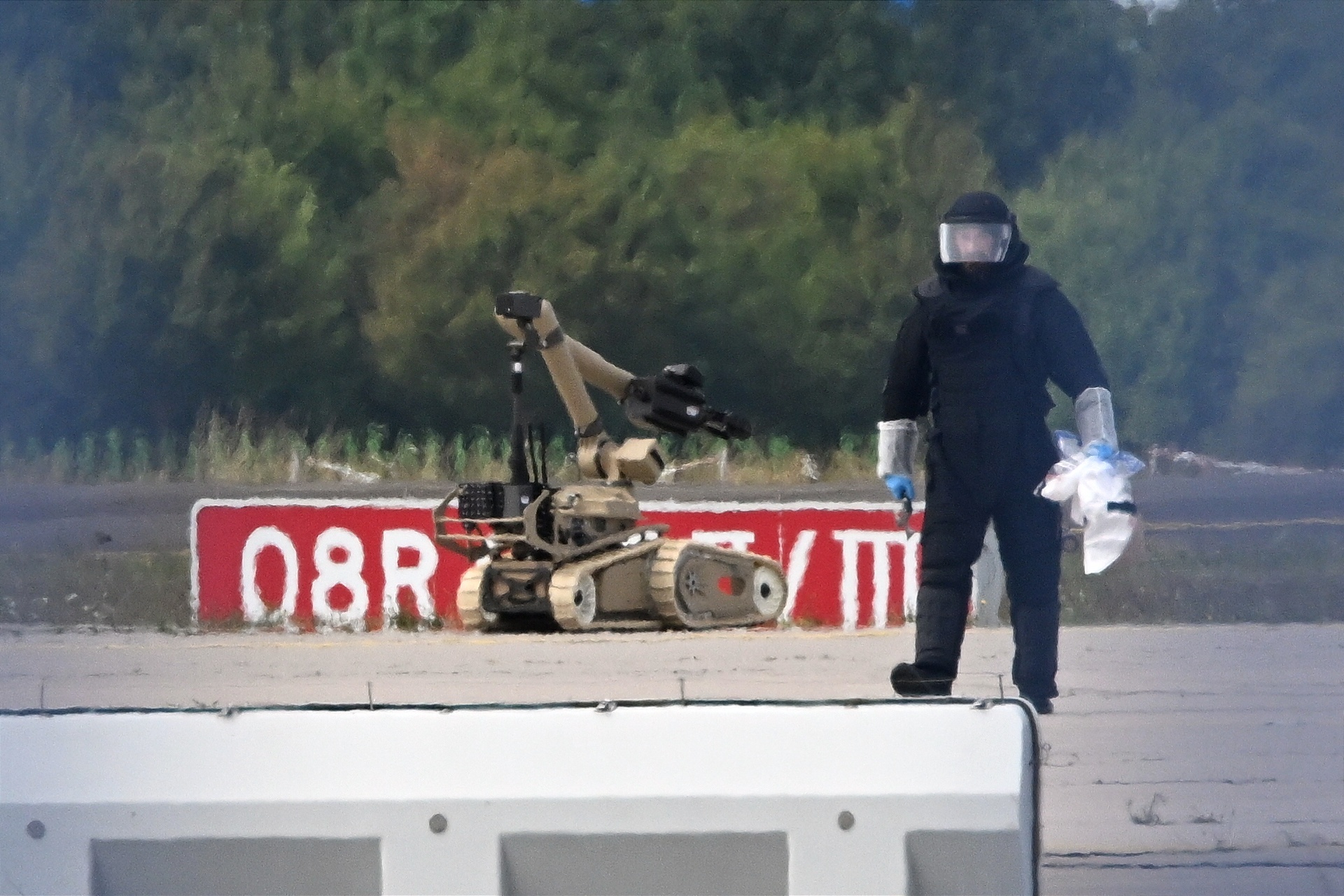
Airports are fragile ecosystems. Everyone focuses on long security lines or liquids in carry-on bags, completely ignoring what flies right outside the perimeter fence. That illusion of safety shattered near midnight on a Tuesday at Leipzig/Halle Airport in Germany.
An employee spotted a drone resting near the south runway. It wasn't just a stray hobbyist quadcopter taking pictures of cargo planes. It carried an explosive device. Federal police had to roll in an anti-explosives robot to remove the detonator. Meanwhile, a departing freight plane struck a second unidentified flying object overhead, sustaining minor damage before limping off to land safely in Hannover.
German Interior Minister Alexander Dobrindt cut short his vacation, flew to the site, and didn't mince words. He called it a new quality of danger. He is right.
The Anatomy of a Hybrid Threat
For years, European intelligence agencies tracked a steady drip of low-level disruptions. Unauthorised drone flights over military training grounds, critical infrastructure, and civilian airports happen all the time. Most are brushed off as nuisance sightings or clumsy espionage.
Arming a commercial-style drone changes the playbook entirely. This wasn't about gathering intelligence. It was an active weaponized setup placed directly inside a major logistics hub. Leipzig/Halle is a massive European freight engine. More importantly, it serves as a primary European base for Ukraine's Antonov cargo transport planes and acts as a key logistics node for NATO allies.
Security analysts immediately started looking east. Investigators noted striking similarities to previous hybrid operations, pointing to a broader pattern of sabotage attempts across the continent. Back in 2024, an incendiary device concealed in a cargo container caught fire at this exact airport terminal, part of a covert logistics sabotage campaign.
Moving from hidden package fires to armed drones sitting on active tarmac represents a terrifying escalation.
Why Traditional Airport Security Cannot Stop This
Commercial aviation defenses are built for a different century. Radar systems are optimized to track large, fast-moving metal tubes at high altitudes. They are practically blind to small plastic quadcopters humming quietly a few hundred feet off the ground.
Counter-drone technology exists, but deploying it around massive commercial airports without disrupting civil air traffic is an absolute nightmare. Jamming radio frequencies can interfere with vital navigation instruments. Kinetic interceptors risk sending debris crashing down onto passenger terminals or fuel farms.
When an explosive-laden drone slips past perimeter security and settles right next to a Ukrainian transport aircraft, it proves that standard facility guards are entirely outmatched. Critical infrastructure protection requires military-grade airspace denial. Airports are waking up to the reality that they are front-line targets in modern hybrid warfare, whether they want to be or not.
The investigation is moving fast, but the implications are already clear. The buffer zone between foreign conflict and European civilian infrastructure has officially evaporated.