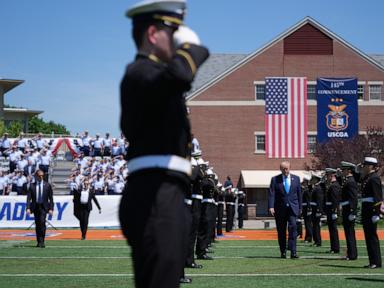
When a President stands before a graduating class of the United States Coast Guard Academy, the rhetoric usually follows a predictable arc. There are mentions of the "long blue line," the weight of the shield, and the inevitable "testing" of the young officers' mettle. But beneath the polished brass and the graduation cap tosses lies a starker truth that rarely makes it into the commencement speeches. The Coast Guard is currently being squeezed between the escalating demands of global power competition and a domestic infrastructure that is, quite literally, rusting away.
Donald Trump’s message to the graduates—that they would be "tested"—was a rare moment of accurate forecasting in a political arena often defined by platitudes. These officers aren't just entering a branch of the military; they are entering a multi-mission agency that is chronically underfunded compared to its Department of Defense cousins, yet tasked with everything from stopping narco-subs in the Eastern Pacific to countering Chinese maritime aggression in the South Pacific.
The Invisible Fleet Problem
While the Navy grabs headlines with carrier strike groups, the Coast Guard operates the oldest fleet in the developed world. It is a logistical nightmare that these graduates inherit on day one. Some cutters still in active service were commissioned during the Vietnam era. These vessels are kept afloat by the sheer will of their crews and a "cannibalization" strategy where parts are stripped from one ship to keep another moving.
This is the first "test" these officers face. It isn't a test of combat bravery, but a test of endurance against mechanical failure. When a propulsion system fails in the middle of a Search and Rescue (SAR) mission in the Bering Sea, the stakes are not academic. They are fatal. The service has struggled to modernize its fleet of Medium Endurance Cutters, and while the new National Security Cutters are impressive, they are too few to cover the vast maritime domain the U.S. claims to protect.
The disconnect between the mission and the means is widening. The Coast Guard is technically part of the Department of Homeland Security, not the Pentagon. This distinction is more than just an organizational chart quirk. It means they don't benefit from the massive, nearly unquestioned budget increases that the Army or Navy receive. They are the "stepchild" of the national security apparatus, expected to perform Navy-level operations on a police-department budget.
Arctic Sovereignty and the New Cold War
One of the most pressing tests mentioned in high-level briefings involves the melting ice of the High North. As the Arctic opens up to shipping and resource extraction, Russia and China have moved aggressively to stake their claims. Russia has a fleet of dozens of icebreakers, many of them nuclear-powered. The United States, by contrast, has exactly two: one heavy icebreaker (the Polar Star) and one medium icebreaker (the Healy).
The Polar Star is over 40 years old.
Think about that. The primary vessel responsible for maintaining U.S. presence in the polar regions is a ship that belongs in a museum. If it breaks down in the ice—a very real possibility every season—there is no American ship capable of rescuing it. We would have to ask the Russians for a tow. That is the strategic reality these new graduates walk into. They are the human faces of a "presence" that is paper-thin.
The Recruitment Crisis and the Human Toll
Beyond the ships, there is the matter of the people. The Coast Guard is currently facing its most severe recruiting shortfall in decades. This isn't just about young people not wanting to join; it’s about the intensity of the work. Coast Guard crews often face higher "optempo" (operational tempo) than their Navy counterparts. A small crew on a fast response cutter might spend 180 days a year at sea, performing grueling boardings of suspicious vessels in heavy swells.
The "test" here is one of mental health and retention. When you combine aging equipment with a lack of personnel, the burden on the individual officer increases exponentially. We are asking 22-year-old ensigns to make life-or-death decisions on whether to fire on a drug-running "go-fast" boat while they are simultaneously managing a crew that hasn't seen their families in months.
Countering the Gray Zone
China has perfected "gray zone" warfare—actions that fall below the threshold of open conflict but still achieve strategic goals. They use their own Coast Guard and a "maritime militia" of fishing boats to bully neighbors and seize territory in the South China Sea. The U.S. response has increasingly been to send our own Coast Guard to the region.
Why? Because a white-hulled Coast Guard ship is seen as less "provocative" than a gray-hulled Navy destroyer.
But this puts our Coast Guard officers in a precarious position. They are being used as diplomatic pawns in a high-stakes game of chicken. They are tasked with enforcing international law against a superpower that doesn't recognize that law. These graduates will find themselves thousands of miles from American shores, navigating the complex legal and tactical waters of the Taiwan Strait or the Philippine Sea. They are expected to be diplomats, lawyers, and warriors all at once.
The Drug War at Sea
The statistics are staggering. The Coast Guard seizes more cocaine and heroin by weight every year than all other U.S. law enforcement agencies combined. Yet, by their own admission, they only intercept about 20% of the known "targets of interest."
The traffickers are getting smarter. They use "low-profile vessels" and fully submersible subs that are nearly invisible to radar. To catch them, the Coast Guard relies on aging aircraft and cutters that simply cannot keep up with the volume. The "test" for a young officer in the Eastern Pacific is the realization that even a "successful" patrol that nets two tons of cocaine is just a drop in the ocean. The futility of the mission can be more draining than the danger.
Cyber Threats and the Digital Shoreline
We often think of the Coast Guard in terms of boats and helicopters, but they are also responsible for the security of our ports. In an era of cyber warfare, a "test" might not come from a storm or a pirate, but from a piece of malware that shuts down the Port of Los Angeles.
The maritime transportation system is the backbone of the American economy. A disruption at a major port would cause immediate, nationwide shortages of food, fuel, and consumer goods. These new officers must now be as proficient with network security as they are with celestial navigation. The problem is that the private sector—the companies that actually run the ports—often views Coast Guard oversight as an annoying bureaucratic hurdle rather than a vital security partnership.
A Service at the Breaking Point
The rhetoric of being "tested" is easy to deliver from a podium. It’s much harder to manage when the "test" is caused by systemic neglect from the very government that sends you into harm's way. The Coast Guard needs more than just words of encouragement; it needs a massive infusion of capital to replace its dying fleet and a clear-eyed strategy that matches its mission to its actual capabilities.
The graduates of the Coast Guard Academy are among the brightest and most dedicated young leaders in the country. They possess an "always ready" (Semper Paratus) mindset that is truly remarkable. But readiness isn't a magic wand. You cannot be ready for a 21st-century conflict with 20th-century tools.
If these officers fail their "tests," it won't be because of a lack of courage or training. It will be because they were sent to a gunfight with a leaky boat and a broken radio. The real test isn't for the graduates. It’s for the policymakers who continue to demand global security on a bargain-basement budget. Stop looking at the uniforms and start looking at the hull maintenance logs.