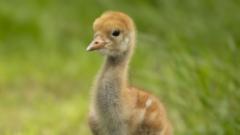
The recovery of the Common Crane (Grus grus) within managed nature reserves is not a product of passive preservation but a result of precise ecological engineering. Population stabilization depends on a three-factor dependency: hydrological stability, predator exclusion efficiency, and caloric availability during the pre-migration fattening phase. When these variables are optimized, a nature reserve functions as a high-output biological incubator. Failure in any single quadrant—such as a 20% drop in water levels during the nesting window—can lead to a total recruitment failure for that calendar year.
The Hydrological Anchor of Nesting Success
Cranes require specific aquatic topographies to mitigate ground-based predation. The core mechanic of a successful reserve is the maintenance of a "moat effect." You might also find this related coverage interesting: The Border Where the Ground Turns to Glass.
- Depth Consistency: Water must remain between 20cm and 40cm. Depths below this range allow mammalian predators (foxes, badgers) to wade into nesting sites. Depths above this range risk flooding the nest platform.
- Substrate Stability: The soil beneath the water must support the weight of a heavy reed nest without subsidence.
- Turbidity and Thermal Regulation: High-quality wetlands act as thermal buffers, protecting eggs from ground-level temperature swings that occur in open fields.
The bottleneck in most restoration projects is "Hydrological Volatility." Climate shifts or upstream agricultural draws can trigger sudden desiccation. Strategic management requires the installation of adjustable sluice gates and solar-powered pumping stations to decouple the reserve's internal water level from external regional droughts. This transforms a natural "luck-based" system into a controlled environment.
The Energetic Calculus of Migration
A crane’s survival is a ledger of caloric intake versus metabolic burn. For a population to expand, the reserve must provide an energy surplus that exceeds the baseline requirements for flight and thermoregulation. As reported in latest reports by The New York Times, the implications are widespread.
Caloric Load Density
Cranes are opportunistic omnivores, but their recovery is tethered to the availability of high-energy tubers and leftover grain in the immediate periphery of the wetland. A reserve's success is directly proportional to its "Foraging Radius Efficiency." If a crane must fly more than 5km from its roost to find food, the net energy gain drops significantly.
- Protein Phase: During the chick-rearing stage, the focus is on invertebrate density (insects, mollusks) within the wet meadows.
- Carbohydrate Phase: Pre-migration requires a shift to high-density starches. This is where agricultural cooperation becomes a strategic asset.
The "Lure Crop" strategy involves planting specific fields with maize or barley strictly for avian consumption. This prevents "Crop Depredation Conflict" with local farmers while ensuring the birds reach the necessary body mass index (BMI) for long-distance transit. Without this surplus, the juvenile mortality rate during the first migration leg can exceed 50%.
Acoustic and Visual Disturbance Thresholds
Cranes possess a high "Flight Initiation Distance" (FID). They are hyper-sensitive to anthropogenic noise and visual movement. The internal logic of a reserve must prioritize the segregation of human activity from core breeding zones.
Spatial Zoning Frameworks
- The Core Zone: Zero human entry. Monitoring is conducted via long-range thermal optics or fixed-position acoustic sensors.
- The Buffer Zone: Controlled access. Limited grazing or low-impact maintenance.
- The Public Interface: Raised hides and screened walkways.
The failure of many smaller "green-belt" initiatives stems from an inability to manage the visual horizon. If a crane perceives a human figure at 500 meters, it may abandon its nest. Effective strategy involves "Vertical Screening"—using fast-growing willow or embankments to break the line of sight between walking trails and the wetland.
Quantifying Success Beyond "Bird Counts"
Raw population numbers are a lagging indicator and often provide a false sense of security. A high count of adult cranes does not equate to a healthy population if the "Recruitment Ratio" is low.
The Recruitment Ratio is the number of juveniles that survive to their first winter divided by the number of breeding pairs.
$$R = \frac{J_{w}}{P_{b}}$$
Where $J_{w}$ is the juvenile count and $P_{b}$ is the number of breeding pairs.
An $R$ value below 0.15 indicates a population in "Stagnant Decline," where the adult population is merely aging out without replacement. A "Growth State" requires an $R$ value of 0.25 or higher. Analysts must look for this ratio rather than the total flock size to determine if a nature reserve is actually "helping" or simply serving as a temporary transit lounge for a dying demographic.
The Genetic Bottleneck Risk
Small-scale restoration efforts often ignore "Metapopulation Connectivity." If a reserve is an island, the localized population will eventually suffer from inbreeding depression, leading to reduced egg viability.
The strategic fix is the "Green Corridor" model. Nature reserves must be linked within a 100km chain. Cranes are strong flyers, but they require "Step-Stone Habitats"—smaller 10-20 hectare wetlands—to rest during regional dispersal. This allows for gene flow between isolated colonies.
Managing the Predator-Prey Equilibrium
Nature reserves often inadvertently create "Predator Sinks." By concentrating a high density of nests in a small area, they signal an all-you-can-eat buffet to opportunistic species.
The standard response is lethal control, but this is a low-leverage tactic. High-leverage strategy focuses on "Habitat Hardening":
- Electrified Exclusion: Low-voltage fencing around the perimeter of the primary nesting marsh.
- Perch Removal: Removing tall trees or poles near the marsh to deny avian predators (like crows or raptors) a vantage point to spot crane chicks.
- Diversionary Feeding: Providing alternative food sources for foxes away from the core nesting area during the critical 30-day hatching window.
Technological Integration in Monitoring
Traditional "boots on the ground" counting is inaccurate and intrusive. The shift toward "Precision Conservation" involves:
- Bioacoustic Pattern Recognition: Using AI to analyze 24/7 audio feeds. Every crane has a unique "signature call." Algorithms can now identify specific individuals and track their presence without ever seeing them.
- Satellite NDVI Analysis: Monitoring the Normalized Difference Vegetation Index (NDVI) to predict food availability weeks before the cranes arrive.
- Thermal Drone Surveys: Executed at night or at high altitudes to count nests without triggering the FID response.
The data gathered from these sources allows for "Predictive Intervention." If thermal imaging shows a drop in water levels in a remote corner of the marsh, management can trigger sluice gates before the water levels reach the critical danger zone.
The Economic Barrier to Scalability
The primary constraint on crane population growth is no longer biological—it is the "Opportunity Cost of Land." A hectare of wetland used for cranes is a hectare not used for high-yield agriculture or housing.
The transition to a sustainable model requires "Payment for Ecosystem Services" (PES). Instead of viewing the reserve as a cost center, it must be viewed as a "Bio-Utility." This involves quantifying the carbon sequestration of the peat-forming wetlands and the flood-mitigation value provided to downstream urban areas. When the crane habitat is priced as a flood-defense asset, the funding for its maintenance moves from "charity" to "infrastructure."
Strategic Optimization for the Next Decade
To maximize the ROI of ecological restoration, conservation entities must pivot from "Preservation" to "Active Systems Management."
The focus must shift toward:
- Dynamic Hydrology: Moving away from static water levels toward "Pulsed Inundation" that mimics natural seasonal flooding, which is necessary for nutrient cycling.
- Trans-Regional Policy: Aligning agricultural subsidies across borders to ensure that "Lure Crops" are available along the entire length of the migratory flyway, not just at the destination.
- Genetic Monitoring: Implementing non-invasive fecal DNA sampling to track the genetic health of the flock in real-time.
The survival of the species is a logistical challenge. By treating the nature reserve as a high-precision biological factory—optimizing inputs of water, calories, and security while minimizing the "waste" of predation and human interference—it is possible to move the Common Crane from the status of a protected rarity to a resilient, self-sustaining biological asset.
Future initiatives must prioritize the acquisition of "Connectivity Parcels" that link existing reserves, effectively turning isolated habitats into a single, contiguous ecological engine.