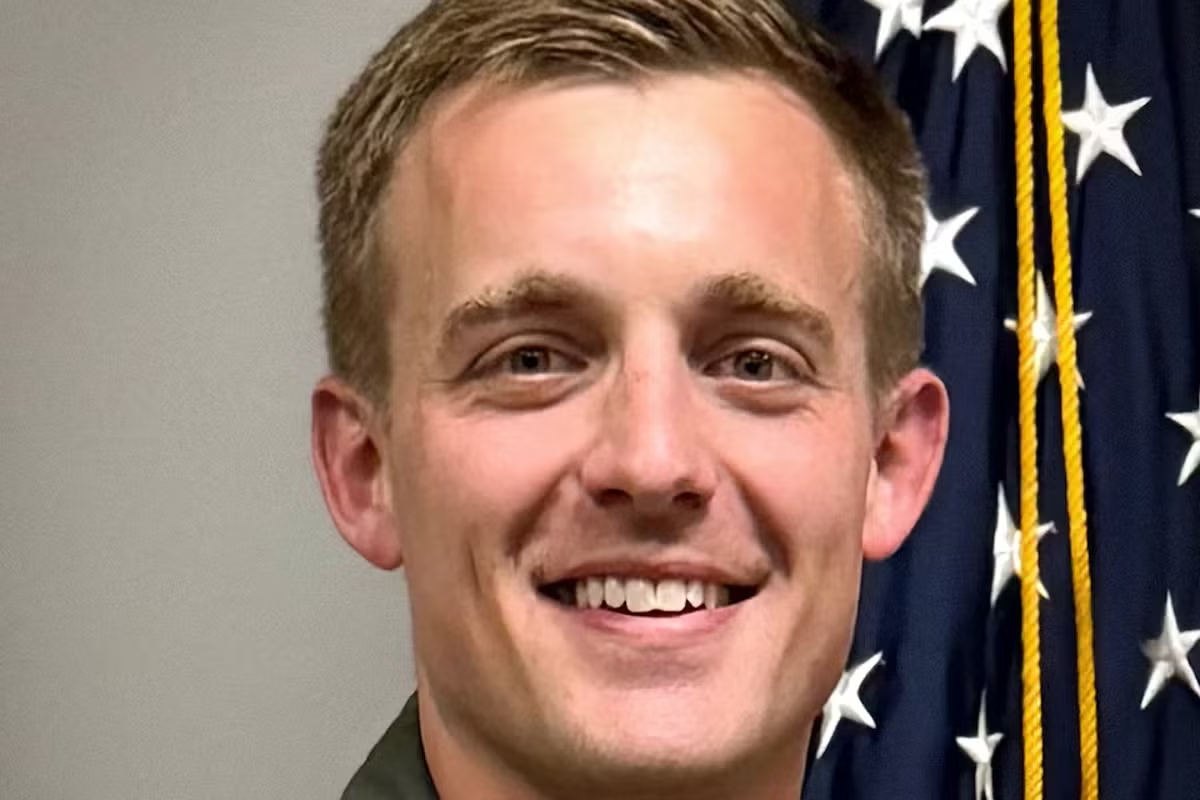
The death of a United States Air Force member in a non-combat aviation mishap represents more than a personal tragedy; it is a catastrophic failure in the military’s most volatile system: the intersection of aging hardware, high-tempo deployment cycles, and the preservation of specialized human capital. When an Alabama-based airman is killed in an Iraq-based crash, leaving behind a multi-generational family structure, the incident exposes the fragility of the Department of Defense (DoD) sustainment models. The primary objective of this analysis is to deconstruct the variables leading to such failures and quantify the systemic impact of losing high-value personnel in non-kinetic environments.
The Triad of Aviation Risk Factors
Aviation mishaps in overseas contingency operations are rarely the result of a single isolated error. They are the output of a risk function where $R = f(M, E, P)$, representing Maintenance, Environment, and Pilot/Crew proficiency.
- Systemic Maintenance Lag: Tactical aircraft operating in the Middle East face accelerated erosion. Sand ingestion, extreme thermal cycling, and limited depot-level access create a "maintenance debt" that compounded over years of deployment. When components fail mid-flight, the margin for recovery narrows to seconds.
- Environmental Friction: Iraq’s airspace presents specific aerodynamic challenges, including unpredictable low-level wind shear and visibility-limiting dust. For airframes designed for traditional runways, these variables increase the cognitive load on the crew during critical phases of flight—takeoff and landing.
- The Proficiency Gap: High-tempo rotations mean that while crews are "current" in flight hours, they may lack "proficiency" in emergency procedure (EP) muscle memory for specific mechanical failures. The transition from routine logistics to a life-threatening malfunction requires a neurological shift that is difficult to sustain over long deployments.
The Shattered Family Unit as a Socio-Economic Variable
The "shattered world" described by the widow of the Alabama airman is a qualitative expression of a quantitative collapse. The loss of a service member with a two-year-old and seven-month-old twins creates a specific type of domestic instability that the military’s "Gold Star" support systems are designed to mitigate but can never fully resolve.
Dependency Ratios and Long-term Stability
In a household with three children under the age of three, the dependency ratio is at its absolute peak. The removal of the primary earner and co-caregiver triggers a cascade of logistical failures:
- The Childcare Bottleneck: The cost of private childcare for three infants/toddlers often exceeds the monthly survivor benefit (SBP) payments, forcing the surviving spouse into a "stay-at-home" trap that prevents re-entry into the workforce.
- Geographic Displacement: Military families often live far from extended kin. The death of the service member necessitates a rapid decision: remain in the base community (social support) or relocate to the family of origin (logistical support). Both options involve significant friction costs.
Evaluating the Human Capital Investment Loss
From a clinical consulting perspective, the Air Force views each airman as a sunk cost of hundreds of thousands of dollars in training, plus the projected value of their future contributions.
The Replacement Cost Function
When a seasoned airman is lost, the Air Force does not just lose a body; it loses an "institutional memory" unit.
- Training Pipeline Lag: Replacing a specialized airman takes 18–24 months of technical training, not including the years of field experience required to achieve mastery.
- The Combat Effect: While the Iraq crash was not a direct combat engagement, the loss of an airman in a non-combat role has a demoralizing effect on the squadron. It creates a "percieved risk" that can lead to lower retention rates among other service members who view the risk-to-reward ratio as unfavorable.
Strategic Decision-Making and Future Mitigations
The Alabama airman’s death serves as a terminal data point in a larger trend of military aviation safety. To prevent these outcomes, the DoD must move beyond the "sympathy" phase and into a "systemic repair" phase.
Implementing Predictive Maintenance AI
The transition from "reactive" to "predictive" maintenance is no longer a luxury. By monitoring real-time sensor data from aircraft in Iraq, ground crews can identify impending component failures before they occur. This eliminates the "maintenance debt" by prioritizing high-risk airframes.
Redefining Family Support as Readiness
Current military support systems are designed to be "post-hoc"—they react after a tragedy occurs. A more robust model would be "pre-emptive" support: providing a dedicated family advocate for spouses with multiple young children before a deployment even begins. This ensures that the airman’s "head is in the game," reducing the human-error component of the risk function.
Optimizing the "Gold Star" Financial Model
The financial bridge provided to widows and children of airmen must be indexed to the current cost of living, not just fixed-rate payments. For a widow with three infants, the current SBP (Survivor Benefit Plan) is often insufficient to cover the sudden $3,000-4,000/month cost of childcare and housing. Adjusting these benefits based on the dependency ratio would ensure that the family of a fallen airman is not penalized for the size of their household.
The death of a father, husband, and airman in Iraq is a systemic failure that must be met with structural changes. The objective is to move from a culture of mourning to a culture of zero-failure operational excellence.
Would you like me to analyze the specific Air Force Instruction (AFI) manuals governing non-combat aviation mishaps or create a comparative risk assessment for different tactical airframes currently deployed in the Iraq theater?