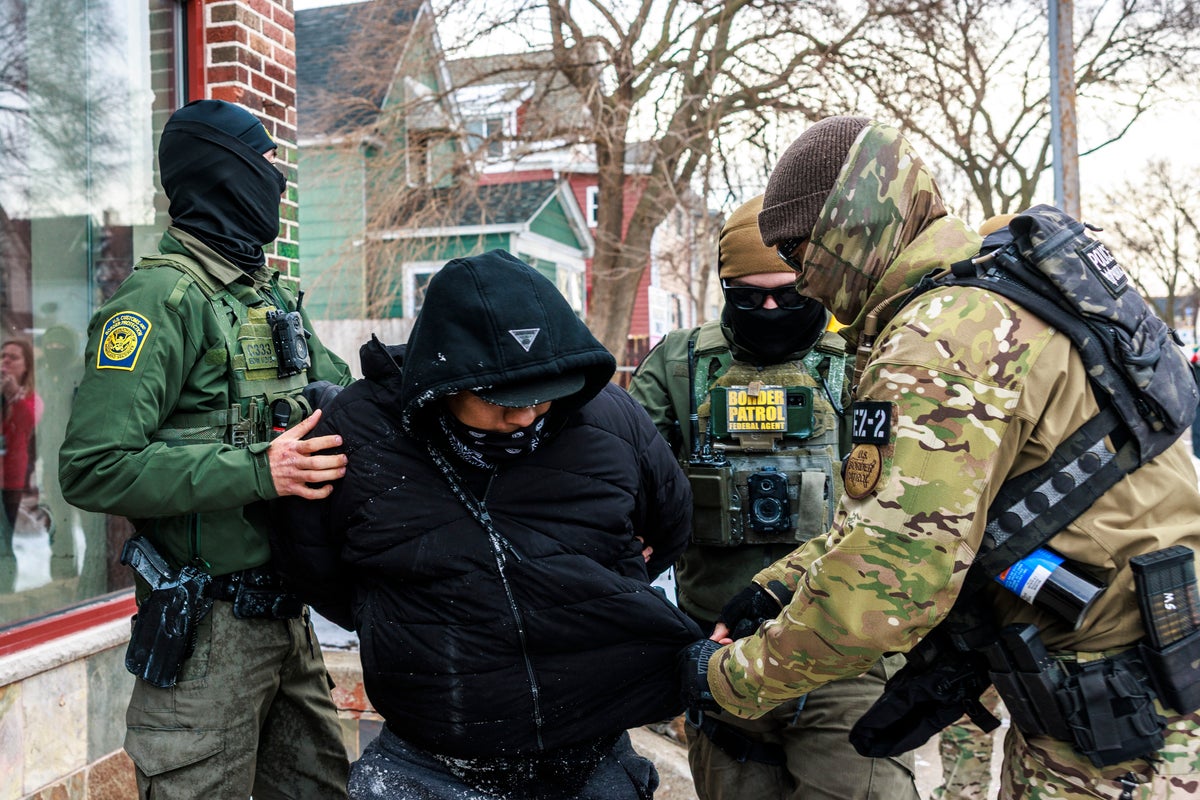
The air in the immigration halls usually tastes like stale coffee and adrenaline. For years, these corridors were the front lines of a frantic, legal tug-of-war. Families sat on plastic chairs, clutching folders bursting with birth certificates, utility bills, and character references—the paper trail of a life they were desperate to keep. Lawyers paced, their phones buzzing with the latest news of raids in local neighborhoods. Everyone was waiting for the blow to fall.
Lately, that frequency has changed. The static has faded into a heavy, uncertain quiet.
The numbers coming out of the executive offices tell a story that seems, on the surface, like a reprieve. Under the current administration’s shift away from broad, sweeping "mass raids," the frantic surge of migrants pleading with the courts to stop their deportations has dropped significantly. When the immediate threat of a door being kicked in at 5:00 AM recedes, the legal machinery slows down.
But silence is not the same thing as safety. It is a transition.
The Mechanics of Fear
To understand why the court dockets are thinning, you have to look at the anatomy of a deportation defense. Most people don’t walk into an immigration court because they want to; they go because they are forced to. When the government pivots its strategy, the ripple effect moves through every kitchen table in immigrant communities.
Consider a hypothetical man named Elias.
Elias has lived in a brick row house for twelve years. He fixes HVAC systems. Under a policy of high-visibility raids, Elias lives in a state of constant, vibrating "high alert." If his neighbor is picked up at a bus stop, Elias rushes to a pro bono clinic. He files a motion to stay a long-standing removal order, even if his chances are slim. He is proactive because the wolf is at the door. The court system becomes a shield, however battered, against an immediate strike.
When the raids stop, Elias breathes. He doesn't go to the clinic. He doesn't file the paperwork. He returns to the shadows, hoping that if he stays quiet enough, the system will forget he exists.
This is the "pull back" the headlines mention. By moving away from the spectacle of mass enforcement, the administration has effectively lowered the temperature. For the Department of Homeland Security, this is a matter of resource allocation—focusing on specific threats rather than casting a wide net. For the people inside that net, it feels like a stay of execution.
The data reflects this shift perfectly. As the boots on the ground stay in the barracks, the petitions in the courthouse dry up. Why poke the bear if the bear is sleeping?
The Invisible Backlog
The reduction in new "pleas to stay" doesn't mean the problem has been solved. It means the pressure valve has been tightened. We are currently looking at a legal system that is still choked with millions of pending cases.
The drop in new filings is a mathematical byproduct of a tactical change. If the government isn't actively trying to put you on a plane this morning, you aren't filing an emergency motion this afternoon. It’s a lull in the storm, not the end of the season.
There is a specific kind of exhaustion that comes with living in this limbo. Imagine trying to build a house on a fault line. You don't buy the expensive windows. You don't plant the oak tree that takes twenty years to grow. You live in a state of temporary permanence.
When the threat of raids was at its peak, the immigrant community was unified by a shared, acute terror. It was loud. It was visible. Now, the terror has become chronic. It’s a dull ache instead of a sharp stab. This shift in enforcement strategy has transformed the crisis from a public spectacle into a private burden.
The Cost of a Quiet Room
The legal community is watching this trend with a mixture of relief and skepticism. On one hand, the courtrooms are less chaotic. There is more space to breathe. On the other hand, the underlying laws haven't changed. The statues are still on the books. The removal orders are still signed. They are simply sitting in folders, waiting for a different hand to pick them up.
The "pleas to stop deportation" were often the last line of defense for people who had run out of all other options. These were the "Hail Mary" passes of the legal world. When those filings drop, it suggests that the immediate "emergency" has passed for many, but it also means that many people are losing their connection to the legal system entirely.
They are drifting.
The Human Calculus
Statistics are a comfort to the mind because they suggest we can measure a tragedy. We see a downward-sloping line on a graph and we think, progress. But the human element isn't linear.
If you talk to the people who work in the shadows—the church leaders, the local organizers, the neighbors—they will tell you that the fear hasn't vanished. It has just changed shape. It has become a ghost that follows you to work.
The current administration’s choice to pull back on mass raids is, in many ways, a move toward a more surgical, less disruptive form of governance. It prevents the public outcry that comes when a father is taken from a school drop-off line. It keeps the peace in the streets.
But for the person whose status is still unresolved, the "quiet" is a terrifying thing. It’s the sound of a clock ticking in an empty house. You know the hour will strike; you just don't know when.
We are witnessing a moment where the absence of conflict is being mistaken for the presence of a solution. The fall in court cases isn't a sign that the immigration system is working; it’s a sign that the people it governs have stopped trying to fight a ghost. They have realized that the best way to survive a predator is to stay perfectly still.
The courtroom is empty. The files are thin. The hallways are quiet.
Somewhere, Elias is fixing an air conditioner. He hasn't called his lawyer in six months. He thinks he is safe because no one is looking for him today. He watches the sun set over the row houses and wonders if the silence is a gift or a trap.
He keeps working. He keeps waiting. He stays still.
The most dangerous thing about a quiet room is how easily you can hear your own heart beating. It reminds you that you’re still there, and that as long as you’re there, you have something to lose.
The data tells us the raids have stopped. The silence tells us the story isn't over.