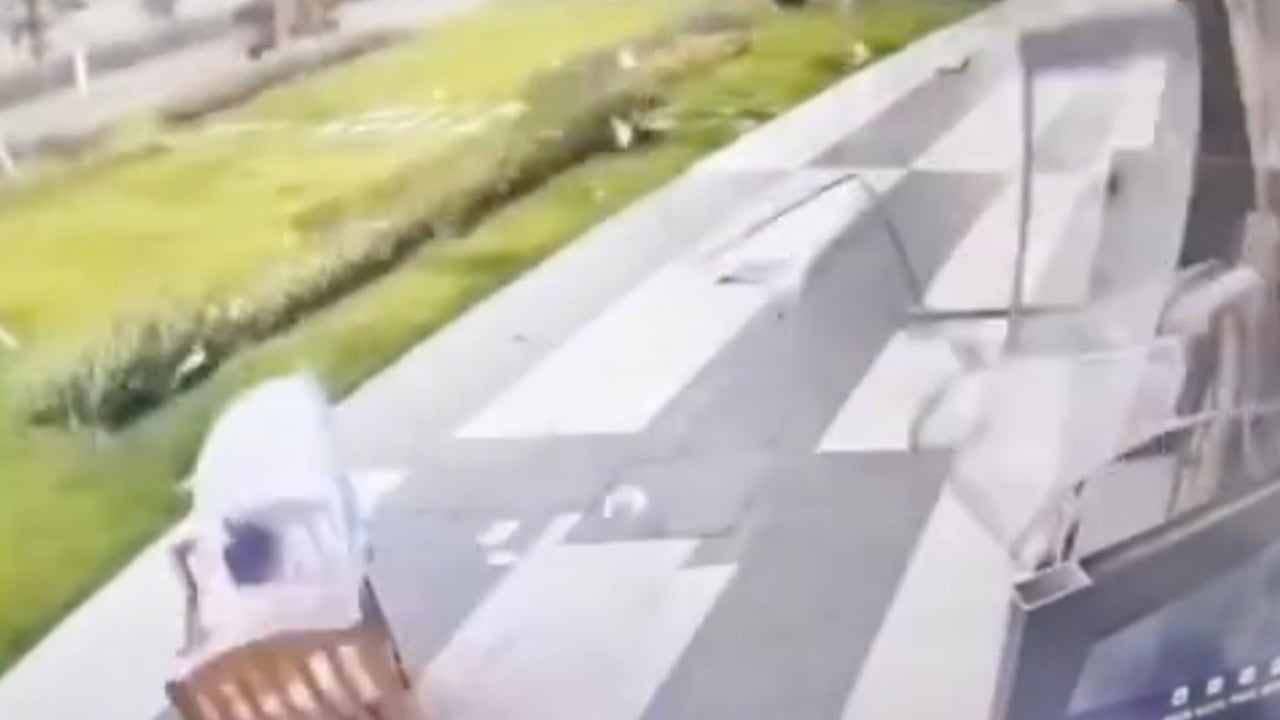
When Typhoon Noul struck southern China, bringing fierce gales and torrential rain, a six-year-old girl in Shenzhen was caught in a terrifying micro-weather anomaly that turned a routine street into a wind tunnel. Surveillance footage captured the exact moment a sudden gust swept the child off her feet, sending her tumbling across the pavement before she managed to scramble back to her feet and run toward the safety of a nearby building.
The internet quickly categorized the incident as a viral novelty, a brief flash of shock followed by relief. That superficial reading misses the entire point.
Urban centers are not static backdrops for extreme weather. They are active participants. Modern metropolises like Shenzhen, packed with towering monoliths of glass and steel, manipulate incoming storms in ways meteorologists have warned about for decades. When a typhoon makes landfall, the wind does not simply blow evenly across the city. It is compressed, redirected, and accelerated by architectural geometry.
Understanding what happened to that child requires looking past the viral video clip. It demands a hard look at how wind behaves when it collides with high-density urban planning.
The Venturi Effect in Concrete Canyons
Fluid dynamics rarely make intuitive sense to the casual observer. When a massive air mass moving at hurricane force encounters a wall of skyscrapers, it cannot simply stop. It must go around, over, or through.
Streets flanked by tall buildings act as massive funnels. This is the Venturi effect in action. As the cross-sectional area of a pathway decreases, the speed of the fluid moving through it must increase to maintain a constant mass flow rate.
During Typhoon Noul, horizontal winds that might have registered as manageable gusts in an open field were funneled into narrow commercial corridors. Wind speeds in these artificial canyons routinely double compared to open-terrain measurements. A sustained wind of forty miles per hour can easily produce localized micro-gusts exceeding eighty miles per hour at street level when forced through a narrow gap between two forty-story towers.
Children possess a high surface-area-to-weight ratio. Combine that physical reality with loose clothing acting as a sail, and a sudden pressure differential created by swirling eddies can displace a small body with shocking ease. The Shenzhen girl was not merely unlucky. She stepped into a localized kinetic trap engineered by the very buildings surrounding her.
Architectural Blind Spots in Asian Megacities
Urban planners have known about wind-tunnel hazards for half a century. Wind tunnel testing using scale models has been a staple of skyscraper engineering since the 1970s. Yet, these tests historically focused on structural integrity rather than pedestrian safety.
Engineers design towers to withstand the sheer lateral loads of a typhoon so the concrete core does not fracture and the glass facade does not disintegrate. They calculate the macro-forces acting on the structure itself. Ground-level pedestrian comfort and safety often take a back seat to maximizing floor space and aesthetic uniformity.
In rapidly developed hubs like Shenzhen, the race to build upward outpaced the integration of pedestrian-level microclimate mitigation. Podium structures—wide, multi-story bases common beneath modern skyscrapers—are frequently designed to house retail spaces or parking garages. These podiums often create sharp 90-degree corners at street level. When a typhoon strikes these corners, turbulent separation occurs. The wind breaks away from the building surface, generating chaotic vortices that swirl unpredictably across sidewalks and crosswalks.
A pedestrian walking down what appears to be a sheltered sidewalk can step out from behind a corner and instantly encounter a violent, rotating downwash. This explains why sudden falls and airborne debris injuries during typhoons often happen in seemingly protected areas close to buildings, rather than out in wide-open plazas.
The Human Element and the Illusion of Safety
Footage of the Shenzhen incident sparked outrage, debate, and immediate finger-pointing about parental supervision. Critics online questioned why a child was outside during a tropical storm warning.
That perspective ignores the chaotic timeline of urban weather emergencies. Typhoons do not announce their localized peak intensities with a neat alarm bell. A lull in the rain can deceive residents into thinking the worst has passed. Furthermore, working parents in high-density urban environments frequently face rigid commuting schedules that do not pause simply because the radar turns red.
Public safety communications often treat weather as a uniform threat across an entire municipal district. A warning covers thousands of square kilometers, treating a quiet residential park the same way it treats a wind-scoured commercial corridor between skyscrapers.
People rely on visual cues for safety. Solid walls, paved walkways, and urban shelters look permanent and secure. When the wind behaves invisibly, altering its velocity through structural manipulation, those visual cues fail. The environment feels safe right up until the moment physics proves otherwise.
Rethinking Urban Resilience for the Next Storm
Climate data indicates that tropical cyclones are intensifying globally, driven by warming sea surface temperatures. Storms like Noul are precursors to a future where high-end wind events become more frequent and more erratic.
Mitigating these risks requires a fundamental shift in how cities manage the space between buildings. Retrofitting existing megacities with wind-deflecting landscaping, canopy structures, and porous architectural screens is expensive and logistically nightmarish. However, future zoning laws must incorporate mandatory pedestrian-level wind impact assessments.
Architects can no longer treat the ground plane as an afterthought. Designing buildings with recessed ground floors, curved podium corners, and integrated windbreaks can disrupt the acceleration channels that put vulnerable populations at risk.
The child in Shenzhen walked away from her encounter with Typhoon Noul with minor scrapes and a story that terrified millions online. The city she lives in remains exposed to the invisible mechanics that threw her across the concrete. Until urban design accounts for the brutal physics of the wind tunnel, every major storm will continue to spring the same hidden traps.